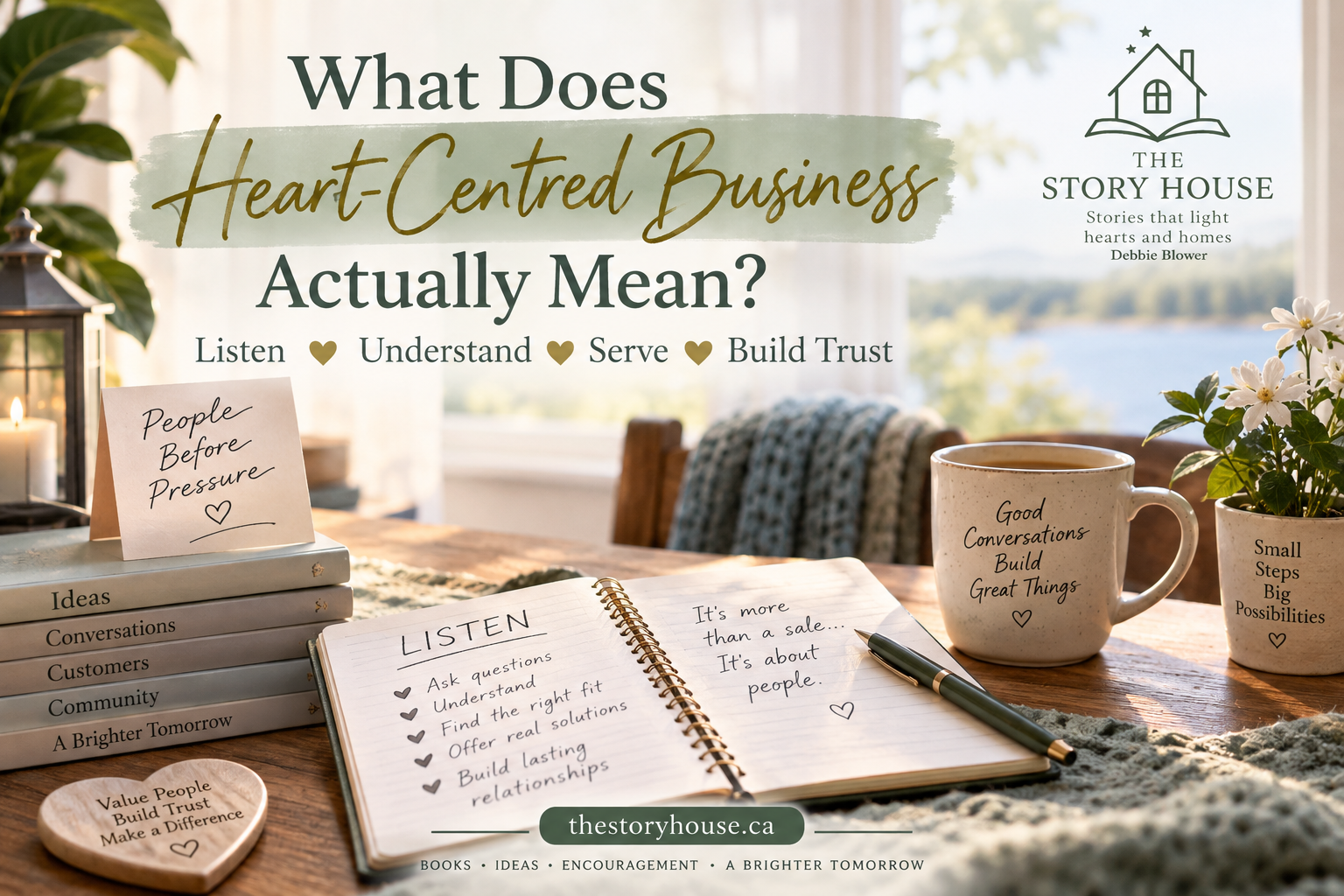
What Does Heart-Centred Business Actually Mean?
Not long ago, I was talking with a mother about her reluctant reader.
At first, the situation sounded familiar. My own children struggled with reading, and those experiences have shaped a great deal of how I think about children, books, and learning.
But the longer we talked, the more I realised that her child’s situation was not the same as ours had been.
Sometimes the difficulty for a reluctant reader is not simply whether they can read or whether the story itself is interesting.
The way the story is presented can matter too.
There may be too many words on a page. Not enough pictures. A storyline that feels too involved. The child may need something lighter, more visual, or even a story that leaves enough unsaid for them to fill in some of the blanks themselves.
If I had assumed I already knew what this mother needed because I had raised reluctant readers myself, I could easily have missed what she was actually telling me.
Instead, I listened.
And that conversation opened an entirely new area for The Story House to explore — different ways of creating stories for different kinds of reluctant readers.
That, to me, is where heart-centred business begins.
Heart-centred business means listening to the person in front of you, putting yourself in their shoes, understanding their need before your own, and showing through your actions that helping them matters more than simply making the sale.
It does not mean forgetting that you are running a business.
It means remembering that there is a person on the other side of it.
Heart-Centred Business Does Not Mean Avoiding Sales
Sometimes the phrase heart-centred business can sound as though selling is somehow wrong.
I do not believe that.
A business needs income.
It needs customers.
It needs to charge fairly for what it creates.
It needs boundaries, good decisions, and enough profit to continue operating.
I am running a business, not a charity.
But there is an important difference between wanting your business to succeed and making your customer responsible for that success.
Over the years, especially while working in direct sales and mentoring teams, I saw how easily that line could become blurred.
Someone would reach the end of the month and suddenly begin telling customers:
I’m this many dollars away from my goal.
I only need a few more orders.
Who can help me reach my quota?
Too often, that happened because the work had not been done consistently throughout the month.
The focus had shifted.
Instead of asking:
What does this customer need?
the message became:
What do I need from this customer?
A goal or quota belongs to the business owner.
It should not become the customer’s responsibility.
Listening Is More Than Waiting for Your Turn to Speak
One of the easiest habits to fall into in business is listening only long enough to decide what you are going to say next.
We hear one familiar phrase and think we already know the answer.
We have a favourite product.
A favourite solution.
A script.
A package.
A process that worked for someone else.
And before the other person has finished explaining, we are already preparing the recommendation.
But people are not scripts.
Two customers can describe what sounds like the same problem and still need very different things.
That conversation with the mother of the reluctant reader reminded me of that.
We shared a common experience, but we did not have the same situation.
My experience gave me empathy.
It did not automatically give me her answer.
That distinction matters.
Heart-centred business means bringing what you know to the conversation without assuming you already know everything about the person sitting across from you.
My STOP Approach to Customer Conversations
One practical way I think about this is something I call STOP.
S — Stop.
Stop talking for a moment. Stop pitching. Give the other person room to finish what they are trying to tell you.
T — Tune in.
Take a breath and pay attention to what they are actually saying rather than thinking about your next response.
O — Observe.
Notice their reaction, hesitation, questions, tone, or body language. Online, that might mean paying attention to the words they keep coming back to or where they seem uncertain.
P — Proceed.
Ask a question based on what you have heard, offer a solution that actually fits, or simply give them more room to talk.
The next step should come from the conversation — not from a script you decided on before it began.
This is not only my own preference for doing business. Ethical selling standards reinforce some of the same principles. The Direct Sellers Association of Canada’s Code of Ethics, for example, says consumers dealing with member companies should receive accurate and truthful product information and have a demonstration or presentation ended promptly when they request it.
Direct Sellers Association of Canada — Code of Ethics
STOP sounds simple.
But simple does not always mean easy.
Listening well can mean discovering that the product you planned to recommend is not right for them.
It can mean suggesting something smaller.
It can mean telling someone they do not need what you sell at all.
It can even mean walking away from a sale.
And sometimes that is exactly the right thing to do.
If this idea resonates with you, you may also enjoy How to Build Trust Before You Ask for the Sale.
Putting People First Does Not Mean Devaluing Your Work
There is another side of heart-centred business that I think is equally important.
Caring about people does not mean saying yes to every request.
Years ago, when I ran my woodworking and painting business, I designed, built, stained, and painted onion and potato bins.
I had already priced them slightly below the average retail price.
One customer wanted two, but she also wanted me to reduce the price by another 60 percent.
At that price, I would have lost money.
So I said no.
I was not unwilling to help her because I did not care about her needs.
I was unwilling to devalue the work, materials, time, and skill that went into creating the product simply for the sake of making a sale.
That is heart-centred business too.
You can listen.
You can be respectful.
You can look for another way to help when one exists.
And you can still have boundaries.
A business cannot continue serving people if every transaction puts it at a loss.
Heart-centred should never mean that everyone else’s needs matter and yours do not.
The relationship needs respect on both sides.
Sometimes the Best Recommendation Is Not the Biggest Sale
I learned this lesson repeatedly in direct sales too.
There were times when a customer was unsure about a larger kit or whether they would even like the flavour of a particular seasoning.
I could have encouraged them to buy the whole package.
Instead, sometimes the better answer was to start with one seasoning that could be used in several different meals.
Try it.
See if you like it.
See if it fits the way you cook.
Then, if it does, you can always come back for more.
That may create a smaller sale today.
But it can create something far more valuable: trust.
The customer knows you were thinking about what made sense for them, not simply about the amount of their order.
This also connects with Canadian marketing standards. The Competition Bureau of Canada states that businesses must not make materially false or misleading representations and notes that truthful information helps consumers make informed buying decisions.
Competition Bureau Canada — Misleading Representations and Deceptive Marketing Practices
For me, honesty goes further than simply staying within the law.
It means being willing to say:
You don’t need the bigger option.
I don’t think this is the right fit for you.
or even:
I don’t think you need to buy anything from me today.
That same idea runs through How to Sell the Problem You Solve Without Sounding Pushy — start with the person’s actual need rather than the product you want to sell.
Heart-Centred Business Can Change What You Create
The conversation with that mother and her reluctant reader has stayed with me for another reason.
Listening did not simply help me respond to one person.
It changed how I thought about part of my business.
It made me look more closely at reluctant readers and realise that there is no single type of reluctant reader.
Sometimes reading difficulty is part of the challenge.
But sometimes the presentation of the book can also affect whether a child wants to stay with it.
Perhaps the page feels crowded.
Perhaps there are not enough visual breaks.
Perhaps the story asks too much concentration at once.
Perhaps the child needs a lighter storyline.
Perhaps they need pictures to help carry the story.
Or perhaps they need room for their imagination to fill in what is not being explained.
That conversation helped open a new direction for The Story House and the way I think about books for reluctant readers.
I might not have seen that possibility if I had entered the conversation thinking I already had the answer.
That is one of the things I value most about listening well in business.
Your customers do not only tell you what they want to buy.
Sometimes they show you what still needs to be created.
Heart-Centred Business Is Not People-Pleasing
This distinction matters.
People-pleasing says:
I have to say yes because I do not want to disappoint someone.
Heart-centred business says:
I want to understand what this person needs and respond honestly.
Those are not the same thing.
Sometimes the honest answer is yes.
Sometimes it is no.
Sometimes it is:
I don’t think this is the right option for you.
Sometimes it is:
There may be a better way to approach this.
Sometimes it is:
I cannot offer it at that price.
And sometimes it is simply asking another question before making any recommendation at all.
The purpose is not to make everyone happy.
The purpose is to deal with people honestly, respectfully, and thoughtfully.
Trust Is Bigger Than One Transaction
I have believed this for years:
The customer and the trust you build with them are more important than one sale.
That does not mean sales are unimportant.
It means looking beyond the immediate transaction.
A sale lasts a moment.
A relationship can continue much longer.
And trust is not simply a nice extra in business. Edelman’s 2025 Brand Trust research described trust as a purchase consideration alongside factors such as quality and price.
2025 Edelman Brand Trust Report
I want someone to leave a conversation with me feeling that their need mattered more than whether I made a sale that day.
If they buy, wonderful.
If they do not, I still want the conversation to have been useful.
That is the kind of business I want The Story House to be.
And it is the kind of business philosophy I tried to pass on while mentoring others.
Before Your Next Customer Conversation, STOP
Before your next customer conversation, ask yourself:
Am I listening to understand, or listening for an opening to sell?
Then STOP.
Stop.
Tune in.
Observe.
Proceed.
You may discover that the person needs exactly what you offer.
You may discover that they need something smaller.
You may discover they need something entirely different.
Or you may discover a need you have never thought about before.
That is not necessarily a failed sales conversation.
Sometimes that is where a better relationship — or even a better business idea — begins.
Frequently Asked Questions
What does heart-centred business mean?
Heart-centred business means running a genuine, financially sustainable business while placing listening, honesty, service, values, trust, and customer needs at the centre of how you make decisions.
Does heart-centred business mean avoiding sales?
No. A heart-centred business still needs to sell, earn income, set prices, and make sound business decisions. The difference is that the customer’s needs are considered honestly instead of treating every conversation as an opportunity to push a sale.
Can I say no to a customer and still run a heart-centred business?
Yes. Caring about a customer does not require you to accept a price that devalues your work, ignore your boundaries, or agree to something that is not sustainable for your business.
How can I become a better listener in sales conversations?
Start by slowing the conversation down. My STOP approach is Stop, Tune in, Observe, Proceed. Listen for what the customer is actually saying before deciding what to recommend.
What if the customer does not need what I sell?
Then honesty matters more than forcing a fit. You may be able to suggest another option, share something useful, or simply tell them that what you offer is not the right solution this time. That kind of honesty can become part of building long-term trust.
Where Heart-Centred Business Begins
For me, heart-centred business comes back to something very simple.
Listen first.
Care enough to understand.
Show that care through what you do, not only through what you say.
Run the business wisely.
Value your own work.
And remember that there is always a person behind the purchase.
If you would like to explore more about building a business around trust, connection, honest marketing, and customer care, you are welcome to continue into the Heart-Centred Business Room at The Story House.
Debbie 💛
Canadian Author/Illustrator
Founder of The Story House