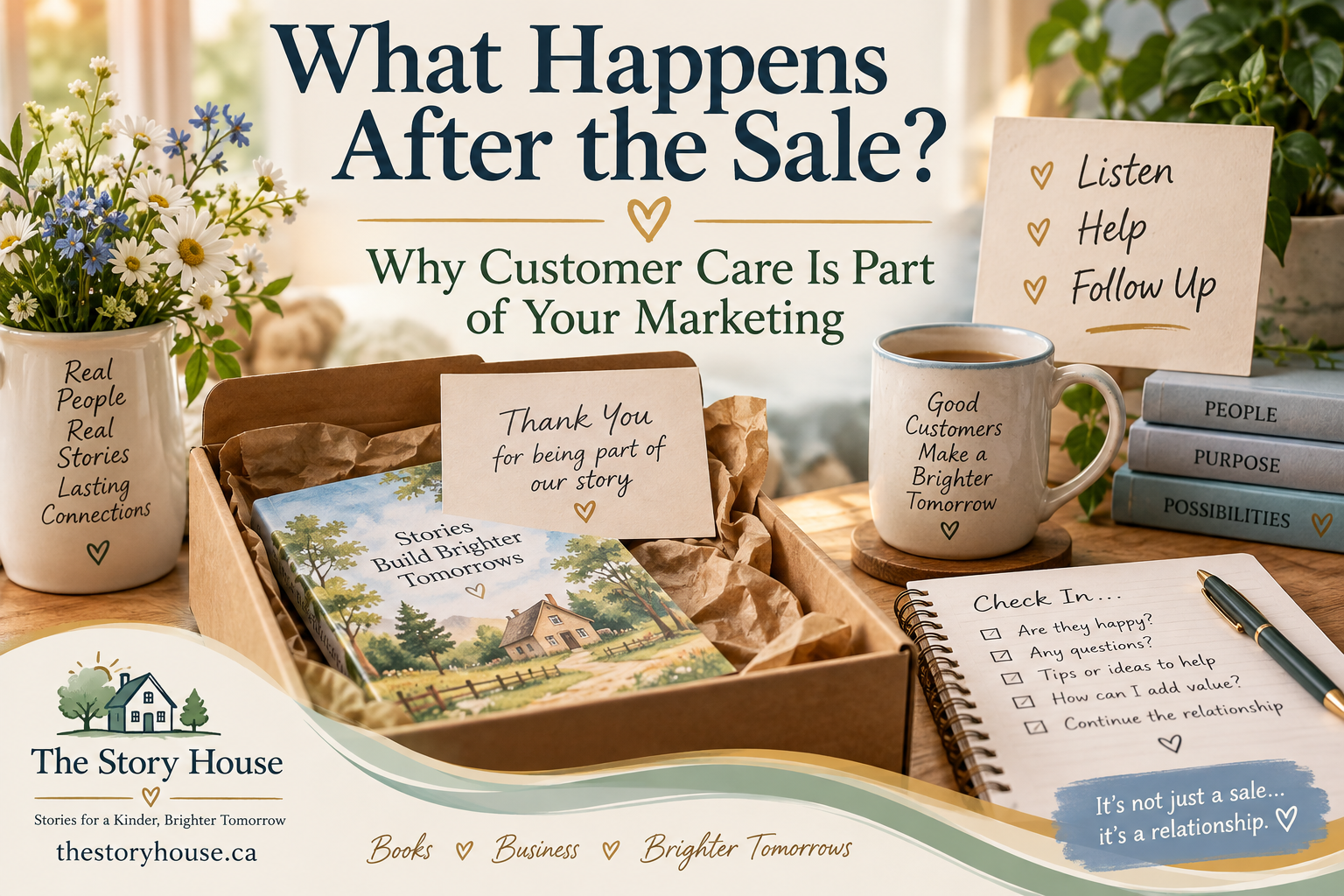
What Happens After the Sale? Why Customer Care Is Part of Your Marketing
A customer once came to me unsure whether her daughter would enjoy one of my book series.
I could have tried to convince her.
I could have explained why I thought the books were wonderful, listed everything I believed her daughter might enjoy, and encouraged her to buy the series.
Instead, I offered her the first book free of charge.
All I asked in return was that she let me know what her daughter honestly thought of it.
Her daughter enjoyed the book so much that they came back and purchased the next two in the series — and then asked when more would be coming.
I did not give her that first book because I knew another sale would follow. I didn’t.
I did it because the mother had a genuine question, and I wanted her to be able to find the answer without feeling pressured into buying something she was unsure about.
That experience says a lot about what I believe happens after — and around — a sale.
Customer care after the sale is part of your marketing because the way you treat someone once they have already purchased shows whether the care you offered before the sale was genuine. Good follow-up gives the customer something useful, answers questions, solves problems, and continues building the relationship without immediately asking for another purchase.
The sale is not where customer care ends.
In many ways, it is where you finally have the opportunity to prove that you meant what you said before it.
Why Customer Care After the Sale Matters
We spend a lot of time in business thinking about how to gain customers.
What should I post?
What should I say?
How do I explain the product?
How do I build trust?
How do I make the sale?
Those questions have their place.
But there is another question I think deserves just as much attention:
What happens after the customer says yes?
Do we continue listening?
Do we check whether the product actually met their need?
Do we answer questions?
Do we help them get more value from what they already purchased?
Or does our attention suddenly move to the next potential customer?
For me, heart-centred business cannot stop at the checkout.
The Business Development Bank of Canada recommends checking in after a sale to see how things are going, answer questions and resolve issues. Importantly, BDC specifically advises businesses not to turn that immediate follow-up into another sales attempt, but instead to listen to the customer’s needs and provide useful information. BDC.ca
BDC: Effective sales follow-up — 5 simple steps
That is very close to the philosophy I developed through my own years in direct sales:
Follow-up should give the customer something more before it ever asks them for something more.
Follow-Up Should Be Useful
When I followed up with customers, I did not want the conversation to sound like:
You bought this. Now would you like to buy that?
If someone had purchased a food product, I might begin by asking what they enjoyed about it.
Then I could offer another way to use it.
A recipe.
A serving idea.
A suggestion they might not have considered.
Something that helped them get more from the product they had already paid for.
That is value.
And it does not always have to involve another physical product.
I approached other kinds of products in the same way.
If someone purchased jewellery, I might ask what they wore it with.
What outfit did they choose?
Was it for a special occasion?
If they had found a lovely or unexpected way to style it, I might ask their permission to share that idea with someone else.
Now the customer is not simply someone who bought a piece of jewellery.
Their experience matters.
Their idea matters.
Their contribution matters.
That is a very different feeling from receiving a message that only asks:
Are you ready to order again?
Listen Before You Solve the Problem
Follow-up becomes even more important when a customer has a concern.
My first response to a problem is not to begin defending the product.
It is to listen.
What is the customer really saying?
Sometimes the concern that is first mentioned is not the whole problem.
Perhaps the product itself is not right for them.
Perhaps they misunderstood something.
Perhaps I misunderstood what they needed.
Perhaps another product would suit them better.
Until I listen, I cannot know which problem I am actually trying to solve.
If the product itself is the issue, I want to help find something that works better for that customer and, where appropriate, offer to handle returning the unsuitable product to the company for them.
That extra step matters to me.
I do not want to leave someone thinking:
Well, I bought it. Now the problem is mine.
If I helped them make the purchase, I should also be willing to help them work through a legitimate problem afterwards.
The Direct Sellers Association of Canada’s current Code of Ethics reflects some of these responsibilities formally. Among other expectations, consumers dealing with member companies should receive accurate product information, explanations about returns or cancellations, appropriate warranty or guarantee information, and contact information for the seller and company. DSA
Direct Sellers Association of Canada — Code of Ethics
Those are standards.
But there is another layer that cannot be written into a policy.
How did you make the customer feel while you were helping them?
When the Mistake Is Mine
Sometimes there is no product problem to investigate.
Sometimes the business simply made a mistake.
I made a mistake.
I misunderstood something.
I sent the wrong item.
When that happens, I believe the first thing the customer deserves is an honest apology.
Not an excuse.
Not an explanation designed to make the error sound less important.
An apology.
Then I want to correct the mistake.
If I sent the wrong item, I would offer the customer the item they actually wanted.
And because the original mistake was mine, I would allow them to keep the item that had already been sent.
That may cost me something.
But I do not believe the customer should have to pay — financially or through unnecessary inconvenience — because I made an error.
Heart-centred customer care does not mean pretending mistakes will never happen.
They will.
It means deciding what kind of business you are going to be when they do.
Lack of Follow-Up Can Say Something Too
One of the biggest customer-care mistakes, in my experience, is simply not following up at all.
Before the sale, there may have been several conversations.
Questions.
Suggestions.
Messages.
Help choosing.
Then payment is made and everything goes quiet.
What does that communicate?
It can leave the customer wondering whether all of that attention existed only because there was a sale at the end of it.
BDC’s customer-retention guidance points out that neglect, poor service or broken promises can cause customers to reconsider whether they want to continue doing business with a company. Staying in touch can also help a business discover changing circumstances or problems it might otherwise never hear about. BDC.ca
BDC: Understanding customer retention
For me, the answer is not to overwhelm customers with messages.
It is to make the contact worthwhile when it happens.
Wanting Something From the Customer Is Not the Same as Helping Them
This is where follow-up can easily go wrong.
A business sends a message because it wants:
another order;
a review;
a referral;
a testimonial;
a booking;
or another sale.
There is nothing inherently wrong with eventually asking for some of those things.
But if every contact begins with what we want, the relationship can become very one-sided.
I would rather begin by asking:
What can I give this customer that will make what they already bought more useful?
That may be advice.
Information.
Encouragement.
A recipe.
An idea.
An answer.
A solution to a problem.
Sometimes it may simply be listening.
That question is the heart of this whole post.
The Book I Gave Away Taught Me Something Too
The family who was unsure about my book series is a good example.
The immediate business decision was not:
How do I sell three books?
It was:
How do we find out whether this is even a good fit for this child?
Giving them the first book allowed the daughter to answer that question herself.
Her opinion mattered.
If she had not enjoyed it, I would have wanted to know that too.
That feedback could have taught me something.
Instead, she loved it.
The family later purchased the next two books and asked when there would be more.
That is loyalty growing naturally from a good experience.
But there is an important difference:
I did not demand loyalty in exchange for helping them.
The relationship had room to develop on its own.
That is the kind of customer relationship I want The Story House to build.
Customer Care Can Teach You About Your Own Business
Customers can teach us a tremendous amount after the sale.
What did they enjoy?
What confused them?
What did they use differently than we expected?
What question came up once they actually had the product in their hands?
What problem did it solve?
What problem did it not solve?
Those conversations can influence future products, resources, books, FAQs, emails and blog posts.
That is why listening to customer questions has also become an important part of how I create content.
In How to Turn Customer Problems Into Content That Connects, I talk more about listening for real questions and frustrations instead of guessing what customers want to hear.
Read How to Turn Customer Problems Into Content That Connects
Customer care and content creation do not have to live in separate boxes.
Sometimes your best content idea begins with:
Someone asked me this after they bought…
The Human Part Still Matters
Technology can certainly make follow-up easier.
We can set reminders.
Organise customer information.
Prepare useful resources.
Schedule emails.
Use AI to help organise ideas.
But I do not believe technology should make the customer relationship feel automated simply because automation is available.
The person should still feel there is a person on the other side.
That is something I explore more deeply in Social Selling & Conversational AI — using technology as support without allowing it to replace the human connection that business relationships still need.
Explore Social Selling & Conversational AI
Use STOP After the Sale Too
The STOP approach I use in customer conversations does not need to end once someone has purchased.
S — Stop.
Before sending another offer, stop and ask why you are contacting this person.
T — Tune in.
Remember what they bought and why they needed it.
O — Observe.
Pay attention to what they tell you. Are they happy? Confused? Excited? Is there a question underneath the question?
P — Proceed.
Respond to what they actually need — not automatically to whatever you hoped to sell next.
STOP gives us a moment to move the focus back to the customer.
And sometimes that moment is all we need.
Customer Care Does Not Mean Being Available Every Minute
There is another boundary worth keeping.
Good customer care does not mean the customer owns all of your time.
You are still running a business.
You still have work to complete.
You still have a life outside of it.
Systems can help you provide good service without becoming available around the clock.
You might keep notes about questions that need follow-up.
Set aside certain times for messages.
Create resources around frequently asked questions.
Use email to continue sharing useful information.
The system should support the relationship.
It should not replace it — and the relationship should not consume the entire business either.
Email can also be a wonderful way to continue the relationship after a purchase when the message gives the customer something useful rather than simply presenting another offer. In Inbox Influence, I explore how email can become a place for genuine communication and connection instead of just another sales channel.
That balance is part of what I mean when I talk about building a heart-centred business.
Good customer care also has to be sustainable. You can be dependable without being available every minute of the day. That balance between showing up consistently and protecting the time you need to actually run your business is something I explore further in Confident & Consistent.
If What Does Heart-Centred Business Actually Mean? is already live on your new WordPress site, link that title here:
Customer Care Is Part of Your Marketing
I sometimes think of marketing as what brings someone towards a business.
Customer care is what tells them whether they want to stay connected once they arrive.
Every interaction contributes to the customer’s picture of who you are.
How you answer.
How you solve a problem.
How you respond when you make a mistake.
Whether you disappear after the sale.
Whether you listen.
Whether you make them feel that what they have already purchased still matters.
That becomes part of the story people carry about your business.
And that is marketing too.
Not because every interaction should secretly be designed to generate another sale.
But because your reputation is being built through the experience you give people.
If you want to explore relationship-based business and communication further, The Connection Builder Workbook gives you space to think through your customer, your message and the type of connection you want your business to create.
Explore The Connection Builder Workbook
Before Your Next Customer Follow-Up
Before you contact a past customer, ask yourself:
What can I give them that will make what they already bought more useful?
That one question can change the whole conversation.
Perhaps it is a recipe.
Perhaps it is an idea.
Perhaps it is an answer.
Perhaps it is help solving a problem.
Perhaps it is simply asking how things went and then genuinely listening to the answer.
You can always sell something another day.
Trust is harder to replace.
Frequently Asked Questions
What is customer care after the sale?
Customer care after the sale is the support, communication and help you provide after someone has purchased from you. It may include checking satisfaction, answering questions, helping the customer use what they purchased, resolving concerns and providing additional useful information.
How can I follow up without sounding pushy?
Begin with what might help the customer rather than what you hope to sell. Ask about their experience, answer questions and offer something useful before introducing another purchase.
Should every customer receive the same follow-up?
I do not believe so. Different people and products need different kinds of follow-up. Listen to what the customer purchased, why they purchased it and what they tell you afterwards.
What should I do if I make a mistake with an order?
My approach is to begin with an honest apology, correct the mistake and avoid making the customer carry the inconvenience caused by my error whenever I can.
Can customer follow-up help improve my business?
Yes. Follow-up can reveal questions, problems and changing needs that you may not discover otherwise. BDC also identifies customer feedback and continued contact as useful for improving products, service and customer retention. BDC.ca
The Sale Is Not the End of the Relationship
The customer trusted you enough to buy.
What happens next tells them what that trust meant to you.
Did you disappear?
Did you immediately ask for something else?
Or did you continue to help?
For me, good customer care comes back to listening.
Listen when everything went well.
Listen when something did not.
Admit mistakes.
Fix what you can.
Give people something useful.
And remember that the person who bought from you is still more important than the next transaction.
That is the kind of business I want to continue building through The Story House.
If you are building something with the same heart, you are welcome to continue exploring the resources, books and conversations inside the Heart-Centred Business Room.
Visit the Heart-Centred Business Room
Debbie 💛
Canadian Author/Illustrator
Founder of The Story House