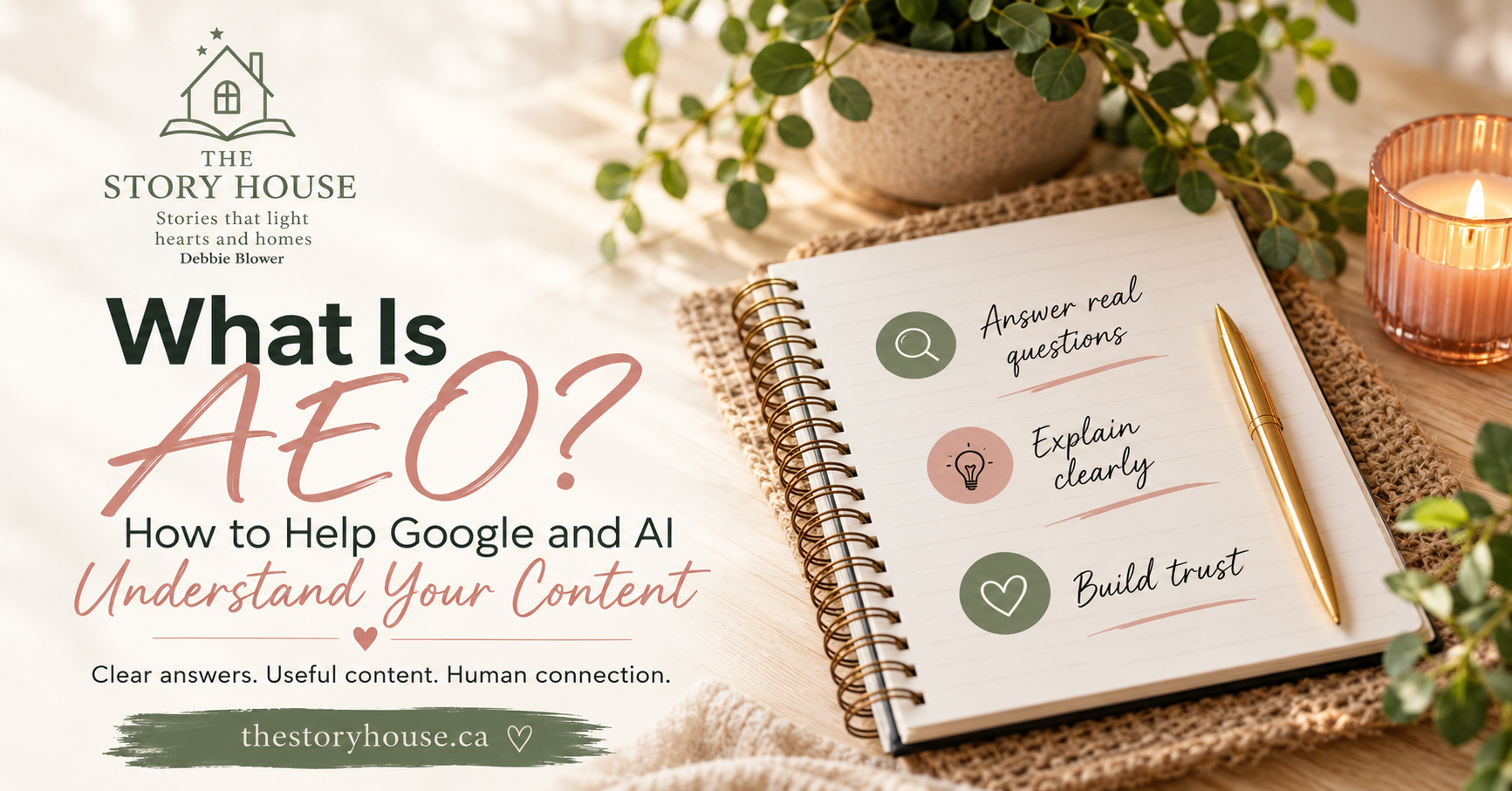
What Is AEO? How to Help Google and AI Understand Your Content
What Is AEO, and How Does It Relate to SEO?
AEO stands for Answer Engine Optimization. It is the practice of creating clear, useful content that answers people’s questions and gives search engines and AI-powered search tools understandable information to work with.
For a small business owner, that begins with something familiar: understanding what your customers need to know.
What are they confused about? What is holding them back? What would help them make a decision?
Your content becomes more useful when it answers those questions with care.
You do not need to turn every blog post into a technical document. You need to make your knowledge easier to find, understand, and use.
What Is AEO, and How Does It Relate to SEO?
SEO—Search Engine Optimization—helps search engines discover and understand your website. AEO places particular emphasis on answering questions clearly.
The two work together.
A helpful article still needs a descriptive title, an accessible website, and links that help readers find related information. Within that article, clear explanations help people understand the answer they came for.
Google explains that its existing SEO practices also apply to AI Overviews and AI Mode. There are no additional technical requirements or special optimizations required for those features.
You can read this directly in Google’s guidance about AI features and your website. developers.google.com
That is reassuring when you are already trying to manage a business, write content, and stay visible.
You can begin by improving the content you already have.
Start With the Question Behind the Search
Before writing a post, ask yourself:
What does someone need help understanding?
A broad topic such as “email marketing” could lead in many directions. A specific question gives the article a clearer purpose:
- How can I start an email list without feeling pushy?
- What should I write in my first welcome email?
- How often should I email my subscribers?
- Why are people opening my emails but not clicking?
Each question points to a different need.
Someone starting an email list needs a different answer from someone improving an established newsletter.
This is why knowing your audience matters. The clearer you are about the person you are helping, the easier it becomes to write something useful.
If your content receives attention but does not lead to meaningful action, you may also find this helpful:
Why Your Content Isn’t Converting
Give the Answer Before the Long Introduction
A reader should not have to search through several paragraphs to find the answer promised by your title.
Begin with a clear response. Then explain the details, examples, and exceptions.
For example, a post titled “How Often Should a Small Business Send Emails?” might begin:
Choose an email schedule you can maintain while giving subscribers something useful. A monthly newsletter can be a manageable starting point, while a weekly email may suit a business with regular updates and an audience that expects them.
That opening gives the reader something useful immediately. The rest of the post can explain how to choose a schedule, set expectations, and adjust based on feedback.
A direct answer does not have to be oversimplified. Sometimes the most helpful answer begins with “It depends,” followed by a clear explanation of what it depends on.
Use Headings That Help Readers Find Their Way
Headings should tell readers what they will learn in each section.
Instead of a heading such as “Moving Forward,” consider something more informative:
“How to Choose a Consistent Email Schedule.”
Instead of “Making It Work,” try:
“What to Include in Your First Welcome Email.”
Question headings can be useful when they match a genuine reader question. Other sections may work better as instructions, examples, or explanations.
You do not need to make every heading a question. You need to make each heading meaningful.
Think of your headings as signposts. Someone scanning the page should be able to understand the main points and find the section they need.
Show What Your Advice Looks Like
Advice becomes easier to use when readers can picture themselves applying it.
“Create valuable content” sounds reasonable, but it leaves a lot unanswered.
What kind of content? Valuable to whom? What should the business owner actually write?
A more useful explanation might be:
If customers regularly ask how to choose between two products, write a comparison that explains who each option suits, what the differences are, and when neither may be the right choice.
Now the reader has a starting point.
You could build helpful content around:
- a question customers ask before buying;
- a common misunderstanding about your service;
- a process people find confusing;
- a decision with several possible answers;
- a problem your product or resource helps address.
Specific examples turn general advice into something a person can use.
Build Trust Through Experience and Reliable Sources
Clear writing matters, but the information also needs to deserve the reader’s trust.
Explain what you know, provide relevant examples, and link to reliable sources when making factual claims. Make it clear who wrote the article and why they are discussing the subject.
Google’s guidance on helpful, reliable, people-first content encourages original value, clear sourcing, accurate authorship, and content that helps readers achieve their goals. developers.google.com
For me, this connects with the heart of The Story House.
Whether I am sharing a story, introducing a resource, or writing about business communication, I want the reader to leave with something meaningful.
A useful question to ask before publishing is:
Have I helped someone understand this better—or have I simply added more words?
Keep the Website Foundations in Place
A well-written answer still needs a website that search engines can access.
Google’s recommendations include allowing appropriate crawling, making important information available as text, using internal links, and ensuring structured data matches the visible page. It also says special AI files or special schema are unnecessary for its AI search features.
These foundations support eligibility; they do not guarantee that a page will appear in an AI answer. Google explains these requirements here. developers.google.com
For an everyday blog post, a sensible starting point is to:
- give the page a clear title;
- organize the article with useful headings;
- keep essential explanations in readable text;
- link to relevant pages on your website;
- check that links work;
- update information when it changes.
AEO works best as part of looking after your website and its readers.
Connect Related Posts With a Purpose
One article rarely answers everything a reader needs to know.
Someone learning about AEO may also need help understanding why their content is not converting, how email supports relationships, or how to communicate consistently.
A relevant internal link gives that reader a useful next step.
For example, if you are thinking about what happens after someone discovers your business, read:
Why Email Still Works Beyond Social Media
The purpose is to help people continue learning.
Choose links because they support the subject. Explain why the next article may be useful, rather than dropping an unrelated link into the middle of a paragraph.
Let AI Support Your Thinking and Keep Your Judgment Involved
AI can help you brainstorm customer questions, organize an outline, or notice where an explanation needs more detail.
You might ask:
“What questions might a small business owner still have after reading this explanation?”
That can help you spot gaps.
Before publishing, check the facts, review the sources, and make sure the advice fits your audience. Add the examples, context, and judgment that make the content yours.
This relationship between technology and communication is something I explore in Social Selling & Conversational AI.
Tools can support the work. Your understanding of the person you are helping gives that work direction.
View The Heart-Centred Business Series Here:
Measure What Happens After People Find You
Visibility is useful, but it is only one part of the picture.
Ask what people do after arriving on your website.
Do they explore another article? Download a resource? Join your email list? Ask a thoughtful question? Find the information they need before making a purchase?
These actions can help you understand whether your content is serving its purpose.
You may discover that a practical article answering one specific question brings more meaningful enquiries than a broad post attracting more visits.
Choose measures that connect with what you want the content to accomplish.
A Simple AEO Checklist Before You Publish
Before publishing your next article, ask:
- Is the main question clear?
- Have I answered it near the beginning?
- Do the headings describe what each section covers?
- Have I included useful examples or practical steps?
- Are factual claims accurate and supported where needed?
- Do the links help the reader continue?
- Is the next step relevant and easy to understand?
Read the article aloud, too.
If a sentence feels awkward or unnecessarily complicated, simplify it. If an explanation feels incomplete, add the missing detail.
You are helping someone understand. Let that guide the editing.
Free Download: The Connection Builder Workbook
Knowing what to write becomes easier when you understand the connection you want to create.
I created The Connection Builder Workbook to help you reflect on your message, plan meaningful content, and show up with greater intention.
Use it to explore:
- what your audience needs;
- what you want your content to communicate;
- how to build authentic connection;
- what consistency can look like for your business.
Download The Connection Builder Workbook
Start with one question your audience is asking. Then create one useful answer.
A Gentle Reflection
Imagine someone arriving on your website with a question they have been carrying for a while.
They may feel confused, discouraged, or unsure where to begin.
What would help them feel understood?
Perhaps a clear explanation. An honest example. A practical first step. A resource that meets them where they are.
That is a worthwhile place to begin your next piece of content.
Final Thoughts
What is AEO in everyday practice?
It means paying attention to the questions people ask and creating answers they can understand and use.
Keep your SEO foundations in place. Write clearly. Share relevant experience. Support your claims. Give readers a helpful next step.
You cannot control whether a search engine or AI tool chooses your content.
You can create a page worth finding—and worth reading when someone gets there.
Debbie Blower 💛
Author/Illustrator
Founder of The Story House
Stories that inspire. Words that heal.