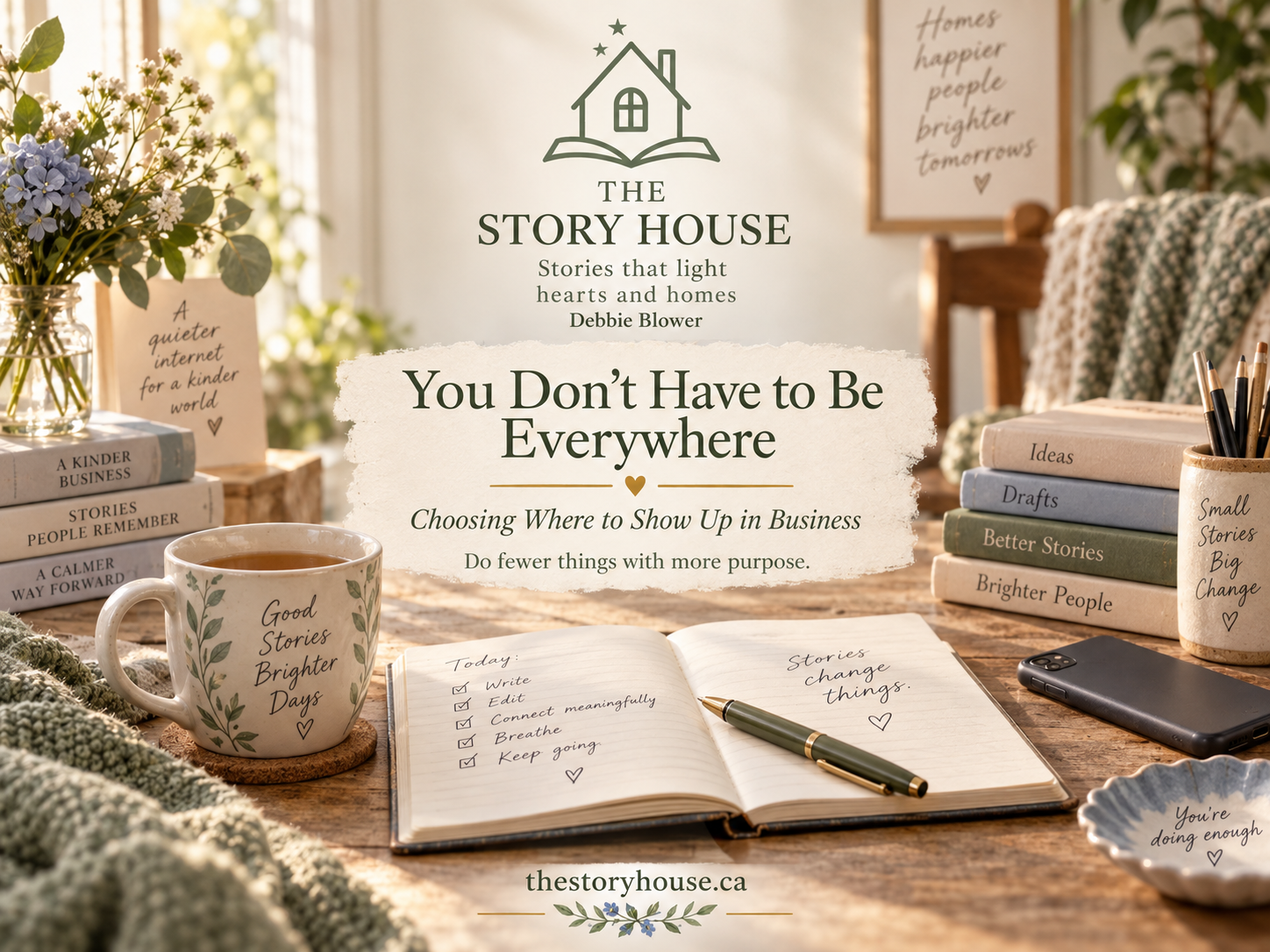
Tired of Trying to be Everywhere in Your Business? Good News: You Don’t have to be Everywhere to Succeed!
A Small Business Social Media Strategy Should Support the Work: Where To Show Up in Business
There came a point when I realized I was spending an awful lot of time trying to be seen.
Facebook. LinkedIn. Groups. Online vendor events. Pinterest. Instagram. Email. Stories. Posts. Comments. Messages.
There was always somewhere else I could be showing up and something else I could be posting.
But while I was concentrating on being visible everywhere, something more important was beginning to happen.
I was spending less time producing the actual work my readers and customers had been asking me for.
That made me rethink what consistency in business really means.
You do not have to be everywhere to build a successful small business. Choosing where to show up should depend on where your people are, what supports your business goals, what creates genuine connection, and — just as importantly — what you can realistically manage without taking time away from the work itself.
Social media has a place in my business.
But it is not the bones of my business.
Being Visible Is Not the Same as Building a Business
There is tremendous pressure on small-business owners to keep producing content.
Post every day.
Make more videos.
Join another platform.
Start a group.
Attend virtual events.
Comment more.
Follow the latest trend.
Do not let the algorithm forget you.
Somewhere along the way, it can begin to feel as though maintaining visibility is the business.
But for me, it isn’t.
The Story House exists because there are books to write, stories to develop, resources to create, readers to listen to, a website to build, emails to write, and new ideas to explore.
If I spend all of my available time talking about the work, when exactly am I supposed to do the work?
That question changed a lot for me.
Content comes after the work. Without the work being done, there is no meaningful content to share — only posting for the sake of posting.
And I no longer want to build my business that way.
I Tried Being Everywhere
This isn’t a conclusion I reached because I dislike social media.
I reached it because I tried the other way.
I participated in Facebook groups.
I maintained LinkedIn.
I took part in online vendor events.
I posted across different platforms and tried to follow content schedules.
Over time, I began looking more carefully at what was actually happening.
My Facebook group was requiring effort but producing very little meaningful return.
LinkedIn, for me, increasingly became a place where people contacted me primarily to solicit me for their own businesses rather than to build the kind of relationships I was looking for.
Many online vendor events became conversations largely between the participating vendors, often because commenting was part of the event requirements. That did not necessarily mean I was connecting with the people The Story House was created to serve.
And my own Facebook experience increasingly felt filled with advertising and very similar, generic content that did not feel particularly relevant to what I was trying to build.
Those are my experiences. Another business owner may have very different results on those same platforms.
And that is really the point.
You have to pay attention to what is working for your business.
The Business Development Bank of Canada makes a similar recommendation in its social-media guidance: businesses do not necessarily need to be on every platform and should focus their efforts where their Those are my experiences. Another business owner may have very different results on those same platforms.
And that is really the point.
You have to pay attention to what is working for your business.
The Business Development Bank of Canada’s guidance on creating a social media strategy makes a similar point. BDC recommends understanding your audience and concentrating on the platforms most likely to reach them rather than assuming a business needs to be everywhere. It specifically notes that being consistently active on one or two appropriate platforms can be more effective than appearing only occasionally across many.
Read BDC’s social media strategy guidance
That gave language to something I had already begun discovering through experience.
More platforms do not automatically create more connection.customers are most likely to be. BDC specifically notes that being consistently active on one or two appropriate platforms can be more useful than appearing sporadically everywhere.
That gave language to something I had already begun discovering through experience.
More platforms do not automatically create more connection.
Where I Choose to Show Up Now
I have not disappeared from the online world.
I have become more deliberate about where I put my energy.
My website has become increasingly important because that is where The Story House actually lives. My books, blogs, resources, rooms, ideas, and future projects can all have a permanent home there rather than disappearing down a social-media feed.
I still use Pinterest because it gives Story House content another way to be discovered and directs people back to the website.
I use Stories on my personal profile and Instagram because they give me a simpler way to share real moments, thoughts, and pieces of what I am working on without feeling that I need to manufacture a formal post simply to fill a schedule.
I have stepped back considerably from LinkedIn. I may respond to comments on previous posts or answer a genuine private message, but I no longer feel that I need to keep feeding the platform simply because businesses are told they should be there.
I have also stepped away from maintaining a rigid content schedule inside Facebook groups. If I have a real story that connects naturally to what The Story House is about, I can share it. I do not need to create something simply because Tuesday says a particular type of post is due.
And I still value direct messages.
When a genuine connection begins somewhere online, moving into a one-to-one conversation is often where the personal part of business begins for me.
That is where I can listen.
Ask questions.
Understand what someone is actually looking for.
And respond as one person to another.
My Emails Are Changing Too
Email is another place where I have reconsidered what “showing up” should mean.
I currently plan to send emails about twice a month.
But I do not want them to become a repeated stream of:
Here is my newest blog post.
Here is my newest product.
Here is something else to buy.
I want to return to the kind of communication that feels more natural to me — true storytelling emails.
There may be a book, blog, product, or resource connected to the story.
But it does not have to be the story.
The relationship comes first.
The product can sit underneath it naturally when it belongs there.
That fits much better with the way I want The Story House to communicate.
Consistency Does Not Have to Mean a Rigid Schedule
For a long time, consistency online has often been presented as frequency.
Post every day.
Email every week.
Publish on certain days.
Maintain a calendar and never miss a slot.
Planning can absolutely be useful.
But I no longer believe consistency has to mean forcing yourself into a rigid schedule that does not fit your business or your life.
Consistency can mean your values are recognisable.
Your voice remains yours.
People know what you stand for.
You return regularly enough that people can still find and connect with you.
And when you do show up, you have something worthwhile to say.
Consistency should be something you can sustain.
Otherwise, the schedule begins controlling the business instead of supporting it.
BDC’s more recent research into marketing channels for Canadian small and medium-sized businesses also cautions against simply chasing the newest platform or trend. Its 2026 guidance recommends investing where people are actually looking and treating websites and useful content as tools that help customers make decisions rather than merely as promotional assets.
Business Development Bank of Canada — How to Create a Successful Social Media Strategy
BDC: How to Create a Successful Social Media Strategy
That is very close to how I now think about The Story House.
I would rather create fewer things with purpose than fill every available space simply so my name keeps appearing.
This is also something I explore more deeply in Confident & Consistent — building a way of showing up in business that feels sustainable, intentional, and realistic rather than trying to keep up with everyone else.
Your Website Should Not Be an Afterthought
One thing this change has reinforced for me is the importance of my own website.
A social-media platform belongs to someone else.
Its algorithms change.
Its rules change.
What it shows people changes.
The way people use it changes.
My website is different.
It is the place where I can organise The Story House around the people I actually serve.
A parent looking for help with a reluctant reader can find resources meant for them.
Someone interested in heart-centred business can enter the Heart-Centred Business Room.
A reader can discover a book, continue into a related blog post, or explore something else entirely.
That makes my website more than somewhere to send people after a social post.
It is becoming the centre of the business.
Social platforms can lead people toward it.
They do not have to replace it.
Apply STOP Before You Add Another Platform
The STOP approach I use when thinking about customer conversations can also be useful when deciding where to spend time in business.
S — Stop
Before adding another platform, campaign, event, or posting schedule, stop.
Do not automatically say yes because someone tells you that every successful business is doing it.
T — Tune In
Tune in to your own business.
What are your readers or customers actually asking for?
What work needs your attention?
What can you realistically manage alongside your family, personal life, and other responsibilities?
O — Observe
Look at what is really happening.
Are people engaging?
Are they visiting your website?
Are meaningful conversations beginning?
Are you developing customer relationships?
Or are you spending hours producing content that disappears without helping either your customer or your business?
Observation also means noticing what a platform is costing you.
Not only money.
Time.
Energy.
Attention.
Creativity.
Those all matter too.
P — Proceed
Then make a deliberate decision.
Continue.
Change the way you use the platform.
Reduce your activity.
Or walk away from it.
There is no prize for maintaining an account that no longer serves your business simply because somebody once told you that you needed one.
Sometimes Stepping Back Creates Room for Better Work
This has probably been the biggest lesson for me.
When I stopped trying to fill every possible space, I had more room to notice what people were actually asking for.
That matters because those conversations influence what I create.
A discussion with a mother about her reluctant reader, for example, opened an entirely new direction for how I think about books for reluctant readers and different ways stories can be designed to meet different needs.
That kind of insight did not come from filling another social-media slot.
It came from listening.
It came from conversation.
It came from having enough mental space to recognise that what someone was telling me mattered.
Being busy and building something meaningful are not always the same thing.
You Are Allowed to Decide Something Isn’t Working
I think small-business owners sometimes stay with platforms or strategies much longer than they want to because leaving feels like failure.
Everyone else is on LinkedIn.
Everyone says Facebook groups build community.
Everyone is making short-form videos.
Everyone says I have to post every day.
But who is everyone?
And are they running your business?
Working with your customers?
Living your life?
Managing your time?
Paying your bills?
Creating your products?
Only you can decide what balance makes sense for your own business, life, and needs.
A platform not working for you does not necessarily mean you used it incorrectly.
It may simply mean it is not where your best work needs to happen right now.
Doing Fewer Things Well Is Still Consistency
I have come to see consistency differently.
It is not about proving that I can keep up.
It is about creating a rhythm I can actually live with.
For me, right now, that includes my website, meaningful email, Pinterest, selected Story posts, Instagram, genuine direct conversations, and social-media activity when there is something real to share.
That may change again.
Businesses change.
Customers change.
Platforms change.
Life changes.
A heart-centred business should be allowed to respond to those changes.
That is different from chasing every trend.
It is making thoughtful decisions about where your presence is genuinely useful.
If you have read What Does Heart-Centred Business Actually Mean?, this is really an extension of the same philosophy: listen, observe, make thoughtful decisions, and do not allow pressure to become the reason behind everything you do.
Frequently Asked Questions
Does a small business need to be on every social-media platform?
No. The better question is whether a platform reaches the people your business serves and whether you have the time and resources to use it well. Even BDC’s guidance recommends focusing on the platforms where your customers are most likely to be rather than assuming every business needs to be everywhere.
How do I decide which platforms are worth my time?
Look at where your customers spend time, which platforms lead to meaningful engagement or website visits, what type of communication suits your business, and what you can realistically maintain. Then consider the cost in time and energy as well as any financial return.
Do I have to post every day to be consistent?
I do not believe so. Consistency can mean maintaining a dependable presence and a recognisable message without following an unsustainable daily schedule. Your frequency should support the business rather than prevent you from doing the work the business exists to do.
Is it okay to leave a social platform?
Yes. If a platform is consuming significant time without producing useful connections, learning, traffic, or other business value, it is reasonable to reconsider how much attention you give it. You can reduce your presence without necessarily deleting the account completely.
Should my website or social media be the centre of my business?
For The Story House, I have chosen to make the website the centre and use social platforms to help people discover and return to it. Your answer may be different, but it is worth asking which part of your online presence gives you the most control over how people discover, understand, and continue exploring your work.
Give Yourself Permission to Choose
You do not have to post everywhere.
You do not have to follow every trend.
You do not have to attend every event.
You do not have to build every platform.
And you do not have to compare the amount of content you produce with a business that may have an entire team behind it.
You do need to understand your own business.
Your customers.
Your available time.
Your energy.
Your priorities.
Your life.
Then choose accordingly.
Before adding one more thing, STOP.
Stop.
Tune in.
Observe.
Proceed.
You may discover that the best thing you can do for your visibility is actually to spend a little less time trying to be visible — and a little more time creating something worth finding.
If you would like to continue exploring ways to build a business around connection, trust, realistic expectations, and work that still feels like your own, you are welcome to visit the Heart-Centred Business Room at The Story House.
Debbie 💛
Canadian Author/Illustrator
Founder of The Story House