
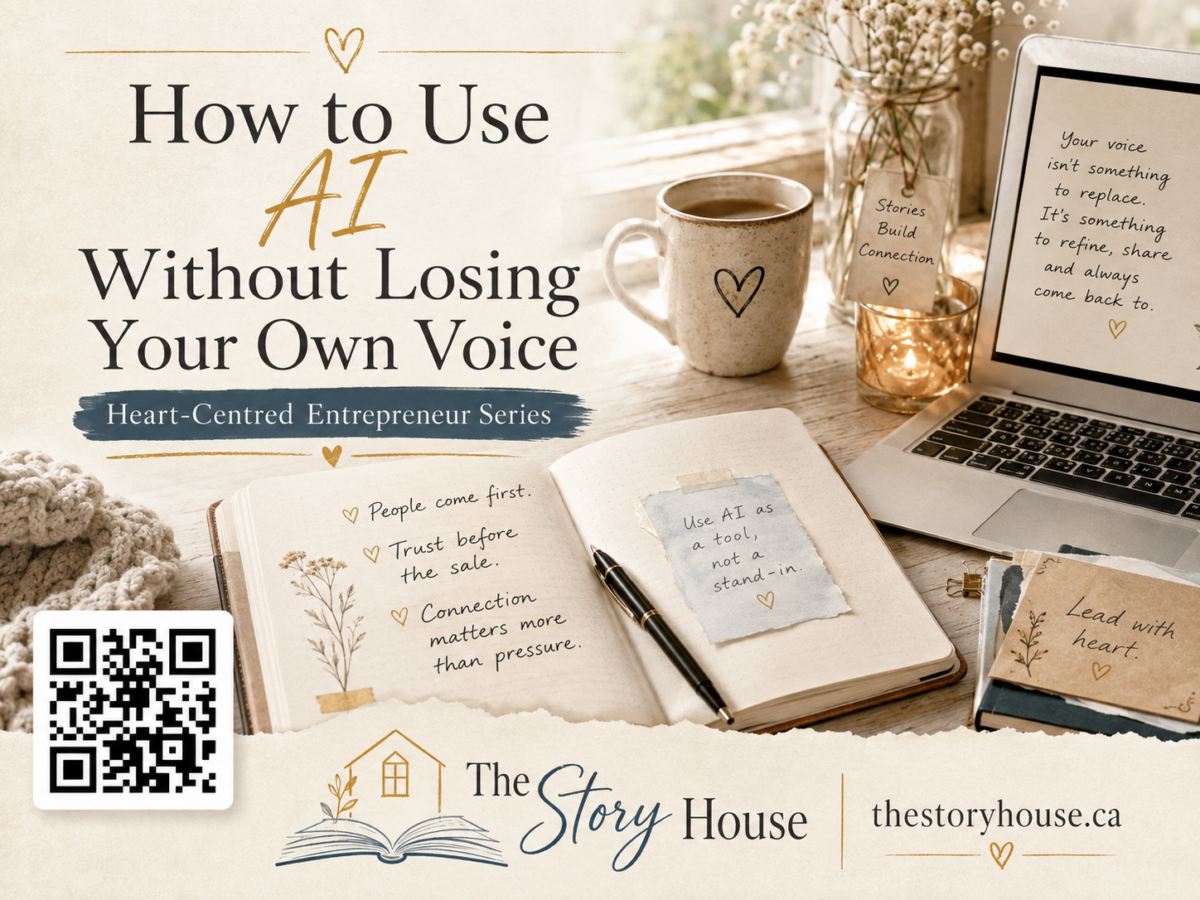
How to Use AI Without Losing Your Own Voice
How can you use AI without losing your own voice?
You can use AI without losing your own voice by treating it as a support tool rather than a substitute for your experience, values, stories, judgment and personal connection with the people you serve.
AI can help organize an idea, suggest a structure, brainstorm possibilities, clean up awkward wording or help when you are staring at a blank page and do not know where to begin.
But the heart of the message still needs to come from you.
Your experiences.
Your beliefs.
The things you have learned from real customers and real conversations.
The way you naturally encourage someone when they are sitting across the table from you.
Those are the things that give your writing a voice.
And those are the things AI cannot manufacture for you.
Why This Conversation Matters
AI has become part of everyday business for many entrepreneurs. It can help with writing, planning, customer communication, research, brainstorming and content creation.
That can be genuinely useful.
But it raises an important question for anyone building a business around trust:
How do we use AI without allowing our message to become generic, impersonal or disconnected from who we really are?
For a heart-centred entrepreneur, the goal should not be to use AI simply to produce more content.
The goal should be to use AI in ways that make good work easier while still keeping the person behind the business visible.
Google’s current guidance on generative AI content makes a similar distinction. It does not discourage AI-assisted content simply because AI was involved. Instead, it emphasizes accuracy, quality, relevance and content that provides genuine value for people rather than mass-produced material created simply to attract search traffic. Google for Developers
That is a distinction I think matters far beyond SEO.
Useful content still needs a human reason for existing.
Use AI as a Tool, Not as Your Identity
There are many things AI can help with.
It can suggest blog outlines, brainstorm titles, draft an email, organize scattered notes, suggest questions your audience might ask or help simplify something that feels too complicated.
Those are useful jobs.
But the better question is not:
Can I use AI for this?
It is:
How can I use AI in a way that still sounds like me?
That changes the relationship with the tool.
Instead of asking AI to decide what you believe, you give it something you already believe and ask it to help you communicate it more clearly.
Instead of asking it to invent your expertise, you give it what you have learned through experience.
Instead of allowing it to create an entire brand voice from nothing, you teach it the values and language that already belong to your business.
AI becomes support.
You remain the source.
Your Voice Comes From More Than Writing Style
Your voice is not simply whether you prefer long sentences or short ones.
It comes from your life.
The people you have served.
The lessons you learned the hard way.
The mistakes you would not repeat.
The values you have chosen to keep even when another approach might have produced a faster sale.
For me, much of that comes from years in direct sales and mentoring teams.
I learned very early that business is not only about what you sell. It is also about how you treat people.
Sometimes the right thing was recommending the smaller purchase.
Sometimes it meant telling someone they did not need the entire set.
Sometimes it meant respecting a no without changing how I treated the person.
Those experiences shaped how I think about selling, customer relationships and trust.
AI did not live those experiences.
I did.
That is why our own stories matter so much when we use AI.
A Lesson AI Could Never Have Learned for Me
There were times in direct sales when a customer was unsure about a product, flavour or larger set.
It would have been easy to recommend the biggest option.
But sometimes the right response was:
“You don’t need the larger set right now. This one will do what you need.”
That may have meant a smaller sale that day.
It also meant the customer knew I was listening.
They knew my recommendation was based on their need rather than my sales total.
And often they came back.
That experience taught me something about trust that no AI prompt could have taught me on my behalf.
AI could help me write about that lesson.
It could suggest a heading.
It could help make the paragraph clearer.
But the judgment behind the story came from living it.
That is the difference.
It is also why this topic connects so naturally with How to Build Trust Before You Ask for the Sale.
Start With Your Own Thoughts First
One of the simplest ways to use AI without losing your own voice is to begin before AI enters the conversation.
Write down a few rough thoughts.
They do not need to be beautifully written.
Ask yourself:
- What do I really want to say?
- Why does this matter to me?
- What have I learned from experience?
- What would I say if the reader were sitting across the table from me?
- What do I want the reader to understand or feel when they finish?
Now you have given the AI something real to work with.
If you begin with a generic prompt, you are much more likely to receive generic content.
If you begin with your own perspective, story and intention, AI has a much better foundation.
I think of it this way:
Let AI help build the frame. You bring the heart.
Give AI the Context It Needs
AI cannot automatically know what matters most to your business.
You have to tell it.
For example, rather than asking:
“Write me a Facebook post.”
you might say:
“Write this in a warm, conversational style. My audience is small business owners who dislike pressure-based selling. I want the post to be helpful rather than salesy. My values are trust, connection, encouragement and integrity. Use Canadian spelling and avoid corporate language.”
That is a completely different starting point.
The clearer your instructions are, the more useful the result can become.
You can also tell AI what you do not want:
“Do not make this sound like an advertisement.”
“Avoid hype.”
“Do not invent personal experiences.”
“Keep my original story intact.”
“If something is uncertain, tell me rather than guessing.”
That last one matters.
Government of Canada guidance warns that generative AI can produce material that sounds credible while still being inaccurate, incomplete or inconsistent. It recommends reviewing generated content rather than treating it as authoritative. Canada
AI can help us work.
It does not remove our responsibility to check the work.
Use AI to Ask Better Questions
AI does not always need to write for you.
Sometimes one of its best roles is helping you think.
You might ask:
- What questions might my readers have about this topic?
- What parts of this explanation are unclear?
- What could make this article more useful?
- What objections might a customer have?
- What information am I assuming the reader already knows?
- Can you help me organize these ideas without changing my meaning?
That can be far more valuable than simply saying:
“Write the whole thing.”
Used this way, AI becomes a brainstorming partner.
Not the author of your experience.
Not the owner of your brand.
Not the source of your values.
A tool that helps you think more clearly.
Add Something AI Could Never Know
This may be the most important step of all.
Before publishing AI-assisted content, add something only you could contribute.
A customer conversation.
A lesson learned through experience.
A mistake you made.
A memory.
A decision that shaped the way you work.
A belief you held onto when the easier choice was different.
A story from mentoring a team.
The reason you created a particular book or product.
Those details change everything.
They turn a generic statement such as:
“Building trust is important in business.”
into something that shows why you believe it.
That is where your business story becomes such a powerful part of your content.
I explored that more deeply in How Your Business Story Builds Connection.
AI may be able to help form the sentence.
You provide the life behind it.
Use AI for Structure, Not Soul
There are days when the idea is there but the structure is not.
You know what you want to say, but the notes are everywhere.
That is a wonderful place to use AI.
Give it the rough thoughts and ask:
“Can you organize these into a logical article without adding new personal details?”
Or:
“Group these ideas under clear headings but keep my examples.”
Or:
“This repeats itself. Show me where the repetition is and suggest how to combine it.”
That saves time without handing over the heart of the message.
It is also very close to how I think AI should be used in heart-centred business:
support what is already human rather than replacing it.
This is one of the ideas behind Social Selling & Conversational AI — using modern tools while keeping trust and real conversation at the centre.
Do Not Let AI Polish Away Your Personality
One of the easiest things to lose with AI is the little imperfection that makes writing sound human.
A polished sentence is not automatically a better sentence.
Sometimes AI will turn:
“I learned this the hard way.”
into something like:
“This experience provided valuable insights that informed my future approach.”
Technically polished.
Emotionally flat.
If you would never say it, change it.
Your natural rhythm matters.
Your favourite phrases matter.
The way you explain something to a friend matters.
Your sense of humour matters.
Your warmth matters.
The goal is not to sound as though a professional marketing department wrote every sentence.
The goal is to sound like you on a good writing day.
Edit Everything Before You Publish It
AI-generated or AI-assisted content should never be treated as finished simply because it sounds convincing.
Read it.
Then read it again as yourself.
Ask:
Would I actually say this?
Is this true?
Did anything get exaggerated?
Did AI add a fact I never supplied?
Does this still reflect what I believe?
Is this helpful to the reader?
Did my personal examples remain accurate?
Is there something missing that only I can add?
This matters because AI systems can produce confident-sounding errors. Canada’s federal guidance specifically recommends reviewing generated content for factual and contextual accuracy and checking important information against trusted sources. Canada
Human review is not the final inconvenience in an AI workflow.
It is part of the workflow.
Keep Your Customer’s Privacy in the Conversation
Using AI responsibly is not only about writing style.
It is also about what we put into the tool.
Small business owners may deal with customer names, email addresses, order information, private messages, personal stories or questions shared in confidence.
Those things deserve care.
Before copying customer information into an AI system, ask:
Do I really need to include this?
Can I remove the name?
Can I remove identifying details?
Do I have permission to use this information?
Do I understand how this particular tool handles the information I enter?
The Office of the Privacy Commissioner of Canada advises organizations using generative AI to limit the sharing of personal, sensitive and confidential information and to be transparent about how personal information is being used. Office of the Privacy Commissioner
For me, the principle underneath that guidance is simple.
If someone has trusted you with information, protect that trust.
Use AI to Save Time — Then Spend the Time on People
This may be my favourite reason to use AI.
Not to create more noise.
To create more space.
If AI saves half an hour while you organize a blog post, perhaps that half hour can go toward answering a thoughtful customer message.
If it helps you brainstorm a week’s ideas, perhaps you have more energy for the conversations happening underneath those posts.
If it helps organize your notes, perhaps you can spend less time wrestling with the blank page and more time actually serving people.
That is where the technology becomes useful to me.
It gives time back.
And what we do with that time still matters.
Let AI Help You Stay Consistent Without Becoming Generic
There is another practical benefit.
AI can help when consistency is difficult.
It can help organize an editorial calendar, turn one idea into several angles, remind you of the pieces needed for a blog post or help repurpose a long article into shorter content.
But consistency should not mean sameness.
Your audience should not begin to feel as though every caption came from the same template.
Add different stories.
Change the rhythm.
Speak from what is happening in your business.
Use real questions people ask you.
Bring in things you have learned recently.
That is also why I connect AI use with Confident & Consistent.
Consistency should help people recognize you.
It should not make you sound like everybody else.
Helpful Content Still Needs a Human Point of View
There is another interesting reason not to surrender your voice to AI.
Search itself is increasingly rewarding what AI cannot easily reproduce: original experience and unique perspective.
Google’s current guidance for AI search specifically encourages creators to provide unique, useful, non-commodity content based on genuine knowledge and first-hand experience rather than simply repeating information already available elsewhere. Google for Developers
That fits beautifully with what I have believed about storytelling in business for years.
Your experiences are not something to remove because AI can write a smoother paragraph.
They are often the very thing that makes the paragraph worth reading.
A Simple Before-and-After Example
Here is a sentence that sounds polished but could belong to almost any business:
Generic version:
Our business provides high-quality solutions designed to help customers improve their experience and achieve better outcomes.
Nothing is technically wrong with it.
But where is the person?
Compare it with:
More personal version:
If you have ever felt overwhelmed trying to figure out what to post, what to say or how to connect with customers without sounding pushy, I created these resources to help you slow down, clarify your message and build trust one conversation at a time.
Now we know something about the reader.
We know what problem they may be facing.
And we know why the person behind the business cares.
That is the difference your voice makes.
Download: The Connection Builder Workbook
If you want to go a little deeper, The Connection Builder Workbook can help you think through your audience, values, business story and the kind of connection you want your message to create.
It is designed to help you slow down before creating more content and ask some of the questions that AI cannot answer for you:
Who am I really trying to help?
What matters to them?
What do I want my business to stand for?
What experiences have shaped the way I serve people?
What do I want someone to feel when they interact with my business?
Download The Connection Builder Workbook
AI can help you put your message into words.
The workbook helps you make sure the message begins with you.
A Simple AI Voice Check
Before publishing anything AI has helped you create, ask yourself five questions:
- Does this sound like something I would actually say?
- Does it reflect my values?
- Did I add a personal example, story or insight?
- Have I checked the facts?
- Will this help my reader feel understood?
If the answer to one of those is no, keep working on it.
Publishing faster is not the goal.
Communicating better is.
Frequently Asked Questions About Using AI and Keeping Your Voice
Can I use AI and still sound like myself?
Yes. Start with your own ideas, experiences and values, then use AI to help organize, clarify or edit them. The more of yourself you put into the starting material, the easier it is to keep the result personal.
What is the best way to use AI for content creation?
Use AI for tasks such as brainstorming, outlining, organizing, editing and generating questions. Then add your own experience, examples, judgment and final editing before publishing.
Why does AI writing sometimes sound generic?
AI often works from patterns found across large amounts of existing material. Without enough context about your audience, values, experiences and preferred style, the result can sound polished but interchangeable.
Should I fact-check AI-generated content?
Yes. AI-generated information can be inaccurate even when it sounds convincing. Important facts, statistics, quotations, links and claims should be checked against reliable sources before publication. Canada
Is it safe to put customer information into AI tools?
Be cautious. Personal, confidential or sensitive customer information should not be entered casually into AI systems. Remove identifying information where possible and understand the privacy practices of the tool you are using. Office of the Privacy Commissioner
Final Thoughts
Learning how to use AI well is not about deciding whether technology is good or bad.
It is about deciding what role we want it to play.
Use AI to organize.
Use AI to brainstorm.
Use AI to help you get unstuck.
Use AI to clarify.
Use AI to ask better questions.
But keep your experience in the message.
Keep your judgment.
Keep your stories.
Keep your values.
Keep the pieces of your business that only a real person can bring.
Because people do not connect with perfectly polished words simply because they are polished.
They connect with meaning.
With experience.
With trust.
With the person behind the message.
Use AI as a tool.
But let your own voice remain the reason someone wants to keep listening.
Debbie Blower 💛
Author/Illustrator
Founder of The Story House