The Quiet Power of Writing Poetry
How It Can Bring Peace, Joy, and Deeper Storytelling
Writing Poetry Creates Space for Reflection
How can writing poetry help us reflect and tell our stories?
Writing poetry gives us a way to explore feelings, notice details, and shape experiences into language. You can begin with an ordinary moment or an honest thought, then experiment with sound, rhythm, and line breaks to discover how you want to express it.
Sometimes a feeling arrives before the words.
Something beautiful catches our attention. A memory returns unexpectedly. A concern stays with us long after the day has settled.
Poetry offers somewhere to begin with those experiences. We can write a little, listen to what the words suggest, and return when we are ready.
You do not need to know every poetic form before trying. Curiosity and a willingness to pay attention are enough for a beginning.
Writing Poetry Creates Space for Reflection
A poem gives us permission to stay with something we might otherwise hurry past.
We can notice the sound of rain against a window, the silence after a difficult conversation, or the familiar comfort of a place we love.
Writing asks us to look more closely.
What exactly caught our attention? What did it remind us of? Which words come closest to the feeling?
The answer may remain uncertain. A poem can hold a question without resolving it.
For me, that is part of poetry’s quiet appeal. It offers room to acknowledge what is present and consider what I want to say.
The Peace and Joy of Making Something Meaningful
Writing poetry can become a welcome pause in a full day.
There may be satisfaction in finding a phrase that feels right or recognizing something on the page that was difficult to explain aloud.
The experience will not feel the same every time. Some poems bring comfort. Others bring questions or reveal feelings we had barely noticed.
Joy has a place here, too.
A poem can celebrate a familiar voice, a garden coming into bloom, or a small kindness. We do not have to wait for a dramatic experience to find something worth writing about.
An ordinary moment can deserve our attention.
How to Start Writing Poetry: Five Simple Steps
1. Choose One Moment, Image, or Feeling
Begin with something specific.
Instead of trying to write about your whole life, choose the kitchen after everyone has gone home, a bird at the window, or a few words you cannot stop remembering.
Ask yourself:
What stays with me about this?
Write down whatever comes to mind.
2. Gather Words Before Shaping Them
Make a few notes about what you saw, heard, remembered, or felt.
Include concrete details where you can: the sound of a chair moving, the colour of the sky, the warmth of a hand.
You do not need complete sentences yet.
If your attention moves somewhere unexpected, follow it for a while. You can decide later what belongs in the poem.
3. Experiment With Lines and Sound
Choose a phrase and try placing it on its own line.
Notice what happens when you pause there. Does the next line continue the thought, introduce a surprise, or give the reader a moment to linger?
Some poems use regular rhyme and metre. Others use free verse, which does not follow a fixed pattern of rhyme or metre.
The Academy of American Poets’ glossary of poetic terms offers explanations of forms and techniques you can explore as your interest grows. Academy of American Poets
You can enjoy experimenting before deciding which approach suits the poem.
4. Read It Aloud
Listen to your words.
Where do you naturally pause? Which phrase feels awkward? Is there a word you included mainly to complete a rhyme?
Try another version and hear the difference.
Reading aloud can help you notice the poem’s pace and sound. It can also reveal a line you want to keep.
5. Return With Fresh Attention
Set the draft aside if you need to.
When you return, ask what feels most important. You might remove an explanation, replace a vague word, or discover that a quieter ending suits the poem.
Revision is part of the creative process.
You can keep the poem private, share it with someone you trust, or prepare it for a wider audience. That choice belongs to you.
Different Ways to Write a Poem
These approaches offer different possibilities:
| Approach | Something to explore |
|---|---|
| Free verse | Flexible line lengths, speech rhythms, and deliberate pauses |
| Rhymed poetry | Patterns of sound without letting rhyme dictate every thought |
| Narrative poetry | A story shaped through poetic language |
| Spoken word | Voice, pacing, and performance |
| Haiku | A brief, attentive encounter with an image or moment; a form originating in Japan |
These categories can overlap. A narrative poem may rhyme, and a free-verse poem may be written for performance.
You can explore different approaches without needing to settle on one permanent style.
What Writing Poetry Means to Me
For me, poetry is where I try to make room for what is true.
Sometimes something sits heavily on my heart. At other times, a beautiful detail catches my attention and I want to hold it a little longer.
Writing gives me a way to respond.
I may begin without knowing whether the words will become a poem. A thought becomes a phrase, and the phrase leads me toward something I had not quite understood.
What matters first is the honesty of the beginning. Then I can return and give the words greater care.
How Poetry Deepens Storytelling
Poetry and storytelling share an interest in language, experience, and meaning.
A poem may hold a brief moment or tell an unfolding story. Either way, writing it can give us practice in choosing details carefully.
Consider the difference between naming an emotion and giving it a setting.
A room full of untouched cups, a coat still hanging beside the door, or a light left on can suggest something without explaining everything.
Those choices matter in stories, too.
Poetry invites us to consider rhythm, image, voice, and what we leave unsaid. That attention can carry into memoir, fiction, family writing, and reflection.
A Small Poetry Exercise to Try
Choose a familiar place and complete these beginnings:
- I notice…
- I remember…
- I wish…
Read what you have written and choose the phrase that interests you most.
Write a few more lines from there. Try changing the line breaks, reading aloud, and removing words that do not add much.
There is no required length. Give the idea enough room to become something you want to return to.
A Poem to Pause With: The Quiet Between
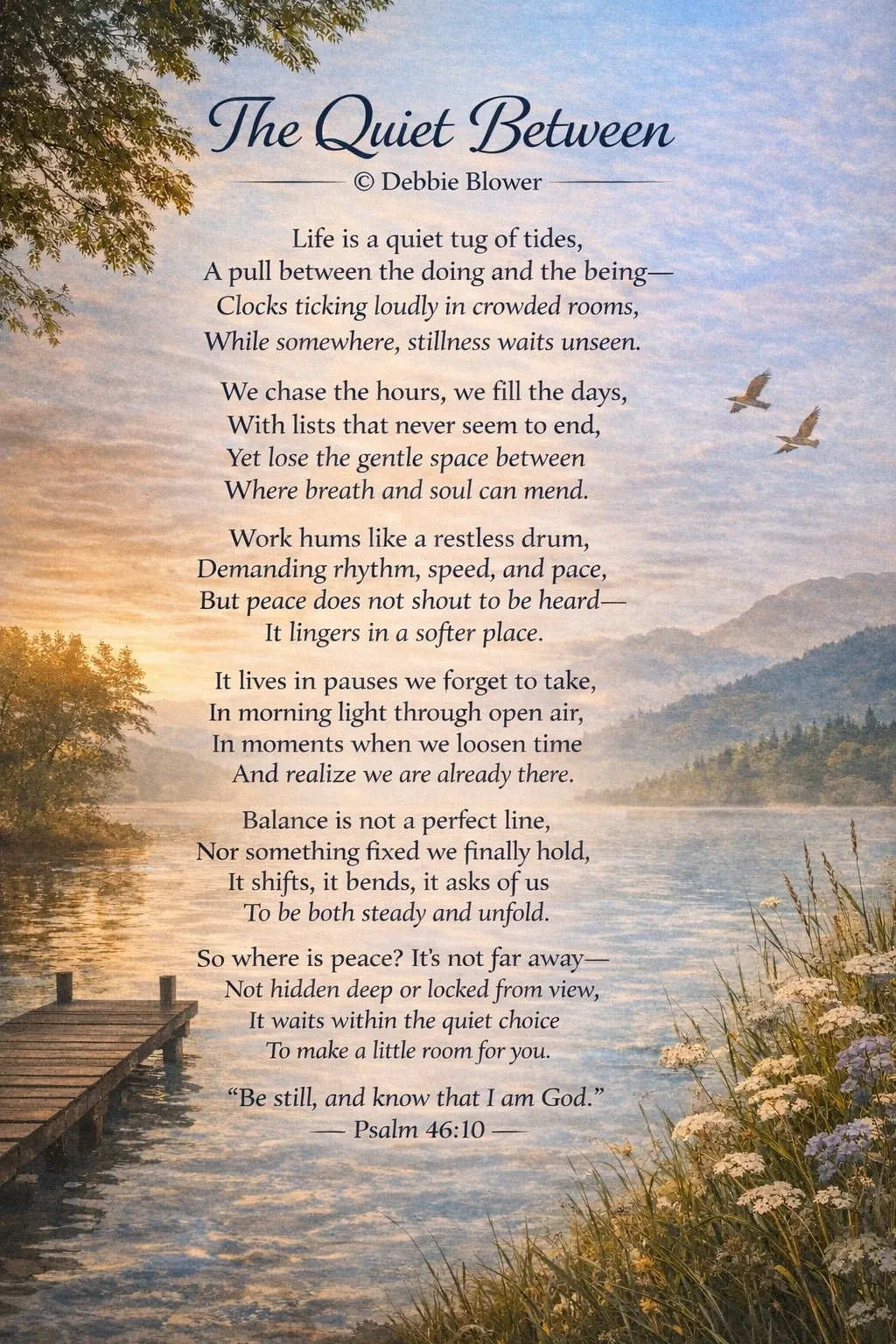
My poem “The Quiet Between” reflects on the tension between full days and the space we need to pause.
These lines sit close to the heart of this post:
But peace does not shout to be heard—
It lingers in a softer place.
I invite you to take your time with the poem. Notice whether a particular image or line stays with you.
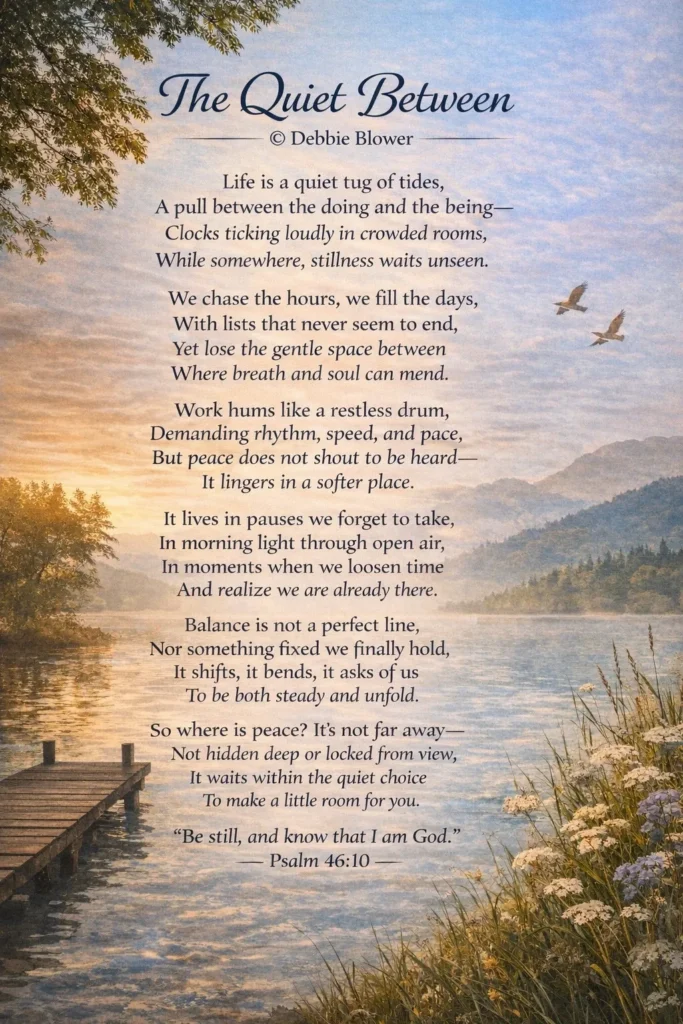
The Quiet Between — a poem by Debbie Blower about the space between doing and being.
Continue With Peaceful Reflections
If you enjoy poetry that makes room for faith, memory, and quiet consideration, you can explore Peaceful Reflections, my poetry collection.
You are also welcome to visit The Faith & Reflection Room for more reading and reflection.
If a poem leaves you wanting to respond in prayer, the Prayer Starters widget offers a place to begin.
Final Thoughts
Writing poetry can begin with something small: an image, a feeling, a question, or a moment you want to remember.
Give it your attention. Try a few words. Listen to them, and allow yourself to revise.
You do not have to know where the poem will lead before you begin.
Sometimes the first line helps you discover what you have been wanting to say.
Debbie Blower 💛
Author/Illustrator
Founder of The Story House
Stories that inspire. Words that heal.