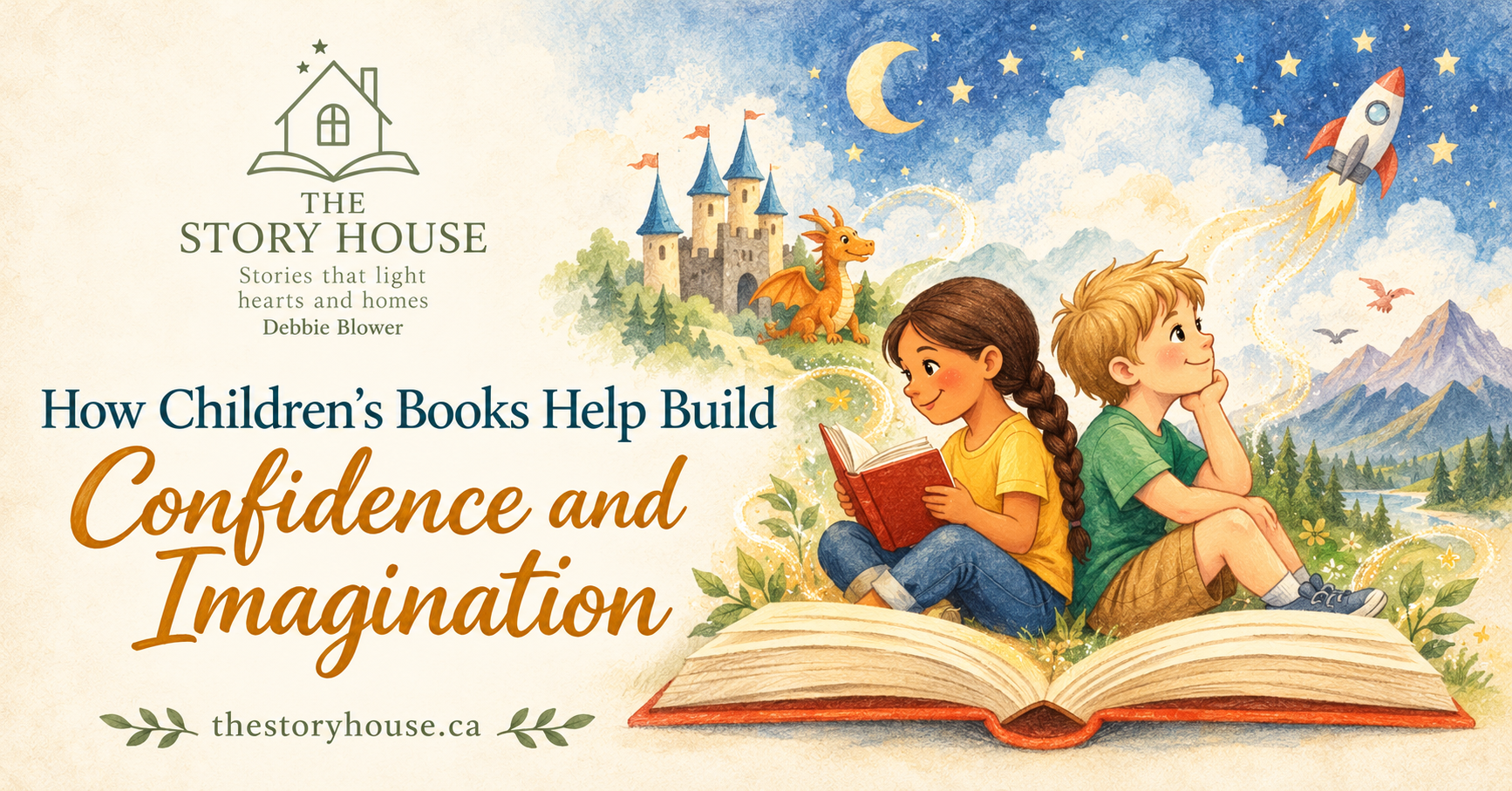
How Children’s Books Help Build Confidence and Imagination
How Stories Can Support Confidence and Imagination
Children’s books can introduce new possibilities, give children characters and feelings to think about, and invite them to share ideas of their own. Reading together adds opportunities for conversation, encouragement, and creative play.
There is something quietly powerful about the stories children grow up with.
A character may ask a question they have been afraid to ask. An illustration may invite them into a world they want to explore. A familiar story may give them words for an experience they have struggled to explain.
The response is not always immediate or obvious.
Sometimes it begins with a question, a drawing, or a child quietly saying, “I think I would have tried something different.”
Those moments give us something worth listening to.
How Stories Can Support Confidence and Imagination
When we talk about confidence, it helps to think beyond being outgoing.
For a child, confidence might mean asking for help, offering an idea, admitting uncertainty, or trying a task again.
Imagination gives them possibilities to explore: another choice, an unexpected solution, or a world they can shape themselves.
A story can provide material for both. The way we share it matters, too.
When adults welcome questions and listen to a child’s interpretation, reading becomes an opportunity to participate. The child has something to contribute, even when they are still learning to read independently.
Characters Give Children Choices to Think About
A character does not need to be fearless to offer an encouraging example.
Often, the interesting part is watching someone feel uncertain, make a mistake, or need help—and then decide what to do next.
After a suitable moment in a story, you might ask:
- “What helped the character try again?”
- “Who could they ask for help?”
- “Would you have made the same choice?”
Allow a different answer from the one you expected.
The conversation can help a child explore possibilities without being placed in the character’s situation. They can consider what courage, kindness, or persistence might look like.
That does not mean every story needs to become a lesson. Sometimes the child simply wants to enjoy the adventure.
Familiar Feelings Can Become Easier to Discuss
Children may recognize a character’s disappointment, excitement, jealousy, or worry before they are ready to talk about their own.
A gentle question can create an opening:
“How do you think that character feels?”
You can notice a facial expression in an illustration or discuss something the character said. Let the child disagree or remain unsure.
The American Academy of Pediatrics explains that reading together about common feelings can help children recognize emotions and understand how others may feel.
Its books about feelings and resilience guide offers examples for families. HealthyChildren.org
There is no need to press a child to reveal something personal. Talking about the character may be enough for that moment.
Imagination Gives a Story Room to Continue
The final page does not have to end a child’s interest.
They may wonder where a character goes next, draw a place mentioned in the book, or invent a new problem for the characters to solve.
Try a small invitation:
“What might be behind that other door?”
Or:
“What would you add to this world?”
Leave room for an answer that changes the direction entirely.
A child might turn a quiet garden into a dragon’s landing place or give a minor character an adventure of their own.
These are opportunities to practise creating, explaining, and making choices. They can happen through conversation, drawing, building, or pretend play.
Being Heard Gives Their Ideas a Place
One useful thing an adult can offer is interested attention.
When a child describes an idea, ask about a detail that caught your interest:
“You said the bridge only appears at night. How does the character discover it?”
That response shows you were listening.
You can also notice something specific in their contribution:
“That description helped me picture the island.”
They do not need to produce a complete story or a polished answer. An unfinished idea can still lead to an enjoyable conversation.
Over time, these exchanges give children opportunities to share their thinking and discover that someone wants to hear it.
Choose Books That Welcome This Particular Child
A book that connects with one child may leave another uninterested.
Consider their interests, the subjects they want to explore, and how much support they need with the text.
A younger child might enjoy discussing expressive illustrations. Another may prefer an adventure, a comic, or a factual book that inspires questions.
Picture books can offer rich ideas, and chapter books can give readers time to follow a developing character. Neither format automatically creates a deeper experience.
Let the child help choose. Read aloud when that makes a story accessible, and make room to return to familiar favourites.
The Public Health Agency of Canada’s guidance on encouraging literacy reminds families that sharing books is about the experience together, rather than simply finishing from front to back. Canada.ca
Try This After Your Next Shared Story
Choose one invitation that fits what the child enjoyed:
| If they noticed… | You could invite them to… |
|---|---|
| A character’s difficult choice | Imagine another choice and what might follow |
| An interesting setting | Draw a place the book has not shown |
| A surprising invention | Design something the character could use |
| A strong feeling | Discuss what might help the character |
| An unanswered question | Invent a possible explanation |
You do not need to work through the whole table.
Follow one moment of curiosity. If the child would rather keep reading, that is a good response, too.
Let Them Create With the Story Starter Generator
If your child wants a fresh idea, visit the Story Starter Generator in the Imagination & Story Growing Room.
Explore a prompt together, then let them decide where it leads. They can tell the story aloud, sketch a scene, build a setting, or write a few words.
Ask what interests them about the idea before suggesting how it should develop.
👉 Try the Story Starter Generator
For a printable activity, you can also explore My Story Starter Adventure.
The Heart Behind My Children’s Books
These possibilities are part of why I write children’s stories.
I want to create characters and situations that invite curiosity, conversation, and a sense of discovery.
In The Storm That Wasn’t, the cousins respond to a storm warning with questions, preparation, and teamwork. Their adventure offers a starting point for talking about uncertainty and finding information.
Through The Imagination Series with Sly, I invite young storytellers to explore ideas and begin creating stories of their own.
Each child will respond differently. My hope is to offer a doorway they may want to step through.
To help your child build confidence and imagination, may also like the explore:
Imagination and Storybuilding resources
A Gentle Reflection
Think about a story that stayed with you as a child.
Perhaps you remember a character, a place, or the person who read it aloud. Perhaps it left you with a question you wanted to explore.
We cannot decide which moments another child will remember.
We can offer thoughtful stories, make time to share them, and pay attention when something catches their interest.
Final Thoughts
Children’s books can offer opportunities to explore confidence and imagination through characters, choices, feelings, and new possibilities.
The conversation around a story matters. So does the space children have to respond in their own way.
Read together. Welcome questions. Listen to an unexpected idea.
A child’s next contribution may begin with something simple:
“What if?”
Debbie Blower 💛
Author/Illustrator
Founder of The Story House
Stories that inspire. Words that heal.