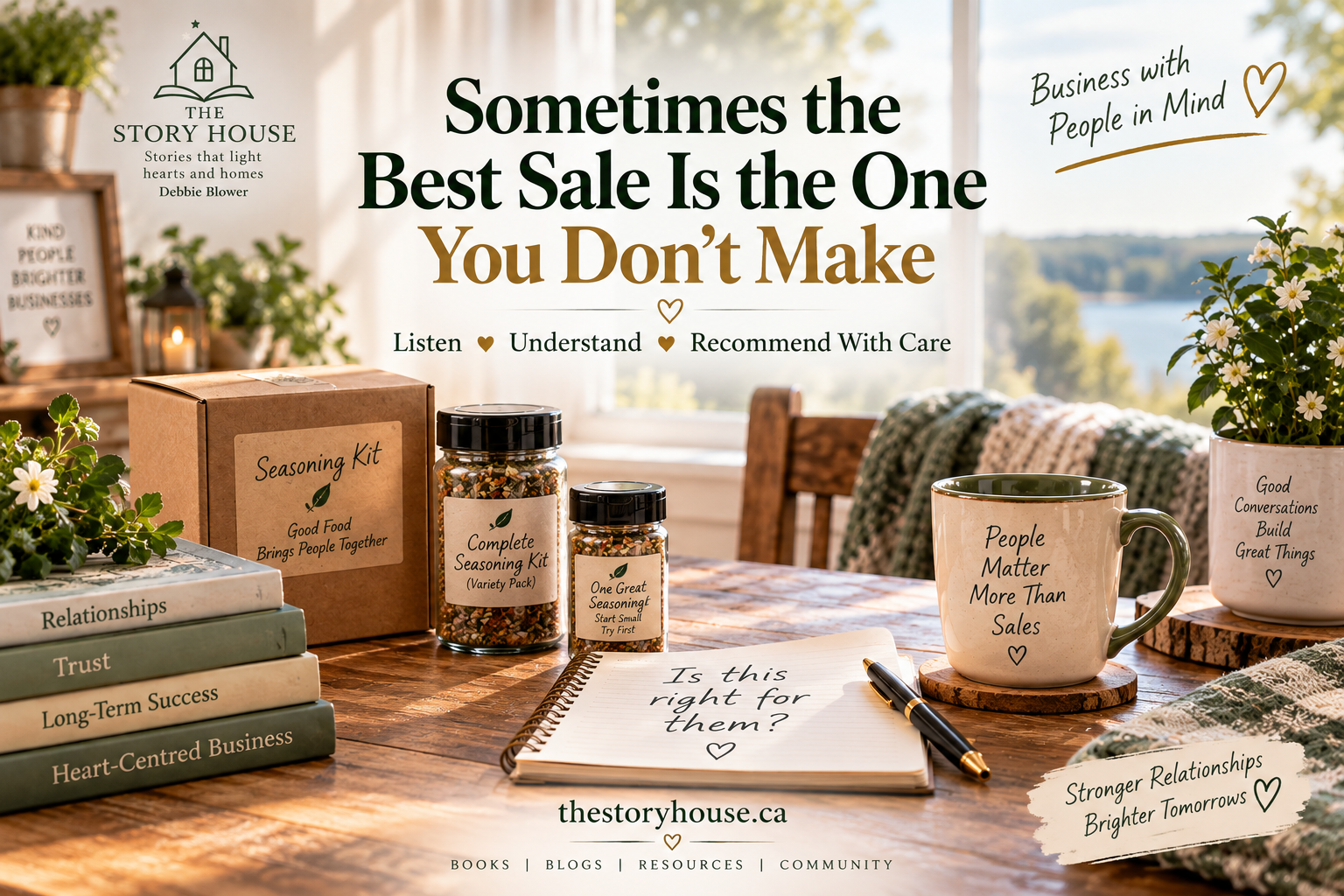
Sometimes the Best Sale Is the One You Don’t Make
Years ago, I had a customer who was interested in buying a larger seasoning kit.
She was not sure whether she would even enjoy the flavour of the seasonings, and buying the whole kit simply to find out did not make much sense to me.
I could have encouraged her to buy it anyway.
It would have meant a larger order.
Instead, I suggested she begin with one seasoning that could be used in several different meals.
Try it first.
See whether she liked the flavour.
See whether it worked with the way she cooked.
If it did, she could always come back for the larger kit later.
That was a smaller sale.
But it was the right sale for that customer.
And I have come to believe there are times when the right sale is even smaller than that.
Sometimes it is no sale at all.
Ethical selling means understanding the customer’s real need before trying to make the transaction. Sometimes that means recommending a smaller or less expensive option, respecting a no, suggesting something different, or being willing to say, “I don’t think you should buy this.”
That may cost you a sale today.
But selling something you know is the wrong fit can cost you something much harder to rebuild.
Trust.
Ethical Selling Begins With the Customer’s Need
When I mentored direct-sales teams, one principle mattered to me again and again:
Finding the customer’s real need can lead to future sales. Pushing the wrong product because you did not understand the need can lead to the wrong kind of word-of-mouth advertising.
People talk about their experiences.
They remember when they felt listened to.
They also remember when they felt pushed into something that did not suit them.
The Business Development Bank of Canada identifies focusing on the product instead of the prospect’s need, rushing the customer, and selling instead of building a relationship as common sales mistakes. Its guidance recommends first identifying the customer’s problem and then suggesting a solution that fits. BDC.ca
Read BDC’s guidance on common sales mistakes
That reflects what I learned through experience.
A product is not automatically the right solution simply because I sell it.
This is also at the heart of What Does Heart-Centred Business Actually Mean? — listening first, understanding the person in front of you, and making decisions that serve both the customer and a sustainable business.
When I Wasn’t Willing to Take the Chance
One customer conversation from my direct-sales years has stayed with me for a very different reason.
A customer wanted to try one of the seasonings I sold, but she told me she needed to avoid potassium.
The product contained an ingredient she was concerned about.
Because the amount appeared small, she was willing to take the chance.
I wasn’t comfortable with that.
And I want to be very clear about something here: I was not qualified to give her medical advice, and I did not try to.
I gave her the company’s ingredient information and asked her to check with her doctor before buying the product.
Health Canada’s guidance explains that the ingredient list on prepackaged foods can be used to check whether a food contains a particular ingredient. Canada
Health Canada: Understanding food ingredient lists
Her doctor’s answer was a firm no.
So there was no sale.
But that was not the end of the story.
She was so appreciative that I had taken her concern seriously instead of simply accepting the order that she became one of my best customers.
She also recommended me to members of her family.
I had shown her something that mattered more than that particular transaction:
Her wellbeing mattered more to me than making that sale.
I could never have promised that doing the right thing would lead to future business.
That was not why I did it.
But trust grew because she knew I had been willing to lose the sale.
Knowing Your Limits Is Part of Serving the Customer
I think this is an important part of ethical selling that does not get talked about enough.
Being knowledgeable about your product does not mean pretending you are qualified to answer every question.
Sometimes good service means saying:
I don’t know.
I need to check that.
Here is the manufacturer’s information.
Please speak with someone qualified to advise you.
That does not make you less knowledgeable.
It makes you more responsible.
The Direct Sellers Association of Canada’s Code of Ethics says consumers dealing with member companies should receive accurate and truthful information about products and services, and that sellers should promptly end a presentation when requested. DSA
Read the Direct Sellers Association of Canada Code of Ethics
For me, that principle goes beyond formal rules.
If I do not know the answer, I should not invent one simply because I want the sale.
A Smaller Sale Can Be the Better Sale
The seasoning-kit example taught me something else.
Sometimes the customer does need what you offer.
They simply do not need as much of it as you originally thought.
There can be pressure in sales to increase the size of every order.
Upgrade.
Add on.
Bundle.
Buy the larger option.
But sometimes the smaller product genuinely makes more sense.
If someone is uncertain about a flavour, why should they spend more money just to discover whether they like it?
Give them a way to try it.
Let them make an informed decision.
If they love it, they know where to find you.
If they do not, you have saved them from spending money on something that was not right for them.
Either way, you have served them well.
That philosophy is closely connected to what I explore in Social Selling & Conversational AI — building business through genuine conversations and relationships rather than pressure-driven selling.
Explore Social Selling & Conversational AI
A No Should Always Be Respected
I sometimes say that no does not always mean the same thing.
But I want to explain exactly what I mean by that.
A customer’s no should always be respected.
It is not an invitation to argue.
It is not a challenge to overcome.
It does not mean the seller should keep applying pressure until the answer changes.
Sometimes, though, the customer is still engaged in the conversation and what they mean is:
Not this product.
Not at this price.
Not right now.
I’m not sure yet.
That is different from a clear:
No, I’m not interested.
The skill is learning to recognise the difference.
Questions That Help Without Pushing
When someone is still comfortable talking, a gentle question can help you understand what they actually need.
You might ask:
- “Is it the product itself that doesn’t feel right, or is this just not the right time?”
- “Is there something specific you’re hoping to solve?”
- “Would a smaller or simpler option be more useful?”
- “Is there something about this particular product you’re unsure about?”
- “Would you like some information to look over, or would you rather leave it here for now?”
- “Is there another kind of solution you’re looking for instead?”
Then listen to the answer.
Do not ask six questions in a row because you are determined to find one that produces a yes.
One thoughtful question may be enough.
And sometimes the answer tells you to stop.
Knowing what to ask — and when to stop asking — is also part of building trust before the sale. I explore that more in How to Build Trust Before You Ask for the Sale.
Knowing When to Stop Matters Just as Much
There is a point when good questioning becomes pressure.
If the customer clearly says they are not interested, stop.
If they are giving increasingly short answers and trying to end the conversation, stop.
If they tell you they do not want another option, stop.
If their body language, tone, or messages make it clear that the conversation is finished, respect it.
If they say, “No thank you,” you do not need to solve the no.
You can simply say:
“Absolutely. If you ever have a question later, I’m happy to help.”
Then mean it.
You have left the door open without standing in the doorway blocking their exit.
The Wrong Sale Can Cost More Than the Order Is Worth
Imagine the alternative.
You persuade someone to buy something that you already suspect is not right for them.
You make the sale.
Your numbers go up.
For the moment, it looks like a success.
Then the customer uses the product and regrets buying it.
What are they likely to remember?
Not how persuasive you were.
They may remember that you should have listened.
And when someone asks about their experience with your business, that story can travel.
That is why my belief has always been:
Finding the customer’s need can create future business. Pushing the wrong product can create the wrong kind of word-of-mouth advertising.
The Competition Bureau of Canada says businesses must not make materially false or misleading representations when promoting products or services, and notes that truthful information helps consumers make informed buying decisions. Competition Bureau
Competition Bureau Canada: Misleading representations and deceptive marketing practices
Ethical selling goes beyond simply staying on the right side of advertising law.
It means caring whether the customer is making the right choice for them.
Selling Less Today Can Build Something Bigger
There is an interesting tension here.
If your only measurement is today’s order total, recommending the smaller option can look like a poor business decision.
Saying no to a sale looks even worse.
But businesses are built over more than one transaction.
Trust matters.
Reputation matters.
Referrals matter.
Repeat customers matter.
Relationships matter.
BDC’s guidance on understanding customers emphasises learning what customers actually want and need so that businesses can tailor their service and offerings accordingly. BDC.ca
BDC: How to understand your customers better
That is something I have seen firsthand.
The customer I asked to check with her doctor became one of my strongest customers not because I persuaded her to purchase that product.
She became a loyal customer partly because I was willing not to sell it to her.
There is a difference.
This Is Not About Being Afraid to Sell
Heart-centred business does not mean apologising for having products.
It does not mean being afraid to make an offer.
It does not mean giving everything away.
And it certainly does not mean running a business that cannot make money.
If I have something that genuinely meets a person’s need, I am comfortable showing it to them.
Selling is part of business.
The question is not:
Should I sell?
The better question is:
Is what I’m offering genuinely a good fit for this person?
When the answer is yes, make the offer.
When the answer is maybe, ask a useful question.
When the answer is no, be willing to say so.
That is where trust begins to matter more than the transaction.
If you are working through how to identify the customer’s real problem before presenting an offer, How to Turn Customer Problems Into Content That Connects explores the same customer-first idea from the content side of business.
Read How to Turn Customer Problems Into Content That Connects
Use STOP at the Moment of Sale
My STOP approach fits here too.
S — Stop.
Before making the recommendation, stop talking long enough to make sure you understand what the customer has actually told you.
T — Tune in.
What do they need? What are they hesitant about? What are they trying to solve?
O — Observe.
Pay attention to their questions, tone, reactions and uncertainty. Are they interested, confused, uncomfortable, or simply not ready?
P — Proceed.
Make the recommendation that fits what you learned — even if that recommendation is smaller than you originally expected.
And sometimes Proceed means:
Don’t sell it.
That is still a decision.
And sometimes it is the best one.
Trust Should Not Depend on the Size of the Order
I want customers to know that the amount they spend does not determine the amount of respect they receive.
Someone buying one item deserves honest guidance.
Someone buying a larger package deserves honest guidance.
Someone deciding to buy nothing deserves respect too.
That is also why I do not believe customers should be made responsible for a seller’s sales target.
Your quota belongs to you.
Your goal belongs to you.
The person standing in front of you should not be pressured into buying something they do not need because you are short of your monthly target.
Steady, relationship-based business is something I explore further in Confident & Consistent, particularly the idea of building in a way that can be sustained without letting pressure dictate how you show up.
Explore Confident & Consistent
What If Saying No Means Losing the Customer?
It might.
That is part of business too.
You can do everything thoughtfully and still have someone buy elsewhere.
Heart-centred business is not a formula that guarantees every person will return.
Ethical selling is not a trick for producing loyalty.
If we practise it only because we expect a future sale in return, we have missed the point.
You recommend what is right because that is how you have chosen to run your business.
Sometimes trust grows into another purchase.
Sometimes it grows into a referral.
Sometimes nothing else happens.
The decision can still have been the right one.
Frequently Asked Questions
What is ethical selling?
Ethical selling means giving customers accurate information, listening to their needs, avoiding unnecessary pressure and recommending products or services because they genuinely fit rather than simply because you want the sale.
Should I recommend a cheaper product if it suits the customer better?
I believe so. If a less expensive option genuinely meets the customer’s need, recommending it demonstrates that your advice is based on fit rather than order value.
What should I do when a customer says no?
Respect the no first. If they are clearly still open to conversation, one gentle question may help you understand whether the issue is timing, fit, price or something else. If they indicate they are finished with the conversation, stop.
Is it ever appropriate to tell a customer not to buy?
Yes. There can be times when you know the product is not suitable, do not have enough information to recommend it responsibly, or believe the customer should seek qualified advice first. In those situations, not making the sale may be the more responsible choice.
What if a customer asks me something outside my expertise?
Be honest about your limits. Give them accurate manufacturer or company information when appropriate, and encourage them to consult a properly qualified professional when the question requires expertise you do not have.
Before You Make the Next Offer
Before your next recommendation, ask yourself:
If there were no quota, target or commission attached to this conversation, would I still recommend the same thing?
That question can tell you a great deal.
Maybe the answer is yes.
Wonderful.
Make the offer confidently.
Maybe the answer is:
I’d suggest the smaller one first.
Then do that.
Maybe it is:
I’d ask one more question.
Ask it.
And sometimes the answer may be:
I would tell them not to buy this.
That is okay too.
Sometimes the best sale is the one you don’t make.
Because a business built around trust has to care about more than whether the transaction happened.
It has to care whether the transaction should happen.
If you would like to continue exploring a way of doing business that puts listening, trust, connection and good judgement alongside sustainable growth, you are welcome inside the Heart-Centred Business Room at The Story House.
Visit the Heart-Centred Business Room
Debbie 💛
Canadian Author/Illustrator
Founder of The Story House