The Stories We Carry Through Faith
A Reflection on the Stories of Faith We Carry
How do stories we carry through faith shape us?
The stories we carry through faith help us remember where God met us, what carried us through difficult seasons and how hope continued even when life did not unfold the way we expected.
Some faith stories are easy to recognize.
Others are much quieter.
They may be found in a prayer whispered when we did not know what else to say, a verse that seemed to arrive at exactly the right moment, a conversation that gave us courage, or a sense of peace that made no sense given what was happening around us.
Sometimes we do not even recognize the story while we are living it.
Only later do we look back and think, God was there.
Those are the stories we carry through faith.
And they can shape us for years.
Faith Stories Become Part of Who We Are
Every life holds moments that teach us something about faith.
Some come through joy and gratitude. Others are formed through waiting, disappointment, loss, uncertainty or the quiet courage required to keep trusting when we cannot see very far ahead.
Faith is often lived that way.
Not in one dramatic moment, but day by day.
Prayer by prayer.
Choice by choice.
Over time, those experiences become woven into who we are.
They affect the way we pray, the way we encourage someone else, the way we understand Scripture and sometimes even the way we respond when another difficult season comes.
Family stories can remind us where we came from. Faith stories often remind us how we were carried.
That is one reason this reflection connects naturally with Why Family Stories Matter More Than We Realize:
The stories are different, but both help us remember what shaped us.
The Quiet Power of Remembering
There is something powerful about looking back.
At the time, we may have seen only the uncertainty.
Later, we notice the pieces we could not see clearly then.
The person who encouraged us.
The prayer that settled our heart.
The unexpected door that opened.
The strength that arrived when we thought we had none left.
The verse we kept returning to.
The moment we realized we were not as alone as we had felt.
Scripture itself gives us this language of remembering. Psalm 77 speaks of remembering what God has done and reflecting on His works. Bible Gateway
That does not mean looking back makes every difficult experience easy to explain.
Some questions remain questions.
Some losses remain painful.
Faith does not require us to pretend otherwise.
But remembering can help us recognize that the hardest chapter was not necessarily the whole story.
Why the Stories We Carry Through Faith Matter
Our faith stories do more than preserve memories.
They become reminders.
When life is steady, they remind us to be grateful.
When life becomes difficult again, they remind us that we have walked through uncertainty before.
When someone else is struggling, they may give us words we would not otherwise know how to offer.
And when younger generations begin asking what faith meant to the people before them, our stories give them something more personal than a list of beliefs.
Psalm 78 speaks about telling the next generation what God has done so those stories are not simply lost with time. Bible Gateway
That is one of the reasons I think writing faith stories down matters.
We may be preserving encouragement for someone we have not even thought about yet.
Drawing Closer Often Happens in Small Moments
Sometimes we imagine that drawing closer to God should feel dramatic.
But often it begins quietly.
A few minutes before the rest of the house wakes.
A prayer spoken while driving.
A moment of stillness.
Opening Scripture because we need direction.
Choosing to come near again after a season when we have felt distant.
James 4:8 carries that simple invitation to come near to God. Bible Gateway
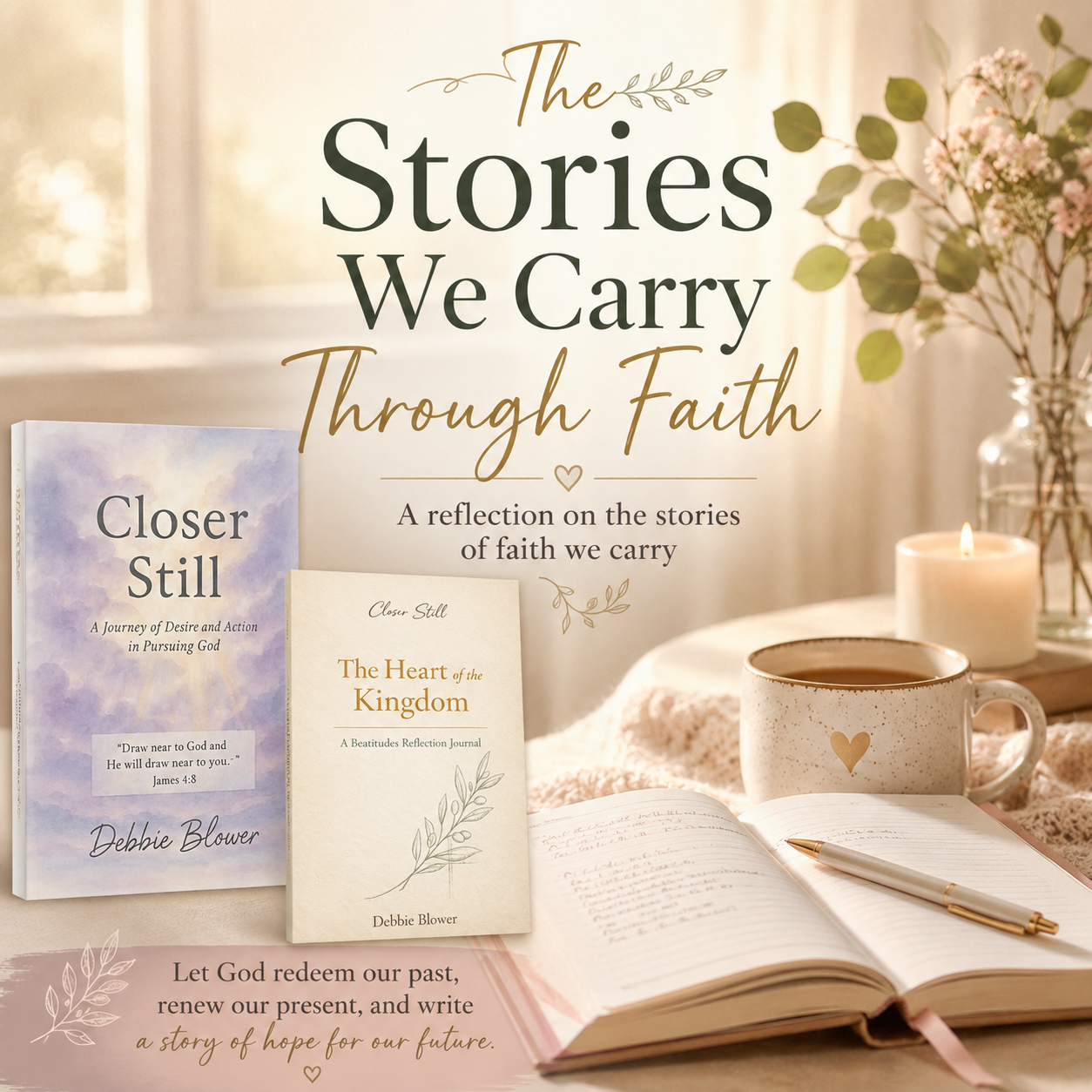
That invitation sits at the heart of Closer Still.
The book grew around the idea that pursuing God is not simply about knowing more. It is about drawing nearer in the ordinary places of life and allowing prayer, praise, purity and perseverance to become part of that journey.
You can explore the Closer Still Collection here:
Faith Is Often Found in Ordinary Places
Not every faith story begins in a church service or a life-changing event.
Sometimes it begins at the kitchen table.
On a walk.
Beside a hospital bed.
While washing dishes.
During a sleepless night.
In the few quiet minutes after everyone else has gone home.
In a conversation with someone who understood what we were trying to say.
Those moments may not look important from the outside.
But sometimes the ordinary moments become sacred because they are the places where we suddenly become aware that God is near.
That is part of the heart behind Peaceful Reflections too — learning to pause long enough to notice.
Faith is not confined to the moments that look spiritual.
Sometimes it is found in the middle of an ordinary Tuesday.
The Stories That Teach Us How to Live
Faith stories do not only remind us of what happened.
They can change how we live afterward.
A season in which someone showed us mercy may teach us to offer mercy.
A time when we had to wait may make us more patient with someone else’s uncertainty.
An answered prayer may deepen gratitude.
A prayer that was answered differently than we hoped may teach us something about surrender.
A painful season may leave us more tender toward people whose lives have not gone according to plan.
This is where faith becomes more than something we say we believe.
It begins shaping the posture of the heart.
That is also the focus of The Heart of the Kingdom, which explores the Beatitudes and what they reveal about living with humility, mercy, peace and a heart turned toward God.
Not Every Faith Story Needs a Perfect Ending
This is important.
We sometimes tell faith stories only after everything has worked out.
The prayer was answered.
The door opened.
The relationship healed.
The diagnosis changed.
The problem disappeared.
But not every faith story ends that neatly.
Sometimes faith is the story of continuing to trust while a question remains unanswered.
Sometimes it is learning to live with something we did not choose.
Sometimes it is discovering that hope can exist alongside grief.
Sometimes the story is simply:
I am still here. I am still trusting. I am still walking.
Those stories matter too.
Faith should never force us to rewrite pain into something prettier than it was.
It can, however, help us recognize that pain does not get the final word.
Faith Stories Can Become Encouragement for Someone Else
There are things we understand differently after we have lived through them.
A person who has experienced waiting can sit differently with someone who is waiting.
Someone who has walked through loss may understand when another person does not need an answer, only a presence.
Someone who has struggled with doubt may know how important it is to make room for honest questions.
That is part of the quiet gift of testimony.
We do not have to stand on a stage.
Sometimes sharing one honest sentence is enough:
“I remember feeling that way too.”
“This is what helped me.”
“This verse stayed with me during that season.”
“I did not understand it then either.”
Our faith stories can become bridges between what we have lived and what someone else is living now.
Writing Faith Stories Down
Many of these stories live quietly in memory until something causes us to remember them.
That is why I think it is worth writing them down.
Not to make them impressive.
Not to make them sound more spiritual.
Simply to keep them.
You might begin with a question such as:
When did I feel especially aware of God’s presence?
Or:
What difficult season changed my faith?
What prayer do I still remember?
What Scripture has followed me through different seasons?
Who helped strengthen my faith?
What do I understand about God now that I did not understand years ago?
What would I want my children or grandchildren to know about this part of my journey?
You do not need to answer every question.
Choose the one that makes you stop.
That may be where your story begins.
A Simple Faith Story Reflection
If you want to preserve one of these memories, try writing just five things:
- What was happening in my life?
- What was I praying or wondering about?
- Where did I notice God in that season?
- What did I learn or carry forward?
- What would I want someone else to know from this story?
You may write a page.
You may write five sentences.
Either can be enough.
What matters is that the story is true.
Faith Stories and the Generations That Follow
One of the most meaningful things about writing faith stories down is realizing they may outlive the moment in which they were written.
A child or grandchild may one day wonder what you believed.
Not simply which church you attended.
Not only which Bible sat beside your bed.
But:
What did faith actually mean to you?
What did you pray about?
What frightened you?
What gave you hope?
When did you struggle?
Where did you see God at work?
Those are precious questions.
And if we record even a few of the answers, we leave something behind that a photograph or family tree cannot quite capture.
We leave part of the inner story.
A Faith Story Reflection Page to Help You Begin
Sometimes we know there is a faith story we want to remember, but we are not quite sure where to begin.
I created a simple Faith Story Reflection Page to help.
It gives you a quiet place to reflect on a faith moment that has stayed with you, a season when you felt God’s presence, a prayer or Scripture you carried with you, what your faith has brought you through, and what encouragement you might one day want to pass on.
You do not have to write a long story.
Start with one memory.
One prayer.
One moment you do not want to forget.
Download the Faith Story Reflection Page
Sometimes the quietest faith stories become the ones that shape us most. faith_story_reflection_page
A Gentle Reflection
Take a moment and ask yourself:
What faith story do I carry?
Perhaps it is a story of hope.
Waiting.
Courage.
Surrender.
Healing.
Forgiveness.
A new beginning.
Or simply learning to trust again.
It does not have to be dramatic to matter.
It only has to be true.
Frequently Asked Questions About Faith Stories
What is a faith story?
A faith story is a personal account of how belief, prayer, Scripture, trust or an awareness of God’s presence became part of a particular experience or season of life. It may involve a major turning point, but it can also come from very ordinary moments.
Why should I write my faith story down?
Writing helps preserve details that can fade with time. It can also help you reflect on what you learned and leave a record of your faith for children, grandchildren or others who may one day need the encouragement.
Does a faith story need to have a happy ending?
No. Some faith stories are still unfolding. A meaningful story can include unanswered questions, grief, uncertainty and continuing trust.
What if my faith story seems ordinary?
Ordinary does not mean unimportant. Some of the deepest experiences of faith happen quietly through prayer, Scripture, relationships and daily life.
Where can I begin if I do not know what to write?
Start with one moment. Ask yourself what was happening, what you were feeling, what you were praying and what you now understand about that season.
Final Thoughts
The stories we carry through faith matter because they remind us that our lives are more than a collection of unrelated moments.
They hold memory.
They hold lessons.
They hold questions.
They hold quiet reminders of God’s presence along the way.
When we write them down and share them carefully, they can become encouragement for someone else.
They remind us what we have walked through.
And, sometimes, they help us recognize Who walked with us.
You can continue exploring faith, reflection and the quieter places where stories and belief meet in the Faith & Reflection Room
Debbie Blower 💛
Author/Illustrator
Founder of The Story House