
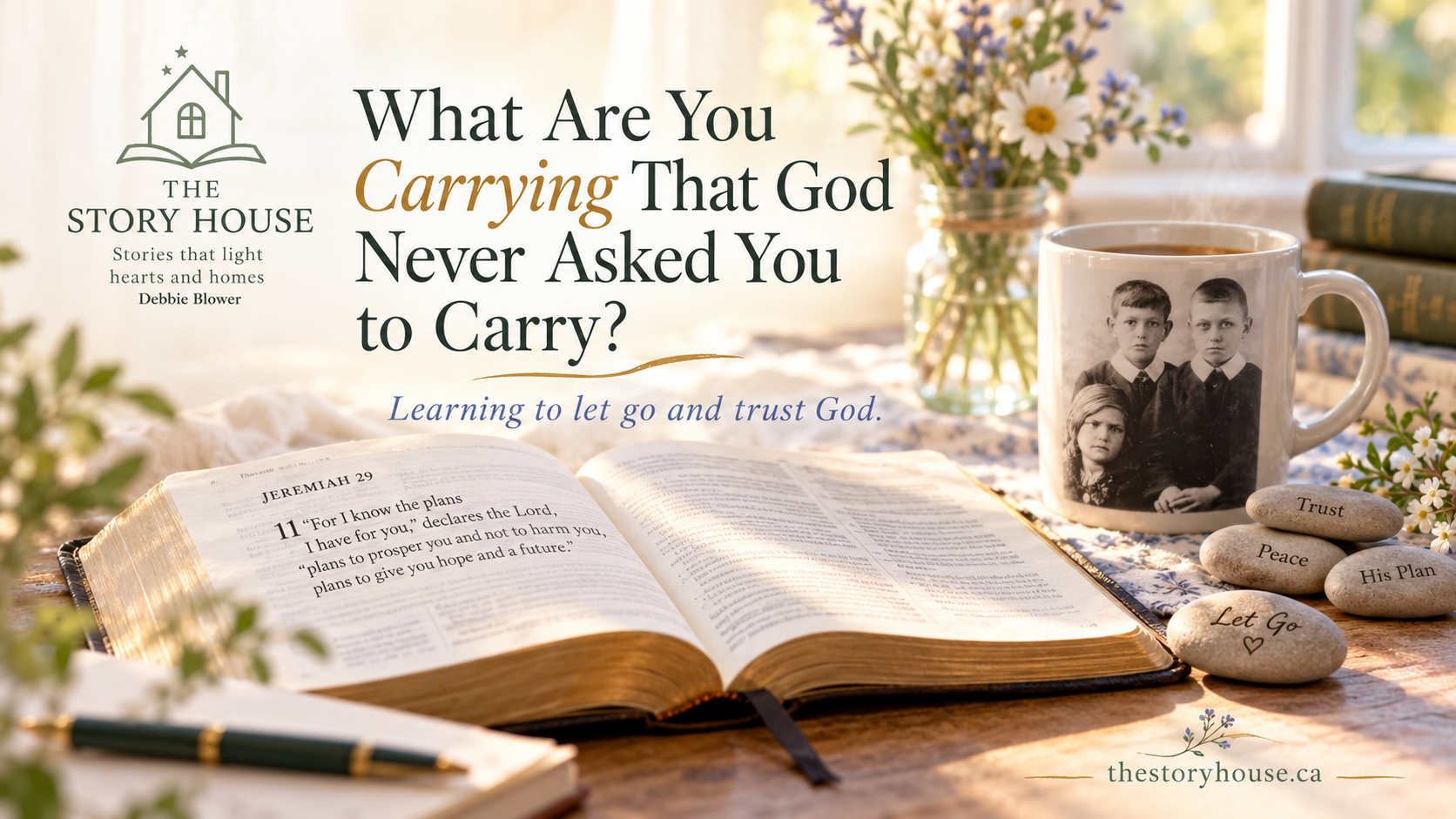
What Are You Carrying That God Never Asked You to Carry?
Do you give your burdens to God?
There have been seasons in my life when I have carried far more than I realized.
Worry about my children and whether I had made the right decisions.
Fear about what the future might hold.
The feeling that somehow I needed to help solve other people’s problems or make things better for them.
And fear for my own health.
Some of those concerns came from love. Some came from responsibility. But somewhere along the way, concern can quietly become a burden we were never meant to carry alone.
I learned that most clearly when I faced cancer.
There are moments when life changes so quickly that all the things we normally rely on suddenly feel very small. Questions about tomorrow become much more than questions.
Will I have a tomorrow?
What will happen to my family?
What does my future look like now?
And in the middle of that fear, one Scripture became my strength:
11 For I know the plans I have for you,” declares the Lord, “plans to prosper you and not to harm you, plans to give you hope and a future. 12 Then you will call on me and come and pray to me, and I will listen to you. 13 You will seek me and find me when you seek me with all your heart.
The words about God’s plans, hope and a future became the light I could see at the end of a very dark tunnel.
Not because I suddenly knew exactly what was going to happen.
I didn’t.
But because I was reminded that God did.
When We Try to Carry What We Cannot Control
I think many of us carry things because we love deeply.
We worry about our children because we want them to be safe.
We think about decisions we made years ago and wonder whether we got them right.
We watch someone we love struggle and immediately begin looking for a way to fix it.
We worry about finances, relationships, health, work and a future we cannot see.
Somewhere inside us is the thought:
If I worry about this enough, perhaps I can somehow protect everyone.
But worry is not the same thing as control.
And caring for someone does not mean we are responsible for determining the outcome of their life.
There are things God asks us to do.
Love.
Pray.
Listen.
Help when we can.
Make wise decisions.
Be present.
Give your burdens to God.
And then there are the things only He can do.
Learning the difference has been part of my own faith journey.
How Do We Give Our Burdens to God?
To give our burdens to God does not mean that we stop caring or stop taking responsibility for the things He has placed in our hands. It means letting go of the things we cannot control and trusting Him with what happens next.
That is much easier to write than it is to live.
I have found that surrender is not always one dramatic prayer followed by complete peace.
Sometimes I give something to God in the morning and discover by afternoon that I have picked it right back up again.
The worry starts circling.
The questions return.
I begin working through every possible outcome.
And once again I have to say:
Lord, this is Yours.
That is why I find 1 Peter 5:7 so simple and so powerful:
“Cast all your anxiety on him because he cares for you.”
It does not say we have to solve the anxiety first.
We bring it to Him because He cares for us. Bible Gateway
Jeremiah 29:11-13 Became My Light
During my cancer scare, Jeremiah 29:11-13 meant something deeply personal to me.
I held tightly to the promise of hope and a future.
But over the years, I have also come to appreciate the setting surrounding that verse.
Jeremiah was writing to people living in exile. They were not being promised that everything difficult would disappear the next morning. They were told to build homes, plant gardens, live their lives and seek God where they were while they waited for restoration. God’s promise came in the middle of a difficult season, not after it had already ended. Bible Gateway
Read Jeremiah 29:4–14 in the NIV
That matters to me.
When I read the word prosper, I do not think first about money or an easy life.
For me, prospering meant God’s continued presence in my life.
It meant trusting that I still had a future.
It meant believing He still had purpose for me, even when I could not understand why this was happening or how it might eventually shape that purpose.
Cancer did not suddenly become something I welcomed.
Fear did not magically disappear.
But the Scripture gave me somewhere to place the fear.
God knew what I could not know.
And that gave me hope.
Trust Does Not Require Knowing the Outcome
One of the hardest things about faith is that we often want God to show us the ending before we agree to trust Him with the middle.
I certainly have.
Tell me this will work out.
Tell me my children will be okay.
Tell me the decision I made was right.
Tell me this health concern will turn out exactly the way I hope.
Then I can relax.
But that really isn’t trust.
Trust says:
I don’t know what comes next, but I know Who does.
Jeremiah 29:11-13 did not give me every answer I wanted.
It gave me something I needed more.
Hope.
We Were Never Meant to Carry Everyone’s Happiness
This has been another hard lesson for me.
I naturally want to help.
When someone I care about is hurting, struggling or unhappy, my first instinct is often to look for a solution.
What can I do?
What can I change?
How can I make this better?
There is nothing wrong with helping.
But there is a point where helping can quietly turn into assuming responsibility for another person’s happiness.
That is a burden none of us can carry successfully.
We can listen.
Encourage.
Pray.
Offer help.
Walk beside someone.
But we cannot make another person’s choices for them.
We cannot heal everything that hurts them.
We cannot create a life in which the people we love never experience disappointment.
Even Jesus invites the weary and burdened to come to Him for rest. His invitation is not to become strong enough to carry everything ourselves. Bible Gateway
Read Matthew 11:28–30 in the NIV
Sometimes the most faithful thing I can do for someone I love is pray and trust God to do what I cannot.
What Is Mine to Carry?
This has become a useful question for me:
Is this mine to carry?
There are responsibilities that are mine.
If I have made a mistake, I need to own it.
If someone needs help that I am able and meant to give, I should help.
If God is prompting me to act, I should not call avoidance “surrender.”
But there is a difference between responsibility and control.
I can love my children without controlling their futures.
I can pray for someone’s happiness without making myself responsible for producing it.
I can make wise decisions about my health without believing worry will determine the outcome.
I can plan for tomorrow without pretending I know what tomorrow will bring.
That distinction has brought me a great deal of peace.
Giving Your Burdens to God Does Not Mean Doing Nothing
I think this is important.
Sometimes phrases such as give it to God can sound almost dismissive.
Someone is frightened, grieving or overwhelmed and we say:
Just give it to God.
But surrender is not pretending something doesn’t hurt.
And trust is not passivity.
When I was dealing with cancer, trusting God did not mean ignoring doctors or refusing treatment or pretending I wasn’t afraid.
It meant doing what was mine to do and trusting Him with what was beyond my control.
That is still how I understand it.
Give your burdens to God, but keep walking faithfully in the responsibilities He has given you.
There is a difference between releasing control and abandoning responsibility.
Prayer Changes Where I Put the Weight
Philippians 4 tells us to bring our concerns to God through prayer and petition, with thanksgiving, and speaks of God’s peace guarding our hearts and minds. Bible Gateway
Read Philippians 4:6–7 in the NIV
I love that picture of peace guarding the heart and mind.
Because those are often the two places where worry works the hardest.
My heart feels the fear.
My mind starts trying to solve it.
Prayer does not always change the situation immediately.
But it changes where I place the weight of it.
Instead of holding it alone, I bring it before God.
Again.
And again if necessary.
Sometimes We Pick the Burden Back Up
I wish surrender were always permanent.
For me, it hasn’t been.
I have prayed about something and felt peaceful.
Then a new piece of information arrives.
Or someone says something.
Or I wake during the night.
And suddenly I am carrying it again.
I don’t think that means the first prayer failed.
It means I am human.
Sometimes trusting God is a daily practice.
Sometimes an hourly one.
I gave this to You yesterday, Lord, and apparently I picked it back up. Here it is again.
There is grace in that too.
The Future I Was Afraid I Might Not Have
When cancer entered my life, one of my greatest fears was losing the future I wanted with my family.
That is why Jeremiah 29:11-13 became more than a verse I knew.
It became personal.
The words hope and a future held a different weight.
I could not see far down the road.
But I could trust God with the part of the road I could not see.
And today, when I look at my family, my writing, The Story House, the books still waiting to be written and the stories still waiting to be told, I understand that promise in a deeper way.
My purpose was not finished simply because I was frightened.
God was still present.
And He still had work for me to do.
This understanding of prayer, trust, perseverance and drawing closer to God is also woven through Closer Still.
What Are You Carrying Today?
Perhaps your burden looks different from mine.
Maybe you are worried about a child.
A marriage.
A diagnosis.
Money.
Work.
An ageing parent.
A decision you wish you could make for someone else.
A future that does not look the way you expected.
Or perhaps you have simply become accustomed to carrying everyone else’s problems alongside your own.
Ask yourself:
Is this mine to carry?
Then perhaps ask a second question:
What part of this belongs in God’s hands?
You may still have something to do.
A phone call.
An apology.
An appointment.
A decision.
A conversation.
But you do not have to carry the outcome as though everything depends on you.
A Simple Prayer for Letting Go
Lord, You know what I am carrying today.
Show me what is mine to do and what I need to place in Your hands.
Help me release what I cannot control and trust You with the people and circumstances I love.
When fear tells me I need to know the outcome, remind me that You already know the road ahead.
Give me peace for today and faith for tomorrow.
Amen.
Frequently Asked Questions
What does it mean to give your burdens to God?
To give your burdens to God means bringing your worries, fears and uncertainties to Him while trusting Him with the outcomes you cannot control. It does not mean avoiding the responsibilities that genuinely belong to you.
Does trusting God mean I should stop worrying completely?
Worry may return. Trust can be something we practise repeatedly. When anxiety returns, we can bring it back to God again rather than judging ourselves for feeling it.
What does Jeremiah 29:11-13 mean?
Jeremiah 29:11 was originally spoken to God’s people during exile, within a promise of eventual restoration. For me personally, its words about hope and a future became a source of strength during cancer because they reminded me that God could see beyond what I could see. Bible Gateway
Does “prosper” in Jeremiah 29:11-13 mean financial prosperity?
That is not how I understand it in my own life. During my health scare, I understood prosperity as God’s continued presence, the hope of a future and trust that He still had purpose for my life.
How can I know whether something is mine to carry?
Ask what action genuinely belongs to you. You may need to help, speak, apologise, plan or make a wise decision. But another person’s choices, every possible future outcome and circumstances beyond your control are not yours to manage.
You Don’t Have to Know the Whole Plan
I still like to know what comes next.
I suspect I always will.
But faith has taught me that I do not need to see God’s whole plan in order to trust Him with the next step.
Jeremiah 29:11-13 was my light at the end of the tunnel during one of the most frightening seasons of my life.
Not because it promised me an easy road.
But because it reminded me that the road continued.
That God was there.
That there was still hope.
That there was still purpose.
That there was still a future.
So when I catch myself carrying something I cannot control, I return to that truth.
God knows the plans.
I don’t have to.
If you are looking for a quiet place to continue exploring prayer, Scripture and everyday faith, you are welcome in The Faith & Reflection Room at The Story House.
Debbie 💛
Canadian Author/Illustrator
Founder of The Story House