Storybuilding With Imagination: Helping Children Create Stories
What is storybuilding with imagination?
Storybuilding with imagination helps children turn ideas into stories through questions, drawing, conversation and creative exploration. Children begin developing characters, settings and problems before being asked to produce a finished piece of writing.
Sometimes a blank page offers too many possibilities at once. A child may have plenty of ideas but feel unsure which one to choose or how to begin explaining it.
A question can give them something to work with. So can a picture, an unusual object or a character who wants something.
That small beginning is where a story can start to grow.
Storybuilding With Imagination Begins Before the Writing
When we ask children to “write a story,” some are eager to begin. Others worry about spelling, handwriting, finding the right words or whether their idea is good enough.
Storybuilding gives them time to explore what they want to say.
They might draw a character, describe a place aloud, act out a scene or tell someone about a problem their character needs to solve. Those choices help make the story more tangible before the child has to manage every part of writing it down.
Useful starting questions include:
- Who is the story about?
- Where does it happen?
- What does the character want?
- What gets in their way?
- What might they try?
- What happens because of that choice?
There is no need to answer everything immediately. One interesting answer can lead to the next question.
From the Original Resource to The Imagination Series With Sly
Storybuilding with Imagination is also the name of the original story-writing resource I created in 1995.
The work grew from my interest in helping young people develop ideas, explore stories and become more comfortable expressing themselves. It connects with the creative writing and arts-based literacy work I co-founded through The Muse Program.
That foundation has stayed with me.
Today, The Imagination Series with Sly is the remake and update of that earlier resource. I am bringing the storybuilding approach forward with refreshed presentation, examples, drawing opportunities, prompts and support for children and their adult helpers.
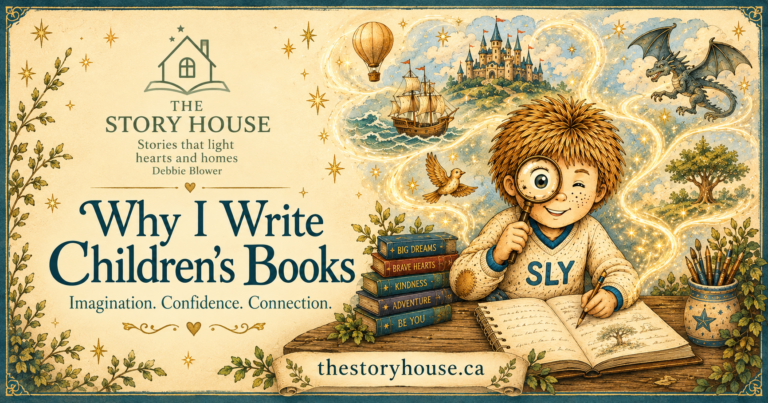
Sly gives young storytellers a familiar guide as they explore. The materials have grown, but the purpose remains close to my heart: helping children recognize that their ideas are worth developing.
You can read more about the background of this work on the About The Story House page.
Why Imagination Matters in Storybuilding
An ordinary object can offer a surprisingly useful beginning.
A child might notice a cardboard box and imagine a ship. A stone could become something a character has been searching for. A backyard tree might hold a door that only appears after rain.
The next question helps the idea develop: What happens because of it?
A ship needs somewhere to go. A discovered stone may belong to someone. A mysterious door gives a character a choice about whether to open it.
That is how imagination begins taking the shape of a story. Children explore possibilities, make choices and consider what those choices might change.
For more ways to begin with a question, read How “What If” Stories Help Reluctant Readers.
Give Children Structure and Room to Explore
A few questions can provide enough structure to begin without deciding the whole story for the child.
For example, you might ask, “Who lives in your forest?” Then wait. The answer may be very different from the one you imagined.
Perhaps the child chooses a small dragon who is afraid of heights. Now you have something to explore together. What does the dragon want to do? When does the fear become a problem? Who might help?
The adult’s role is to keep the conversation moving while leaving the important decisions with the young storyteller.
If a question brings the activity to a stop, try another approach. Invite the child to draw the dragon’s home, describe its favourite food or explain what happened yesterday. Sometimes a little distance from the main problem helps another idea arrive.
Drawing and Talking Can Be Part of the Process
A child does not have to begin with sentences.
Drawing can help them decide what a place looks like or what a character is doing. Talking lets them try an event aloud and hear whether it makes sense. A few pictures arranged in order can help them remember what happens next.
ReadWriteThink’s Draw a Story: Stepping from Pictures to Writing offers an example for younger children. The activity moves from drawing and spoken storytelling towards writing or dictating a story to accompany the pictures. www.readwritethink.org
Older children can use drawing too. A rough map, a quick character sketch or a few illustrated scenes may give them useful details to carry into their writing.
The picture does not need to be polished. It only needs to help the child think.
Helping Reluctant Writers Take a Smaller First Step
A reluctant writer may be an enthusiastic storyteller in another setting. They might invent games, explain imaginary worlds or describe adventures aloud, yet hesitate when asked to put those ideas on paper.
It helps to notice which part feels difficult.
Are they unsure what happens next? Do they lose their idea while trying to spell a word? Does a whole page feel like too much?
Try making the task smaller:
- Draw one character and add three descriptive words.
- Tell someone what goes wrong in the story.
- Write one sentence beneath a picture.
- Make a short list of possible endings.
- Ask an adult to record a spoken idea.
An adult can help capture words while keeping the child involved. Read the words back and ask, “Does that say what you meant?”
For additional support, Reading Rockets’ writing resources provide information and activities for families and educators encouraging children’s writing. www.readingrockets.org
Try This Storybuilding Activity
Begin with a question:
What if you opened a door and found a world no one else had ever seen?
Give the child a moment to imagine it. They may want to draw the doorway or describe what they see beyond it.
Then explore a few choices together.
Who opens the door?
It might be the child, an invented character or someone quite unexpected.
What do they notice first?
Encourage one or two details. Perhaps the grass makes music, the sky is green or everything is very quiet.
What does the character want?
They might want to explore, find someone or return home.
What makes that difficult?
Perhaps the door disappears, a map is missing or someone needs help.
What will they try next?
Let the child choose an action and consider what happens afterwards.
You now have the beginnings of a character, setting, goal and problem. The child can continue aloud, add another drawing or begin writing the part that interests them most.
Keep Creating With My Story Adventures
Has that imaginary doorway sparked a story? My Story Starter Adventures offers another invitation to keep creating.
Gather some pencils, make a little room at the table and follow your child’s curiosity. You can explore together, listen to their ideas and help with the words whenever they need support.
Download My Story Starter Adventures and see where the next idea takes you.
Encourage the Idea Before Editing Every Word
When a child shares a story, it is tempting to begin fixing it immediately. We notice a missing detail, an unusual spelling or an ending that arrives rather suddenly.
First, listen for what they are trying to create.
You might say, “I could picture that place,” or “I wasn’t expecting your character to do that. Tell me more.”
Then ask whether they would like help with a particular part.
There is room to revise, organize and practise writing skills. Beginning with interest in the story gives the child a chance to explain their choices before the conversation becomes a list of corrections.
I want young storytellers to experience the satisfaction of making something that carries their own ideas.
Explore The Imagination Series With Sly
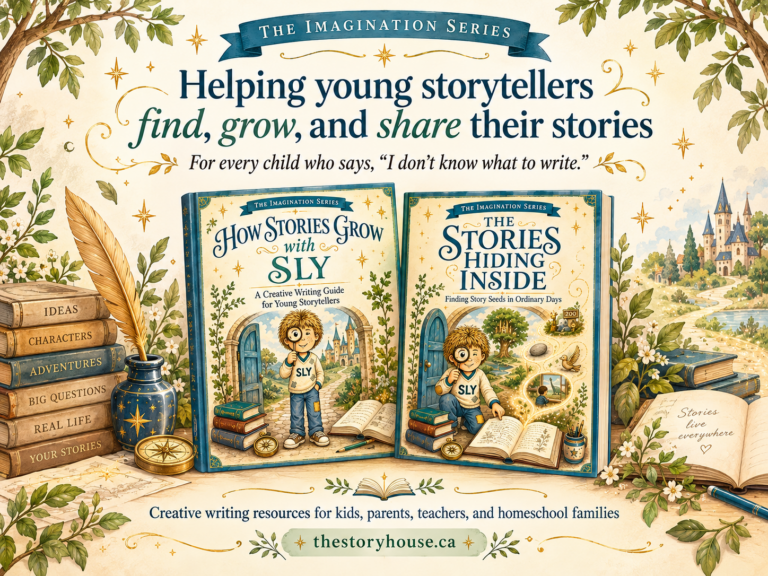
The updated series currently includes two books.
How Stories Grow with Sly
How Stories Grow with Sly helps children explore story beginnings, characters, settings and possibilities through guided prompts, drawing and writing activities.
It offers starting points for young storytellers and support for the adults helping them.
The Stories Hiding Inside
The Stories Hiding Inside invites children to notice story seeds in ordinary experiences: memories, family moments, questions, feelings and things they see around them.
It encourages a closer look at everyday life and the possibilities imagination can add.
You can explore both books through The Imagination Series
For an introduction to the character who accompanies children through the series, read Meet Sly: Helping Children Grow Stories With Imagination.
Who Can Use Storybuilding With Imagination?
Storybuilding activities can be adapted for children who already enjoy inventing stories and those who need more help beginning.
Parents and grandparents can use a question during a quiet afternoon. Teachers can introduce a shared starting point and let children develop different responses. Homeschool families can combine conversation, drawing and writing across several sessions.
An enthusiastic writer may develop a whole adventure. Another child may finish with a drawing and a few sentences. The activity can grow with the child’s interests and the support they need.
Shared reading offers another source of ideas. Talking about a character’s choices or wondering what might happen after a book ends can lead naturally into creating something new.
You may also enjoy How to Help Children Fall in Love With Reading.
Frequently Asked Questions
What is storybuilding with imagination?
Storybuilding with imagination is a way to develop story ideas through questions, drawing, conversation and writing. Children explore characters, settings and events as they work towards a story.
Is Storybuilding with Imagination an older resource?
Yes. Storybuilding with Imagination was the name of my original story-writing resource, created around 1995. The Imagination Series with Sly is its revised and updated form.
Do children need to write independently to begin?
No. They can draw, talk through ideas or dictate words to an adult. The amount of writing can be adapted to their current skills.
How can I help without taking over the story?
Ask open questions, allow time for answers and let the child make the main creative choices. Offer practical help with recording or organizing ideas when needed.
Are these activities useful for confident writers too?
Yes. Children who enjoy writing can use a prompt to explore a new character, try a different setting or develop a longer story. They can take the starting idea further in their own way.
Final Thoughts
Storybuilding with imagination gives children time to explore an idea and discover what they might do with it.
That was the heart of my original resource around 1995, and it remains the heart of The Imagination Series with Sly today.
A story can begin with something small enough to hold in a conversation: a character, a question, a place or an unexpected discovery. With encouragement and a little room to explore, that beginning can become something the child is pleased to share.
Let’s see where your imagination takes us.
Debbie Blower 💛
Author/Illustrator
Founder of The Story House
Stories that inspire. Words that heal.