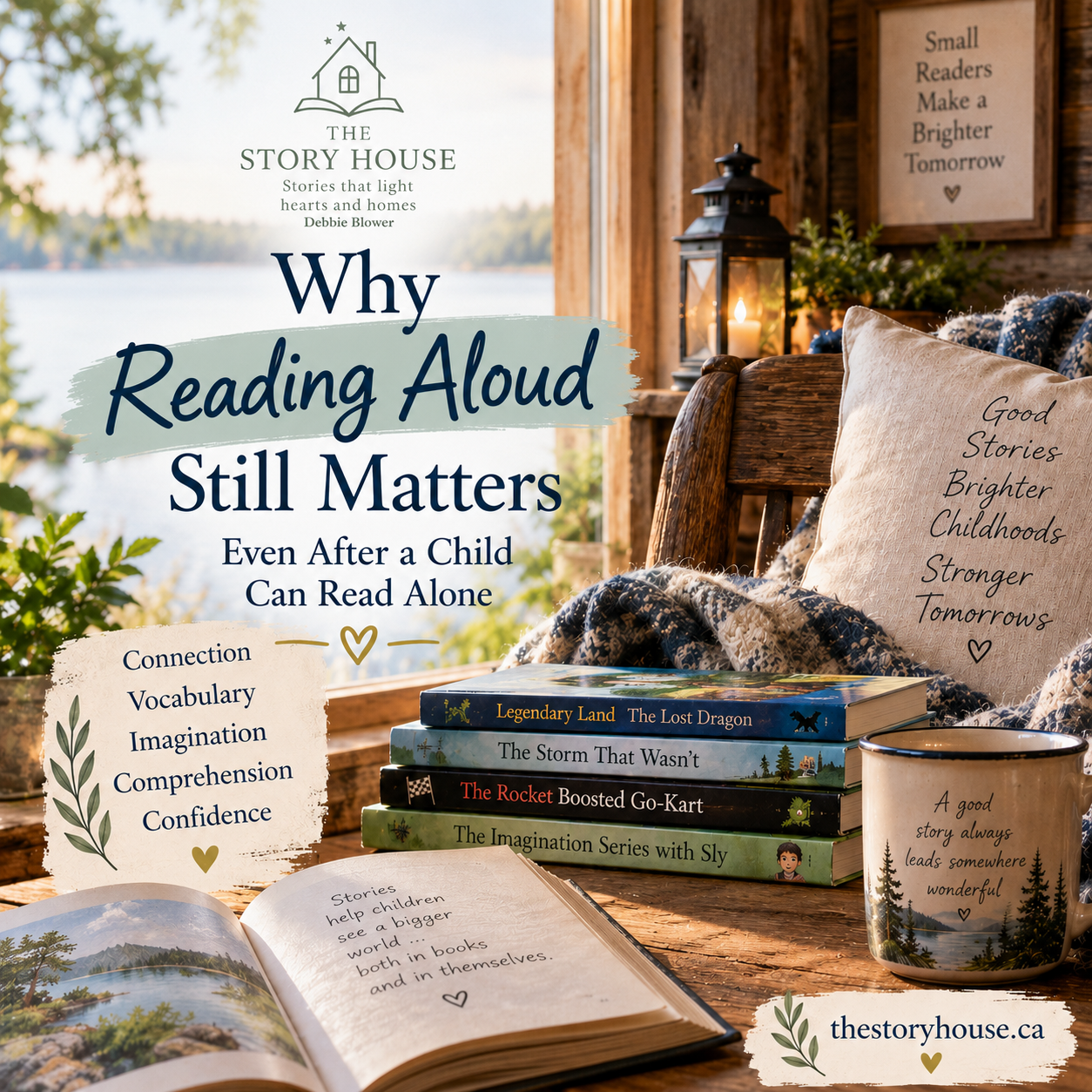
Why Reading Aloud Still Matters — Even After a Child Can Read Alone.
Reading aloud to older children still matters, even after they can read confidently and independently.
Does reading aloud still matter after a child can read alone?
Why Reading Aloud to Older Children Still Matters
Reading aloud still matters even after a child can read independently because it builds connection, strengthens vocabulary, supports comprehension, sparks imagination, and reminds children that stories are not only about reading skill — they are also about shared moments.
Sometimes we think that once a child learns to read on their own, reading aloud is no longer needed.
But children do not outgrow being read to the moment they can read independently.
They may be able to read the words.
They may be able to follow the story.
They may even enjoy reading alone.
But that does not mean they no longer need the comfort, connection, conversation, and imagination that can grow when someone reads with them.
Reading aloud is not only for toddlers or early readers.
It can still matter deeply for older children too.
Reading Aloud Builds Connection
One of the most important reasons to keep reading aloud is connection.
A book gives a child and adult something to share.
A story can create a quiet moment in a busy day.
It can become part of a bedtime routine, an afternoon pause, a homeschool lesson, a classroom moment, or a grandparent visit.
When you read aloud to a child, you are not only sharing words.
You are sharing time.
You are saying:
I am here.
This moment matters.
This story is something we can enjoy together.
That kind of connection can stay with a child long after the book is closed.
Many adults still remember being read to when they were young — not only because of the story, but because of the feeling attached to it.
The voice.
The closeness.
The laughter.
The pause before turning the page.
The comfort of knowing someone was there.
Reading aloud can become one of those small moments that quietly shapes a child’s memory of books, family, and belonging.
Children Can Understand More Than They Can Read Alone
One of the beautiful things about reading aloud is that children can often understand stories that are above their independent reading level.
A child may not be ready to read every word in a longer book alone, but they may still be ready to enjoy the story when someone reads it to them.
That matters.
Reading aloud allows children to hear richer language, deeper stories, more complex ideas, and new vocabulary without the pressure of decoding every word by themselves.
This can be especially helpful for children who are still building reading confidence.
They can enjoy the story without feeling stuck on the mechanics of reading.
They can listen, imagine, ask questions, and understand more than they may be able to manage alone on the page.
That is not “doing the work for them.”
It is supporting them as readers.
Reading Aloud Helps Build Vocabulary
Children learn words through hearing them, seeing them, using them, and understanding them in context.
When we read aloud, children hear language they may not come across in everyday conversation.
They hear descriptive words.
They hear emotion words.
They hear action words.
They hear dialogue.
They hear the rhythm of sentences.
They hear how language can create suspense, humour, beauty, mystery, or comfort.
A child may not stop and ask about every unfamiliar word, but those words are still being heard.
Little by little, reading aloud can help expand vocabulary and understanding.
Sometimes a child learns a word because it appears in a story they care about.
The story gives the word a place to live.
That makes it easier to remember.
Link to Related Post: From Pictures to Chapter Books
This connects beautifully with helping children grow into reading without pressure, especially when visual support, read-aloud time, and Bridge Books are part of the journey.
Read more:
How Bridge Books Support Young Readers
Reading Aloud Supports Comprehension
Reading is not only about saying the words correctly.
Children also need to understand what the words mean.
They need to follow the story.
They need to notice what is happening.
They need to understand why a character made a choice.
They need to connect one event to another.
They need to hear tone, feeling, humour, and meaning.
Reading aloud gives adults a natural way to support comprehension through conversation.
You can pause and ask:
What do you think will happen next?
Why do you think the character did that?
How do you think they feel?
What would you do?
Did anything surprise you?
These questions do not need to turn the story into a test.
They can simply become part of the conversation.
That is one of the best things about reading aloud.
It lets children think with someone beside them.
Reading Aloud Helps Children Who Struggle With Reading
This topic matters to me personally because my own children struggled with reading.
I know how hard it can be when a child wants to understand a story, but the reading itself feels difficult.
As a parent, you want to help without adding more pressure.
You want your child to feel capable, not discouraged.
You want them to enjoy books, not feel defeated by them.
Reading aloud helped create a gentler way in.
It allowed the story to stay enjoyable.
It gave room for discussion.
It helped with understanding, vocabulary, and confidence.
It reminded me that a child who struggles with reading is not a child without imagination.
They may have wonderful ideas.
They may understand stories deeply.
They may simply need support while their reading skills continue to grow.
That is one of the reasons I believe so strongly in stories that welcome children in different ways.
Some children need to hear the story first.
Some need pictures.
Some need shorter sections.
Some need to take turns reading.
Some need to talk through what they have read.
Some need to be reminded that reading is not a race.
Reading Aloud Keeps Imagination Alive
When a child hears a story read aloud, something wonderful happens.
They begin to picture it.
They imagine the setting.
They hear the character’s voice.
They feel the suspense.
They laugh at the funny parts.
They wonder what might happen next.
Reading aloud gives imagination room to stretch.
It invites children to step inside the story without worrying about whether they are reading fast enough or perfectly enough.
That can be especially powerful for children who are creative but unsure as readers.
A read-aloud story reminds them that books are not only about performance.
They are about possibility.
They are about wonder.
They are about entering a world made of words, images, feelings, and questions.
Storybuilding With Imagination
Reading aloud and storybuilding often go together because both help children imagine, wonder, and begin to see how stories grow.
Read more:
Storybuilding With Imagination: Helping Children Create Stories
Reading Aloud Can Make Difficult Moments Gentler
Stories can also help children process feelings.
Sometimes a child hears something in a story that gives words to what they are feeling.
A character may feel afraid.
A character may be unsure.
A character may need courage.
A character may make a mistake and learn from it.
A character may face a storm, a mystery, a problem, or a change.
When an adult reads aloud, those moments can become gentle openings for conversation.
A child may not always say, “I feel worried.”
But they may say, “I think the character is scared.”
And that can be the beginning of understanding.
Reading aloud can give children a safe distance from big feelings while still helping them explore those feelings.
That is part of the quiet power of stories.
How Stories Help Children Understand Big Feelings
Stories can help children understand emotions in a safe and meaningful way.
Read more:
How Stories Help Children Understand Big Feelings
Older Children Still Benefit From Being Read To
There is something tender about reading aloud to an older child.
They may not crawl onto your lap the same way they once did.
They may be able to read by themselves.
They may even act like they are too old for certain things.
But many children still enjoy being read to when the moment feels natural and relaxed.
Older children can benefit from read-aloud time because it:
- builds connection
- introduces more complex stories
- encourages discussion
- strengthens listening skills
- supports vocabulary
- keeps reading enjoyable
- creates shared memories
- gives them a break from always having to do the reading themselves
Sometimes we stop reading aloud too soon because we think independence means they no longer need us in that part of their life.
But independence does not mean connection has to end.
A child can read alone and still enjoy being read to.
Both can be true.
Reading Together Does Not Have to Look One Way
Reading aloud does not have to be formal.
It does not have to be a perfect routine.
It does not have to happen every night.
It can be simple.
You can read one chapter together.
You can take turns reading pages.
You can read while the child draws.
You can listen to an audiobook together and talk about it afterward.
You can read a funny section out loud.
You can reread a favourite scene.
You can let the child read the dialogue while you read the narration.
You can pause and talk about the pictures, the clues, the characters, or the feelings.
The goal is not to make reading aloud another task.
The goal is to keep books connected to warmth, curiosity, and relationship.
My Experience With School Reading Programs
My belief in reading aloud also comes from time spent as a parent volunteer in school reading programs.
I saw how different each child’s reading journey could be.
Some children needed help with phonics.
Some needed support with reading comprehension.
Some needed help building vocabulary.
Some needed encouragement to keep going.
Some needed more time to sound things out.
Some needed to talk through what they were reading so the story made sense.
Those experiences reminded me that literacy grows in many ways.
Reading aloud is one of those supports.
It can help children hear fluent reading.
It can help them understand the meaning behind the words.
It can help them connect language to story.
It can help them feel less alone in the process.
And sometimes, it can help them enjoy a book before they feel fully confident reading it on their own.
Reading Aloud Can Lead to Better Conversations
One of the gifts of reading aloud is what happens around the story.
A book can lead to conversations that might not happen otherwise.
A child may ask a question.
They may share an opinion.
They may say they like or dislike a character.
They may connect the story to something in their own life.
They may imagine a different ending.
They may ask what a word means.
Those conversations matter.
They help children think.
They help adults understand what the child is noticing.
They make reading feel active instead of passive.
And they remind children that their thoughts about a story are valuable.
That can build confidence too.
The Power of Storytelling in Child Development
Storytelling supports imagination, emotional understanding, language, empathy, and confidence.
Read more:
The Power of Storytelling in Child Development
Read-Aloud Time Can Support Reluctant Readers
For reluctant readers, reading aloud can remove some of the pressure.
A reluctant reader may avoid books because reading feels hard, slow, embarrassing, boring, or frustrating.
But when someone reads aloud, the child can experience the story without carrying the whole reading load.
They can laugh.
They can wonder.
They can ask questions.
They can enjoy the action.
They can begin to associate books with something positive again.
That matters.
Sometimes the first step toward reading independently is simply remembering that stories can be enjoyable.
Reading aloud can help with that.
It can rebuild the bridge between the child and the book.
Why Adventure Books Are Great for Reluctant Readers
Adventure books can help reluctant readers stay engaged through action, curiosity, humour, imagination, and discovery.
Read more:
Why Adventure Books Are Great for Reluctant Readers
How The Story House Books Can Be Used for Reading Aloud
Many Story House children’s books can be enjoyed as read-alouds, even when children are also beginning to read independently.
The Storm That Wasn’t can be read aloud as a gentle Bridge Book with emotion, imagination, and meaningful moments for discussion.
Turbo Minds: The Rocket Boosted Go-Kart can work well for children who enjoy humour, movement, invention, and fast-paced “what if?” moments.
Legendary Land: The Lost Dragon gives families and readers clues, hidden worlds, dragons, friendship, and adventure to talk about together.
The first two books in The Imagination Series with Sly can also support reading, writing, and storybuilding because they invite children to explore ideas and imagine stories of their own.
Each book gives children a different doorway into reading.
Some through adventure.
Some through emotion.
Some through imagination.
Some through storybuilding.
And all of them can create moments of connection.
A Gentle Read-Aloud Idea
Choose a book your child might not read fully alone yet, but would enjoy hearing.
Read a small section together.
Then ask one simple question:
What did you notice?
That question is gentle.
It does not feel like a quiz.
It lets the child share what stood out to them.
They may talk about a character, a picture, a word, a funny moment, a clue, or a feeling.
From there, the conversation can grow naturally.
Sometimes one small question is enough.
Final Thoughts
Reading aloud still matters.
Even after a child can read alone.
Even after they move beyond picture books.
Even after they begin choosing books for themselves.
Because reading aloud is not only about teaching children how to read.
It is about connection.
It is about vocabulary.
It is about imagination.
It is about comprehension.
It is about shared stories and meaningful moments.
It is about helping children remember that books can feel welcoming, not overwhelming.
Children do not outgrow the need for connection the moment they gain independence.
And they do not outgrow the comfort of hearing a story shared with care.
Sometimes the best thing we can do is simply sit beside them, open a book, and read.
Debbie 💛
Canadian Author/Illustrator
Founder of The Story House
Explore Children’s Books From The Story House
If you are looking for children’s books that encourage imagination, adventure, creativity, emotion, and reading confidence, you can explore The Story House children’s books here:
👉 Explore Children’s Books from The Story House