How Stories Help Children Understand Big Feelings
Why do stories help children understand emotions so well?
Stories help children understand big feelings by giving them a safe place to recognize emotions, see how someone else responds to them, and find words for feelings they may not yet know how to explain.
Fear. Worry. Excitement. Loneliness. Frustration. Courage. Belonging.
Those feelings can be very real for a child, even when they cannot tell us exactly what is happening inside.
Sometimes asking, “What’s wrong?” brings only a shrug.
But put a character in a story who is nervous about something new, afraid of a storm, worried about making a mistake or wondering whether they belong, and suddenly the conversation can feel easier.
The feeling belongs to the character first.
The child gets to explore it from a little distance.
And sometimes that is exactly what they need.
Stories Can Help Children Feel Less Alone
One of the gentlest things a story can say to a child is:
Someone else has felt this too.
A character may be frightened and still find courage. They may make a mistake and discover that the world does not fall apart. They may feel left out, worried or unsure and eventually find comfort, friendship or another way forward.
A child does not need to have lived the exact same experience to recognize the emotion.
That recognition matters.
The American Academy of Pediatrics has highlighted the wider social-emotional value of shared reading, including the way books and conversations around them can strengthen nurturing relationships and support children’s social understanding and emotional development. American Academy of Pediatrics
That does not mean a book fixes every difficult feeling.
It means a book can give us a place to begin.
Sometimes It Is Easier to Talk About the Character
I saw pieces of this years ago through The Muse Program, long before The Story House existed.
When children were invited into an imaginary situation through story, art, questions or visualization, they often found ways to express things that were harder to approach directly.
Children will sometimes tell us much more when we ask:
“Why do you think she feels that way?”
rather than:
“Do you feel that way?”
We might ask what the character is worried about, what could help them, what they might do next or who they could talk to.
There is no pressure for the child to make the conversation personal.
But if they want to, the doorway is open.
That is one of the gifts stories give us.
Imagination Gives Feelings Somewhere to Go
Children naturally use imagination to make sense of their world.
A thunderstorm can sound enormous.
A dark bedroom can become mysterious.
The first day somewhere new can feel much bigger in anticipation than it does once the child gets there.
Stories let children explore those feelings without having to experience every situation themselves.
They can wonder:
What would I do?
What might happen next?
Who could help?
Was the character’s fear as big as the thing they were afraid of?
What made them feel safer?
Imagination does not dismiss a child’s emotion.
It gives the emotion room to move.
Reading Rockets also recommends children’s books as a way of helping children build awareness of emotions, empathy, perspective-taking and other social-emotional skills. Reading Rockets
That is one reason stories can be such a natural companion to conversation.
Gentle Stories Can Help Build Courage
Not every story about feelings needs to be heavy.
Sometimes the quietest stories can do beautiful work.
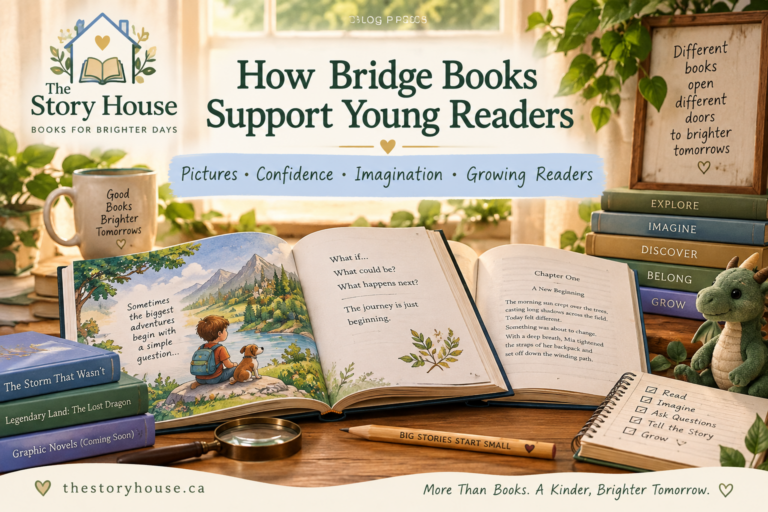
This is part of what I wanted to explore in The Storm That Wasn’t.
A child’s fear can feel very large in the moment. Telling them simply, “There’s nothing to be afraid of,” does not necessarily make the feeling disappear.
A story gives us another option.
We can allow a character to wonder.
To investigate.
To misunderstand something.
To ask questions.
And eventually to discover that what seemed frightening may not have been quite what they imagined.
The child gets to come along for the discovery without being told what they should feel.
That difference matters.
Stories Give Children Words for Feelings
Children are still developing the vocabulary they need to describe what is happening inside them.
They may know they feel “bad” without knowing whether the feeling is disappointment, embarrassment, worry, anger or loneliness.
Stories expose children to those emotional words in context.
Instead of simply defining nervous, a story can show a character with a fluttery stomach before walking into a new classroom.
Instead of defining disappointed, it can show someone who expected one thing and had something completely different happen.
The word and the experience begin to connect.
The American Academy of Pediatrics’ updated literacy guidance notes that shared reading can support children’s vocabulary around emotions and mental states as well as broader social-emotional development. American Academy of Pediatrics
And once children have more words, they have more ways to tell us what they need.
The Conversation After the Story Matters Too
We do not have to turn every story into a lesson.
Sometimes reading together and enjoying the book is enough.
But when a child pauses, asks a question or reacts strongly to something a character does, that can be a lovely opening.
Instead of explaining the story immediately, we can wonder with them.
“What do you think he was feeling there?”
“Why do you think she did that?”
“What would have helped?”
“What would you have done?”
“Do you think he’ll feel differently tomorrow?”
There does not have to be one correct answer.
The conversation itself encourages a child to think about feelings, motivations, choices and different points of view.
And sometimes, in the middle of talking about the character, a child quietly says:
“That happened to me once.”
Now the story has become a bridge.
Stories Can Help Children See Another Point of View
Emotional understanding is not only about recognizing our own feelings.
It is also about beginning to understand someone else’s.
A character may make a choice the child would not make.
Someone in the story might misunderstand.
Two friends may see the same situation differently.
That gives children an opportunity to wonder why.
Why was one character angry?
Why did the other character walk away?
Could both of them have been hurt?
What might each person have needed?
Stories allow children to practise looking beyond their own perspective without turning the moment into a lecture.
That is part of how empathy grows.
Stories Are a Doorway, Not a Test
One thing I would never want a child to feel is that every book about emotions is secretly a test.
We do not need to finish the story and immediately ask twenty questions.
We do not have to make a child reveal something personal.
And we certainly do not have to correct every interpretation.
Sometimes we simply read.
We cuddle.
We laugh.
We wonder together.
A child may come back to the conversation later.
That gentle space matters too.
Stories work best when children feel free to enter them, rather than feeling they are being examined through them.
The Stories Children Carry With Them
Most of us probably have at least one childhood story we still remember.
We may not remember every page.
We may not even remember the complete plot.
But we remember how it made us feel.
Safe.
Brave.
Curious.
Understood.
Hopeful.
Perhaps we remember the person who read it to us just as clearly as we remember the story itself.
That is another part of shared reading that matters.
A book is not only words and pictures.
It can become part of a memory between a child and someone they love.
Big Feelings Can Become Story Ideas
Sometimes a child can explore a feeling by creating a story of their own.
This is where imagination and emotional understanding come together beautifully.
Instead of asking a child to explain everything about their own emotion, we might ask:
“What if we made up a character who felt this way?”
Who are they?
What happened?
What does the feeling look like?
What does the character wish would happen next?
Who might help?
The story can be silly, magical, adventurous or completely ordinary.
The goal is not to analyse the child.
The goal is simply to give imagination somewhere to begin.
A Free Big Feelings Story Prompt Page
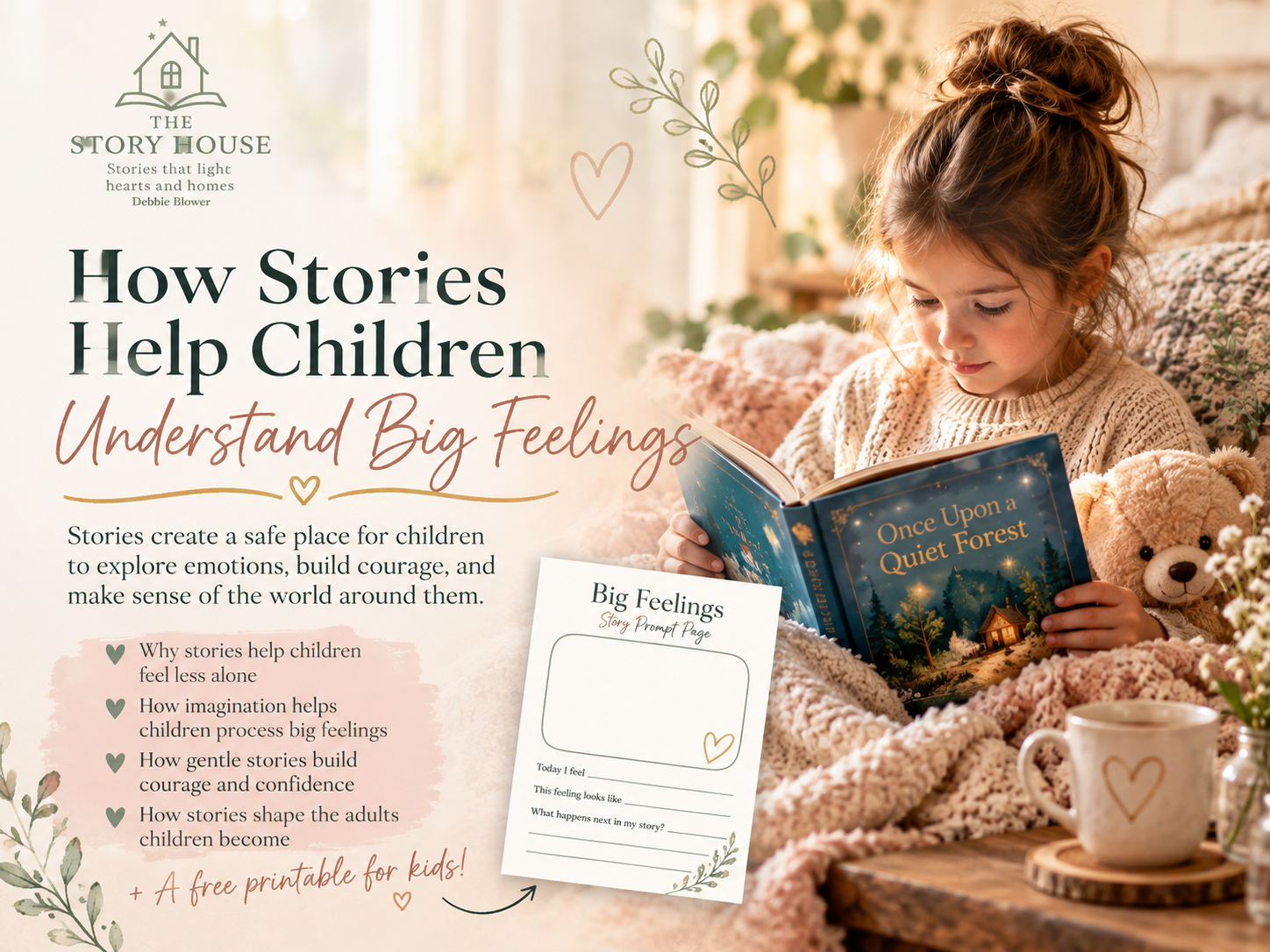
I created a Big Feelings Story Prompt Page for exactly this kind of moment.
It gives children space to draw and write about a feeling through story, with gentle prompts such as what they feel, what that feeling looks like and what might happen next.
There is no right story to create.
A child can draw.
Write a sentence.
Invent a character.
Or simply talk about the picture they imagine.
Download the Big Feelings Story Prompt Page
Sometimes the easiest way to talk about a big feeling is to let a story carry it first.
From The Muse Program to The Story House
Looking back, I can see how much of what I learned through The Muse Program still lives inside The Story House today.
Children often have far more imagination than they realize.
Sometimes they just need the right doorway.
A picture.
A question.
A sound.
A feeling.
A character wondering what to do next.
Once the pressure of the blank page disappeared, ideas often began to grow.
That same belief runs through my Imagination & Story Growing Resources today — helping children notice that stories can begin with the ordinary things already around and inside them.
And feelings are part of those stories too.
A Gentle Reflection for Parents and Grandparents
The next time you read with a child, notice what catches their attention.
Which character do they talk about?
What part makes them laugh?
What worries them?
Where do they pause?
What do they want you to read again?
You may discover that the story they choose to talk about is telling you something.
Not always.
But sometimes.
And when it does, you do not necessarily need the perfect answer.
Often the most valuable response is simply:
“Tell me more.”
Frequently Asked Questions About Stories and Big Feelings
How can stories help children understand emotions?
Stories give children examples of feelings within situations they can observe safely. They can see how characters react, learn words for emotions and talk about what might help without needing to begin by discussing their own experience.
What kinds of books are best for talking about feelings?
Look for age-appropriate stories with relatable emotions and characters whose feelings are shown naturally through the story. Books do not necessarily need to be specifically labelled as “emotion books” to create meaningful conversations.
Should I ask questions while reading?
Yes, but keep them natural. Wondering what a character feels or what might happen next can encourage conversation. There is no need to interrupt every page or turn reading time into a lesson.
What if my child does not want to talk about the story?
That is okay. Enjoy the book together. Children sometimes need time before they connect a story to their own feelings, and they may return to it later.
Can children write stories about their own feelings?
Absolutely. Drawing or inventing a character who experiences a similar feeling can give children another way to explore emotions through imagination. The Big Feelings Story Prompt Page can help them begin.
Final Thoughts
Stories help children understand big feelings because they give emotions somewhere safe to be seen, named and explored.
They can help a child recognize that someone else has felt afraid.
That courage does not mean never being nervous.
That mistakes can be repaired.
That difficult moments can change.
That there are different ways of seeing the same situation.
And perhaps most importantly, stories can open conversations between children and the adults who love them.
Sometimes a child needs advice.
Sometimes they need reassurance.
Sometimes they need an answer.
And sometimes they simply need someone beside them, turning the page.
Debbie Blower 💛
Author/Illustrator
Founder of The Story House