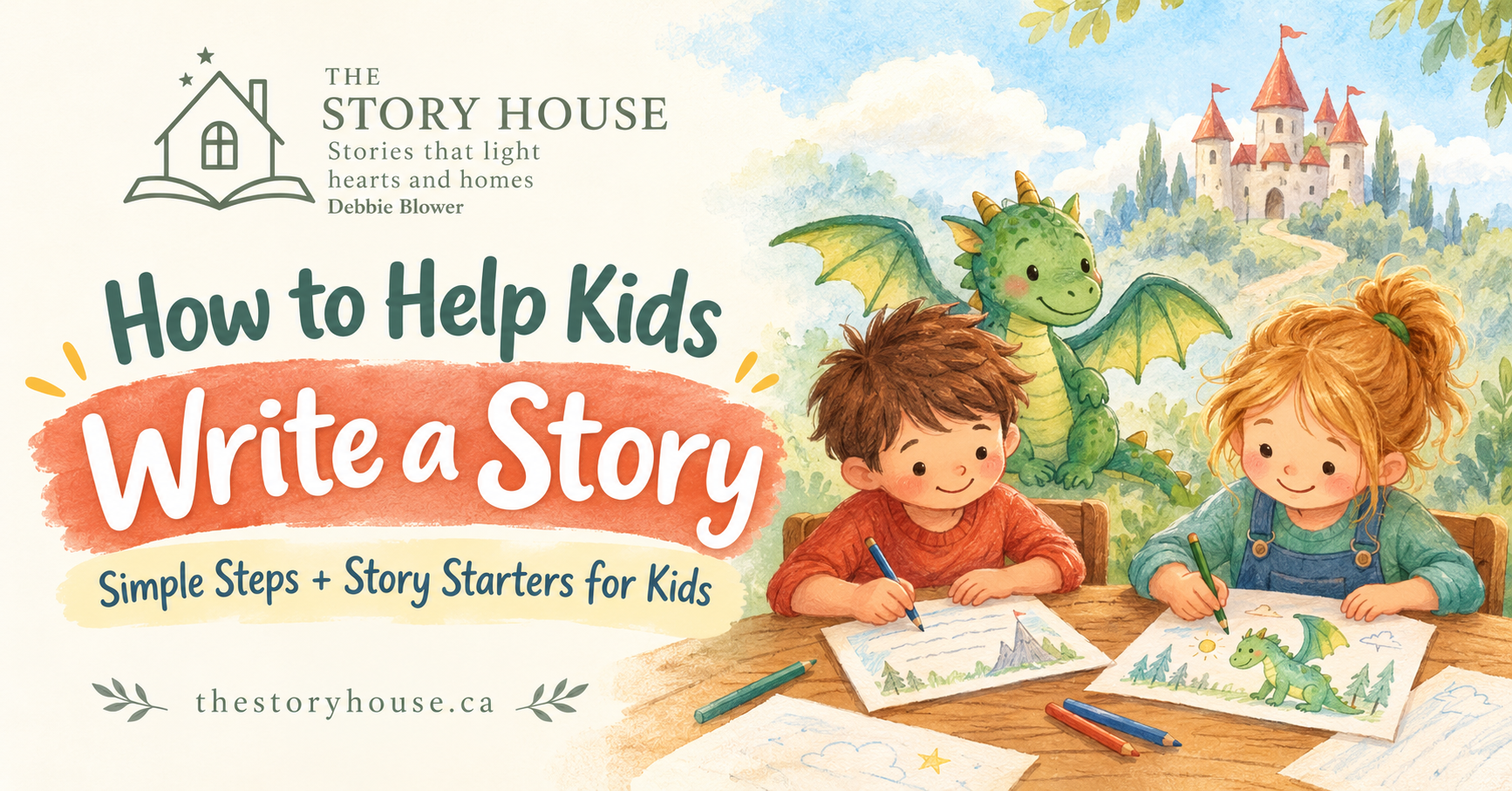
How to Help Kids Write a Story
Simple Steps + Story Starters for Kids
How to Help Kids Write a Story: Start With One Idea
Help a child choose a character, imagine a setting, decide what the character wants, and introduce a problem. Then explore what the character tries and how the story ends. Let the child talk, draw, or act out ideas before writing, and offer support without taking over.
Have you ever listened to a child describe an imaginary adventure and wished you could capture it?
Perhaps there was a dragon behind the garden shed, a mysterious island beneath the kitchen table, or a toy animal with an important mission.
Sometimes children have plenty of ideas but need help organizing them. Other times, they need a spark before anything comes to mind.
A few gentle questions can help. The aim is to give the child enough structure to move forward while leaving the story in their hands.
How to Help Kids Write a Story: Start With One Idea
Begin by asking what the child would enjoy creating.
They might choose an animal, a favourite place, something funny, or a question that makes them curious.
If they seem unsure, offer two or three possibilities. Too many choices can make beginning harder.
You could ask:
Would you rather write about a tiny dragon, a talking bicycle, or a mysterious parcel?
Let them change your suggestions. A talking bicycle might become a scooter that only speaks in riddles. That change is already part of creating.
Once an idea catches their attention, explore the following steps at their pace.
1. Choose a Character
Ask: Who is your story about?
Start with a name and one interesting detail. Your character could be a child, an animal, a magical creature, or an ordinary object with an unexpected personality.
For our example, let’s choose Pip, a tiny dragon who delivers letters.
You do not need a complete character history. Details can appear as the story develops.
Try asking what the character enjoys, worries about, or carries in a pocket.
2. Imagine the Setting
Ask: Where does the story happen?
A setting gives the character somewhere to act.
It might be a familiar neighbourhood, a woodland village, a campsite, or a world the child invents.
Pip’s story could begin beside a narrow bridge in a forest.
Invite one or two details: What can Pip hear? Is the bridge slippery? Does something move beneath it?
A quick sketch may help the child picture the place before describing it.
3. Decide What the Character Wants
Ask: What is your character trying to do?
A clear goal gives the story direction.
The character might want to find something, reach a place, solve a mystery, or help someone.
Pip wants to deliver a letter before the woodland party begins.
Now the child has a reason for Pip to leave home and something for the reader to follow.
4. Introduce a Problem
Ask: What makes that difficult?
The problem does not need to be frightening or dramatic. It could be a missing object, a misunderstanding, an unexpected visitor, or a plan that goes wrong.
As Pip crosses the bridge, a gust of wind blows the letter into the stream.
The problem connects with what Pip wants. That makes it easier to explore what might happen next.
5. Explore What the Character Tries
Ask: What does the character do—and what happens because of it?
Let the child suggest a response before offering your own.
Pip might reach with a twig, call for help, or try to fly after the letter. Perhaps the first attempt does not work.
Instead of adding unrelated events, help the child notice the connection between actions and consequences:
The twig is too short. What could Pip try now?
For a first story, one or two attempts may be enough.
6. Find an Ending
Ask: How does this part of the adventure finish?
Perhaps a duck retrieves the letter and carries it across the stream. Pip delivers it just in time—and discovers that the duck is invited to the party, too.
The ending responds to the problem we introduced.
You can ask how the character feels or what has changed. But the child does not have to attach a lesson to every story. A funny surprise or a satisfying solution can be enough.
See How the Pieces Fit Together
Here is our example in a simple plan:
| Story part | Pip’s adventure |
|---|---|
| Character | Pip, a tiny dragon who delivers letters |
| Setting | A forest bridge above a stream |
| Goal | Deliver a letter before a party begins |
| Problem | The wind blows the letter into the water |
| Attempts | Pip reaches with a twig, then asks a duck for help |
| Ending | The duck retrieves the letter, and they reach the party together |
This is a guide the child can change. They may invent a completely different ending.
Reading Rockets describes story maps as a way to organize elements such as characters, settings, problems, and solutions. Its simplest maps focus on a beginning, middle, and end.
Explore Reading Rockets’ story-map guidance. Reading Rockets
For a child who finds six steps overwhelming, try three pictures: what begins, what happens, and how it ends.
Help Them Capture the Story
Once the child has an idea, ask how they would like to record it.
They could draw scenes with captions, dictate while you write, create a comic, type, or write a few sentences independently.
If you are recording their words, read them back and ask whether they sound right. Keep the child’s expressions wherever possible.
Avoid adding so much adult detail that the child no longer recognizes the story as theirs.
You can work on one scene today and another later. Leave a note about what they wanted to happen next.
Read It Together and Choose One Improvement
When the child is ready, read the story aloud.
Begin with something specific you enjoyed:
“I could picture Pip leaning over the bridge.”
Then ask a helpful question:
“Would the reader understand why the letter matters?”
Choose one manageable revision. You might clarify an event, add a detail, or explain how the problem is solved.
Spelling and punctuation can receive attention, too. Keep the amount of feedback appropriate to the child and the purpose of the activity.
A first attempt gives you something to develop together.
Story Starters to Try
If your child needs a different beginning, offer one of these:
- One day, a tiny dragon woke up and realized it could…
- In a quiet forest, a little rabbit found…
- Every time she drew a picture, it came to life…
- A mysterious parcel arrived with a note that said…
- A child discovered a gift that could help someone else…
- An ordinary bicycle began making a very unusual sound…
Ask which idea interests them. They can change the character, combine prompts, or invent something new.
Free Printable: 50 Story Starters for Kids
For more possibilities, 50 Story Starters for Kids includes simple, imaginative, meaningful, silly, and adventurous prompts.
Choose one together, then use the storybuilding questions above to explore it.
Download “50 Story Starters for Kids” PDF here.
Turn the Story Into a Homemade Book
When a child wants to keep their work, fold paper into a booklet and add a cover.
They can choose a title, include illustrations, and place their name on the front as the author.
A younger child might create one illustrated sentence per page. Another may want several paragraphs or a comic format.
Ask whether they would like to share it. Keeping a story private can be a valid choice, too.
The book is a way to celebrate their work without requiring it to look professionally published.
Another Gentle Starting Point
If a child would welcome a guided activity, My Story Starter Adventure offers a place to choose an idea, draw, and begin building a story.
Download My Story Starter Adventure.
You can also explore children’s books and storybuilding resources from The Story House, including The Imagination Series with Sly.
These resources continue the heart behind my work: helping children discover ideas they can shape into stories of their own.
A Gentle Reflection
When a child shares an unexpected idea, pause before deciding where it should lead.
Ask what interests them about it.
You may discover that the detail you almost passed over—the tiny key, the strange noise, the dragon’s pocket—is the part they most want to explore.
Let their curiosity have room.
Final Thoughts
Learning how to help kids write a story begins with listening and a few useful questions.
Choose a character and setting. Explore what the character wants, what gets in the way, and what happens next.
Offer help with recording and organizing the ideas while leaving creative choices with the child.
A story can grow from one question—and a child who has someone willing to listen.
Debbie Blower 💛
Author/Illustrator
Founder of The Story House
Stories that inspire. Words that heal.