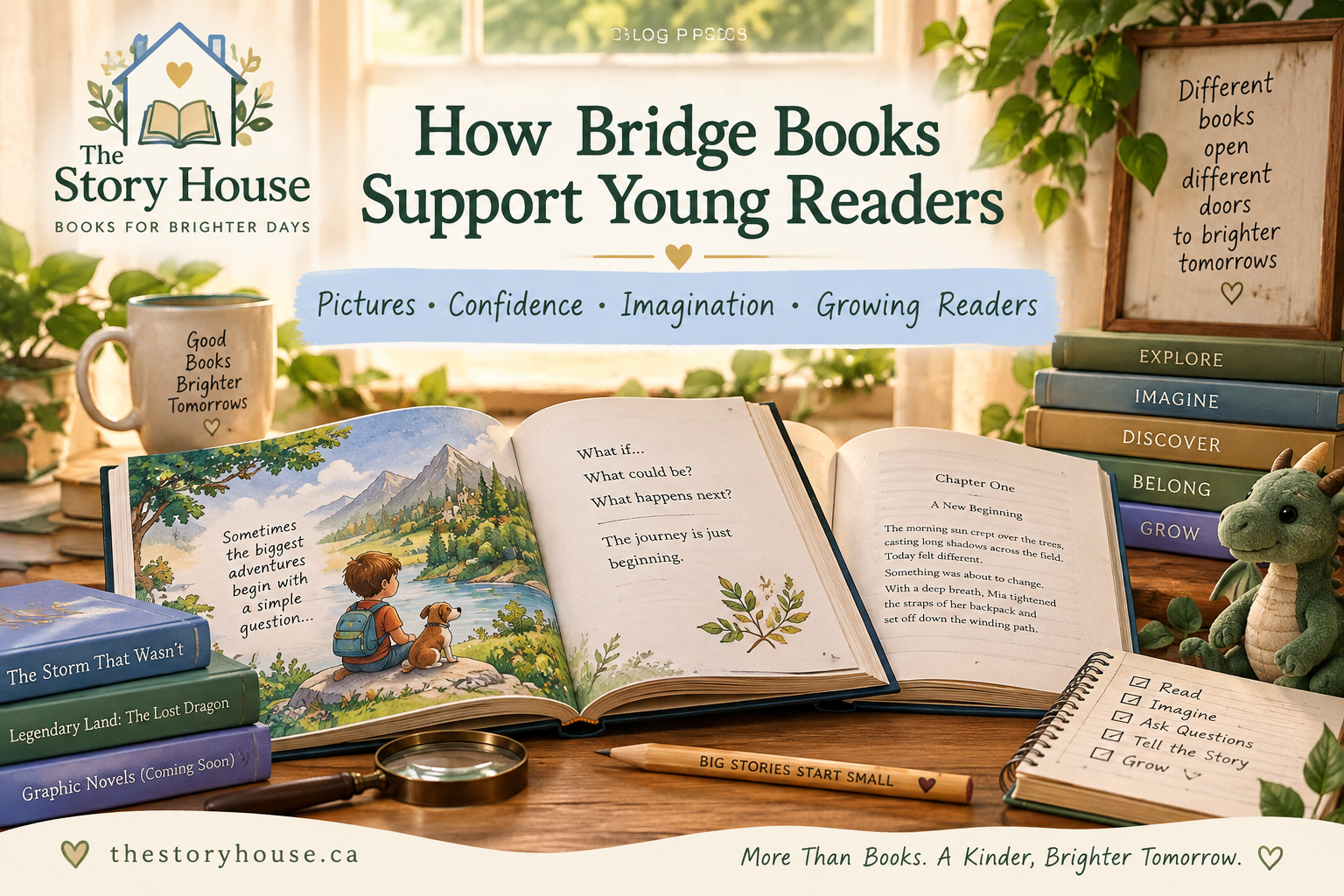
How Bridge Books Support Young Readers
When my own children were struggling with reading, one of the things that helped was not always asking them to read every word on the page.
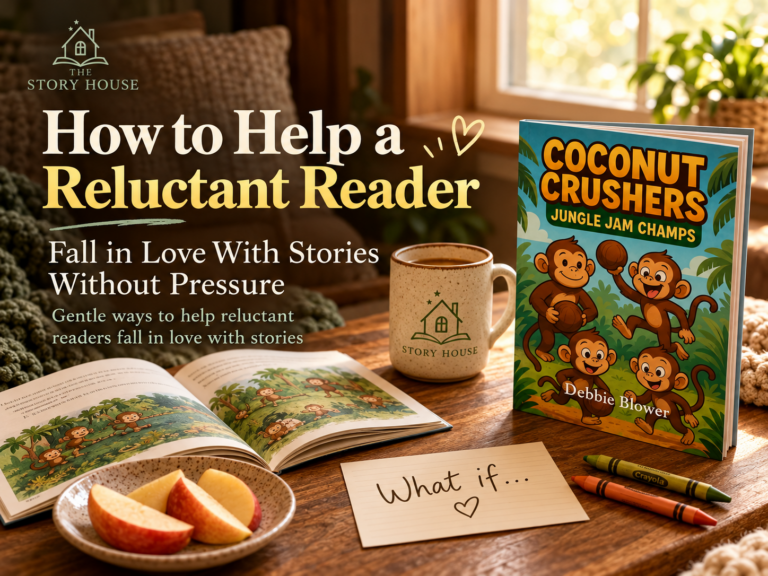
Sometimes I would let them look at the pictures and tell me what they thought was happening.
Then I would ask questions.
What do you think happened before this?
Why do you think the character looks worried?
What do you think might happen next?
What do you notice in the picture that gives you a clue?
Little by little, the story began to grow.
They were not simply looking at pictures. They were observing, thinking, making connections, using imagination, and building a story in their own words.
That experience stayed with me.
It is one of the reasons I believe so strongly in what I call Bridge Books.
Bridge Books support young readers by giving them a gentler step between picture-heavy books and longer chapter books. They can use more illustrations, shorter sections of text, lighter storylines, more white space, visual clues, and room for children to imagine or fill in parts of the story themselves.
For some children, that difference can make reading feel much less overwhelming.
A Reluctant Reader May Need a Different Format — Not an Easier Story
When a child says, “I don’t like reading,” it is easy to assume the problem is the story.
Sometimes it is.
But not always.
A child may like the idea of the story and still struggle with the way it is presented.
The page may feel too crowded.
There may be too many words before the next visual break.
The storyline may require too much concentration all at once.
There may not be enough pictures to help carry the meaning.
Or the story may explain so much that there is little left for the child to imagine.
That is something I have been thinking about much more closely through The Story House.
A reluctant reader is not one type of child with one type of problem.
Different children may need different ways into a story.
For one child, that may mean more illustrations.
For another, shorter sections.
For another, a lighter storyline.
And for another, it may mean giving them enough of the story to follow while leaving room for their imagination to do some of the work.
What Is a Bridge Book?
At The Story House, I use the term Bridge Book for stories that help children move more comfortably from one reading experience into another.
The goal is not simply to make the story shorter or easier.
The goal is to make the reading experience more approachable.
A Bridge Book might include:
- more illustrations throughout the story;
- shorter sections of text;
- more white space on the page;
- visual clues that support understanding;
- lighter or more focused storylines;
- chapters or sections that do not feel overwhelming; and
- room for the child to imagine what is not fully explained.
These choices can help children stay connected to the story while still growing as readers.
Pictures Do More Than Decorate the Page
Illustrations are not there simply to make a book pretty.
They can help children understand what is happening.
A picture may show emotion before the child has fully understood the words.
It may show where the story is taking place.
It may reveal a clue.
It may show movement, humour, tension, or something the text never says directly.
That gives the child another way to enter the story.
I saw that with my own children.
When I let them tell the story from the pictures first, I was giving them permission to begin somewhere they felt more confident.
Then I could ask pointed questions that helped them expand what they saw.
The picture became a starting place.
The story grew from there.
Leaving Room for the Child to Fill in the Blanks
I also think there can be value in not explaining absolutely everything.
Sometimes children need room to wonder.
They need to decide what they think a character might be feeling.
They need to imagine what happened just before the picture they are looking at.
They need to guess what might happen next.
They need space to bring something of themselves into the story.
That can turn reading from something they are simply receiving into something they are participating in.
And for a reluctant reader, participation can be powerful.
Instead of feeling as though they have to get through a wall of words, they are helping build meaning along the way.
Bridge Books Are Not “Lesser” Books
I think this is important to say clearly.
A book with more pictures or fewer words on a page is not automatically a lesser reading experience.
The same is true of graphic novels.
Visual storytelling still asks children to follow characters, sequence, emotion, action, dialogue, and meaning.
They are still interpreting.
They are still thinking.
They are still imagining.
They are still reading.
For some children, visual stories may even be the format that helps them discover that books can be enjoyable in the first place.
And once that confidence begins to grow, they may be more willing to try something else.
That is the bridge.
Visual storytelling can support vocabulary, reading confidence, comprehension, and story understanding, especially for children who may struggle with more traditional text-heavy books.
Bridge Books Can Build Confidence Without Pressure
One of the hardest things about helping a struggling or reluctant reader is knowing how much to push.
Too much pressure can make reading feel like a test.
Not enough encouragement can leave a child feeling stuck.
Bridge Books can help create a middle space.
The child still gets a full story.
They still encounter new ideas.
They still build reading stamina.
But they can do it in smaller, more manageable pieces.
That can help move the child from:
This is too much.
to:
Maybe I can do this.
And that small change in confidence matters.
How Bridge Books Fit at The Story House
For the current Story House books, I see The Storm That Wasn’t and Legendary Land: The Lost Dragon as Bridge Books for children roughly ages 6 to 10.
Each one approaches the reading experience differently, but both give young readers ways into the story through imagination, visual elements, emotion, adventure, and manageable sections.
The Storm That Wasn’t gives children a gentler story experience with emotion, imagination, and room for discussion.
Legendary Land: The Lost Dragon uses adventure, clues, friendship, discovery, and fantasy to keep children wondering what happens next.
I am also currently working on graphic novels beginning around age four, which will take this Bridge Book idea in another direction.
These books will use visual storytelling even more intentionally.
For younger readers, that can mean beginning with pictures, expressions, actions, and short sections of text that let the child follow the story without feeling overwhelmed by the page.
Bridge Books Can Begin Earlier Than We Think
When we talk about Bridge Books, it is easy to think only about children moving from picture books into chapter books.
But I think the bridge can begin earlier.
A four-year-old looking carefully at a picture, telling you what they think is happening, and answering questions about the characters is already learning how stories work.
They are noticing sequence.
They are interpreting emotion.
They are building vocabulary.
They are predicting.
They are making connections.
They are practising storytelling before they can necessarily read every word themselves.
That matters.
This is one of the reasons I am excited about exploring graphic novels for younger children as part of The Story House.
The bridge does not have to wait until a child is struggling.
It can begin with helping them feel at home inside stories from the very beginning.
How Parents and Grandparents Can Use Bridge Books
You do not have to turn a Bridge Book into a formal reading lesson.
Sometimes the most helpful thing is simply to read together and talk.
You might let the child look at the illustration first.
Ask:
What do you think is happening here?
Then try:
What makes you think that?
Or:
What do you think happens next?
If the child wants to tell you the whole story from the pictures before reading the words, let them.
You may be surprised by how much they notice.
You can read some of the text and let them read some.
You can talk about a character’s expression.
You can stop at the end of a section and guess what might happen next.
The goal is not to test them.
The goal is to help them feel involved.
This Connects to Reading Aloud Too
Children do not need to stop being read to just because they can read independently.
Reading aloud can give a child access to stories that may still be difficult for them to manage alone, while also supporting vocabulary, comprehension, imagination, and connection.
That is why Bridge Books and read-aloud time can work so well together.
A child might read one section independently and listen to the next.
You might take turns.
Or you might simply read the story together and talk about what you notice.
If you would like to explore that further, you may also enjoy Why Reading Aloud Still Matters — Even After a Child Can Read Alone.
What If a Child Still Does Not Want to Read?
Sometimes changing the format helps.
Sometimes it does not.
And that is okay too.
A reluctant reader may need time.
They may need a different subject.
They may need humour instead of seriousness.
They may need adventure instead of explanation.
They may need a story connected to something they already love.
Or they may need the freedom to stop reading one book and try another.
The important thing is to keep paying attention to the child.
That is something I have learned both as a parent and through my experience volunteering in school reading programs, where I helped children with reading comprehension, phonics, literacy skills, vocabulary, and confidence.
There was never one approach that worked for every child.
That is still true.
Frequently Asked Questions
What age are Bridge Books for?
At The Story House, the current Bridge Books are mainly aimed at children around ages 6 to 10. The graphic novels I am developing will begin at around age four, using more visual storytelling and shorter sections of text.
Are graphic novels good for reluctant readers?
They can be. Graphic novels combine words and pictures, which can help children follow the story, understand emotion and action, and stay engaged without facing a page filled with dense text.
Does using pictures mean a child is not really reading?
No. Pictures can support understanding, prediction, vocabulary, sequencing, and storytelling. They can give children information that works together with the words rather than replacing them.
Should I encourage my child to move away from illustrated books?
Not simply because of age. If illustrations are helping the child understand, enjoy, and stay connected to the story, they are serving an important purpose. The goal is to help children grow as readers without taking away the kind of books that are helping them succeed.
What if my child can read but still avoids books?
Look beyond reading ability alone. Consider the page layout, number of words, storyline, interests, amount of visual support, and whether the book feels manageable. Sometimes the format is part of the problem.
A Bridge Into Reading — Not a Race Through It
I do not believe the goal should be to move children past pictures as quickly as possible.
I think the goal is to help them build enough confidence, curiosity, and enjoyment that they want to keep going.
For one child, that may happen through a chapter book.
For another, through a picture-heavy story.
For another, through a graphic novel.
And for another, it may begin by looking at a picture and telling you the story they see there.
There is more than one way to grow a reader.
That is what I want Bridge Books at The Story House to honour.
If you would like to explore this approach further, you can discover The Storm That Wasn’t, Legendary Land: The Lost Dragon, and the growing collection of children’s books at The Story House. I will also be sharing more about the graphic novels I am developing for younger readers as they grow.
Children & Youth Room
The Storm That Wasn’t
Legendary Land: The Lost Dragon
Looking for Related Child and Reading Blogs?
Debbie 💛
Canadian Author/Illustrator
Founder of The Story House