How to Help a Reluctant Reader Fall in Love With Stories Without Pressure
Why a Reluctant Reader May Need a Different Doorway Into Stories
Not every child falls in love with reading in the same way.
Some children curl up with a book almost from the beginning. Others need humour, adventure, movement, pictures, questions, imagination or a little bit of “What if?” before a story begins to feel inviting.
And some children we call a reluctant reader may not dislike stories at all.
They simply have not found the doorway that feels like theirs yet.
That is why helping a reluctant reader does not always begin with saying:
“You need to read more.”
Sometimes it begins much more gently.
A funny character.
A mystery.
A book about something they already love.
A story read aloud.
A snack at the kitchen table.
A ridiculous question that makes them laugh.
A book that feels like adventure instead of homework.
At The Story House, I want stories to feel less like pressure and more like an invitation.
What Is a Reluctant Reader?
A reluctant reader is generally a child who can be hesitant to choose books or who associates reading with boredom, frustration, difficulty or pressure.
But reluctance can have many reasons behind it.
A child may simply prefer other activities.
They may not yet have discovered books connected to their interests.
The books they have been offered may feel too difficult, too easy or simply uninteresting.
Or reading itself may genuinely be hard for them.
That distinction matters.
Reading Rockets notes that motivation is closely connected to engagement, choice and a child’s confidence as a reader. When children continually encounter material that feels too difficult, reading is less likely to become rewarding. Reading Rockets
So rather than beginning with the assumption that a child doesn’t like reading, I think it is worth asking:
What might make reading feel different for this child?
Follow the Child’s Curiosity
One of the best places to begin is with what the child already loves.
Animals?
Cars?
Sports?
Dinosaurs?
Space?
Mysteries?
Jokes?
Drawing?
Building things?
Cooking?
Adventure?
Facts?
Video-game worlds?
Camp stories?
Fantasy?
A child’s existing interest can become the bridge into reading.
Reading Rockets identifies book choice and personal interest as important parts of reading motivation. Children are more likely to engage when they have some ownership over what they read. Reading Rockets
That means the book we think they should love may not be the book that opens the door.
And that is okay.
The goal is not to make every child love the same stories.
It is to help each child discover the kind of story that makes them wonder what happens next.
Start With Imagination, Not Pressure
One of the things I learned through years of working with children and storytelling is that imagination can create a very different kind of doorway.
Instead of beginning with:
“Finish this chapter.”
try:
“What do you think happens next?”
“What would you do if you were there?”
“What if the dog could talk?”
“What if the treasure map was wrong?”
“What character would you add?”
Now the child is entering the story rather than being tested on it.
That is why imagination sits at the heart of so much of what I create through The Story House’s Imagination & Story Growing Resources.
Sometimes a reluctant reader needs to discover that stories are places to play before books begin to feel like places they want to stay.
Let the Child Become Part of the Story
Reading does not have to be completely passive.
A child can:
- predict the ending,
- draw a new cover,
- invent another character,
- act out a funny scene,
- make a map,
- create a different ending,
- build the setting with blocks or toys,
- or invent a completely new “what if?” version.
Now the story belongs partly to them.
For some children, that changes everything.
They are no longer simply trying to get through words on a page.
They are participating.
That kind of engagement can be especially useful for a reluctant reader who already loves making, building, drawing or imagining.
Choose Books That Feel Like an Invitation
The right book matters enormously.
A child who is reluctant to read may need something funny, fast-moving, mysterious, visual, adventurous or connected to a subject they already enjoy.
Sometimes shorter chapters help.
Sometimes illustrations help.
Sometimes a high-interest book at an easier reading level gives a child the chance to experience success rather than frustration. Reading Rockets specifically recommends high-interest/low-reading-level books as one useful option for struggling readers. Reading Rockets
And sometimes the hook is simply fun.
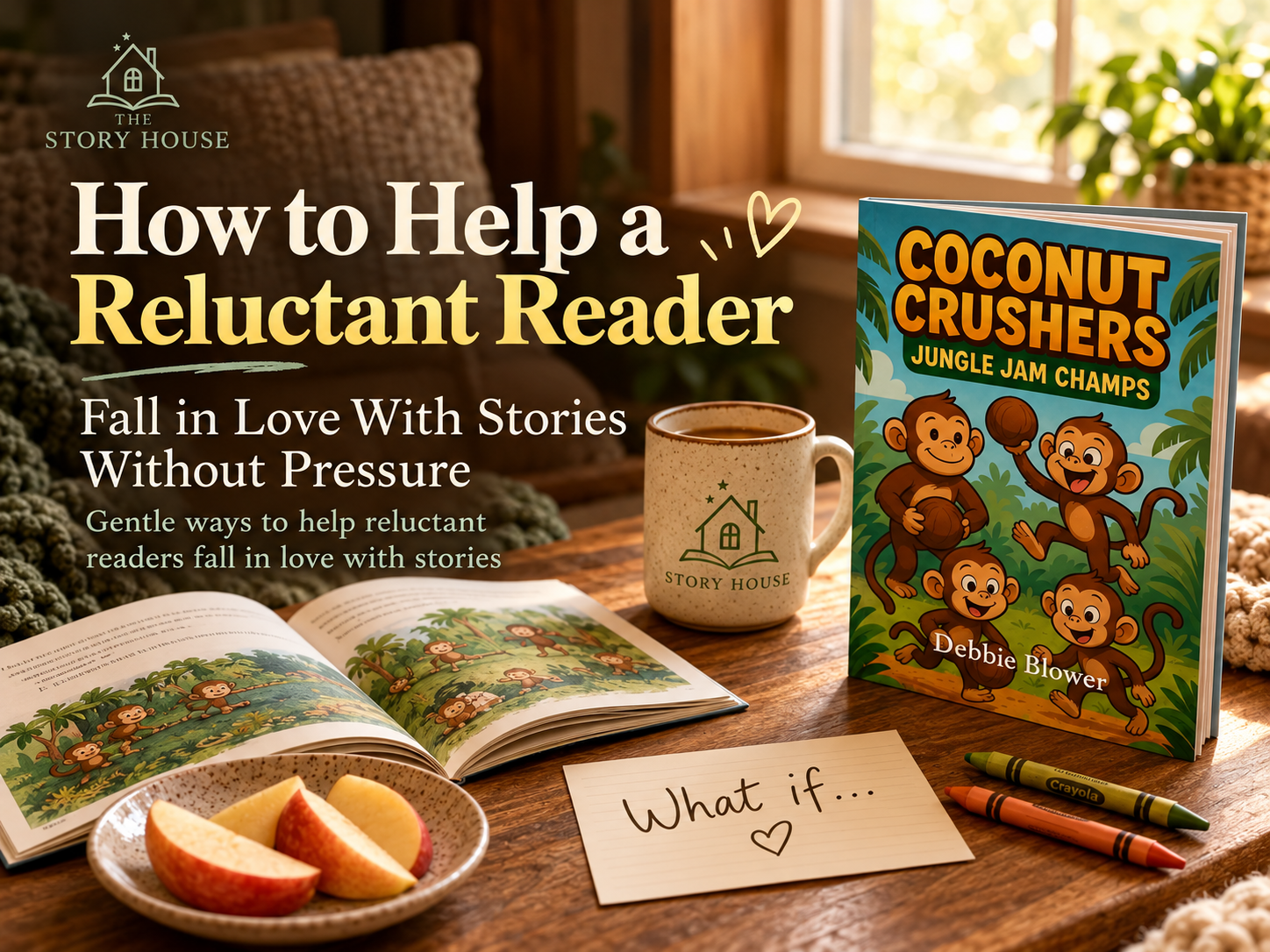
That is part of the thinking behind books such as Coconut Crushers.
Monkeys.
Competition.
Movement.
Humour.
Things happening.
A child does not have to begin by deciding that reading is educational.
They can begin by wanting to know what those monkeys are going to do next.
That is enough.
Read Aloud — Even When They Can Read for Themselves
We sometimes stop reading aloud once children can decode the words independently.
But being able to read and being able to relax into a story are not always the same thing.
Reading aloud lets a child enjoy the humour, suspense, rhythm and characters without carrying all of the reading effort at once.
They can listen.
Laugh.
Ask questions.
Imagine.
Talk about what is happening.
The American Academy of Pediatrics continues to emphasize shared reading as a valuable way to support literacy, language and the relationship between children and the adults reading with them. American Academy of Pediatrics
And reading together does not have to stop the moment a child learns to read alone.
Sometimes the shared story is what reminds a reluctant reader that books can actually be enjoyable.
Take Turns Reading
There is another option between reading the whole book aloud and asking the child to carry the entire reading load.
Share it.
You read one page.
They read one.
You take the longer paragraph.
They take the short funny one.
Or let them choose which character’s lines they want to read.
The goal is not to trick the child into reading.
It is to make the experience feel manageable.
A little success has a very different emotional weight from a long struggle.
Let Reading Begin Small
Sometimes we accidentally make reading feel enormous.
A whole chapter.
Twenty minutes.
A full book.
A reading log.
A report.
A target.
For a reluctant reader, even hearing the requirement can create resistance before the book is opened.
Try smaller.
One page.
One scene.
One funny paragraph.
One picture with a conversation around it.
One question.
One read-aloud moment before bed.
Small reading experiences can build something very important:
confidence.
Reading-motivation research points to successful experiences as one factor that can strengthen children’s belief in themselves as readers. Reading Rockets
A child who thinks “I can do this” approaches the next page very differently from a child who expects to fail.
Make Reading Feel Like Connection, Not Correction
Reading skills matter.
There is no question about that.
But if every reading moment becomes a stream of corrections, a child can quickly begin to associate books with getting things wrong.
There are times when helping with a word is necessary.
There are also times when it is worth letting the story breathe.
Instead of always asking:
“Did you read that correctly?”
try asking:
“What did you think?”
“What was your favourite part?”
“Did anything surprise you?”
“Which character would you want as a friend?”
“What should happen next?”
Those questions tell a child that their ideas matter too.
Books are not only words to decode.
They are things to think about.
Pair Reading With Something They Already Enjoy
Reading does not have to happen at a desk.
Take the book outside.
Read under a blanket.
Bring it on a road trip.
Read over breakfast.
Take turns reading while you bake something.
Set out apple slices and a favourite drink.
Make a little reading basket.
For some children, connecting a book with a comfortable ritual makes the experience feel less like another school task.
This is one reason I enjoy connecting children’s books with Kids & Storytime Snacks and From My Kitchen.
Food and stories have something in common.
Both can bring people to the table.
Use Story Seeds to Build Confidence
Some children would rather create a story than read one.
That is not a dead end.
It can be a doorway.
Give them a story seed:
What if a go-kart suddenly had rocket power?
What if a child found a map inside an old lunchbox?
What if there were glowing footprints across the backyard?
What if four monkeys entered the wildest competition in the jungle?
The child might tell the story rather than write it.
Draw it.
Act it out.
Build it.
You can write down what they say.
Then read their own words back to them.
Suddenly reading and storytelling belong to the same world.
This is part of the philosophy behind How Stories Grow with Sly — that stories can grow from one small idea, and children do not need to know the whole story before they begin.
Try Different Kinds of Reading
Books are wonderful.
But books are not the only reading children encounter.
A reluctant reader might enjoy:
a joke book,
instructions for building something,
a recipe,
a comic or graphic novel,
sports statistics,
animal facts,
a magazine,
a map,
game instructions,
a nature guide,
or a book connected to a favourite hobby.
Reading Rockets points out that motivation can grow when children see reading as useful, social and connected to their own interests. Reading Rockets
That still counts.
We are helping the child experience words as something that opens doors rather than something that closes them.
Do Not Worry If They Abandon a Book
Adults abandon books all the time.
We rarely call ourselves reluctant readers because of it.
Sometimes the book simply is not the right one.
If a child has tried a book and genuinely dislikes it, allowing them to choose another can preserve the idea that reading itself was not the failure.
The book was simply not the right match.
That said, if a child consistently struggles to read material appropriate for their age, avoids reading because it is unusually difficult, or seems to be falling behind despite support, that deserves attention beyond simply finding a more exciting book.
A teacher, literacy specialist or other qualified professional can help determine whether the issue is primarily motivation or whether the child needs additional reading instruction or support.
Pressure and support are not the same thing.
A child can need help without needing to feel ashamed.
Let Books Live Around the House
Helping a reluctant reader does not necessarily require a formal reading programme at home.
Sometimes books simply need to become visible.
Put one beside the couch.
Leave one in the car.
Keep a basket near the kitchen table.
Take a book outside.
Let children see adults reading.
Talk about something interesting you read.
Mention a character at dinner.
Ask a “what if?” question while driving.
Stories begin to feel different when they are part of ordinary life rather than something that only appears when someone says:
“It’s reading time.”
Grandparents Can Be Wonderful Reading Partners
Grandparents sometimes have a special opportunity here.
We do not necessarily have the homework deadline.
Or the reading log.
Or the classroom expectation.
We may simply have time together.
That makes room for reading to become something shared.
Let a grandchild choose the story.
Laugh at the silly parts.
Read the character voices badly on purpose.
Stop halfway and guess what happens.
Share a snack.
Tell them about a book you loved when you were young.
There does not have to be a lesson at the end.
Sometimes the memory of being read to by someone who loved them becomes part of the reason books feel safe and familiar later.
What If the Child Still Says, “I Hate Reading”?
Do not panic.
And do not argue them into loving it.
Try listening instead.
“What don’t you like about it?”
Their answer may surprise you.
Maybe the books are boring.
Maybe reading feels too hard.
Maybe they are afraid of making mistakes aloud.
Maybe someone else reads faster.
Maybe they love stories but hate worksheets.
Maybe they would rather listen to the book first.
The phrase “I hate reading” can sometimes be hiding another sentence underneath it.
Our job is to find out what that sentence might be.
Frequently Asked Questions About Reluctant Readers
What is a reluctant reader?
A reluctant reader is a child who does not readily choose reading or who may feel bored, hesitant, frustrated or disconnected from books. The reasons can vary, so it helps to understand whether the difficulty is motivation, book choice, reading skill or a combination.
How can I help a reluctant reader enjoy books?
Start with the child’s interests, allow meaningful choice, keep early reading experiences manageable, read aloud together and focus on stories and ideas rather than making every moment a performance test.
What kinds of books work well for reluctant readers?
There is no single best type. Humour, adventure, mystery, graphic novels, nonfiction, short chapters and high-interest books can all work well depending on the child. Interest matters more than choosing one particular genre. Reading Rockets
Should I force a reluctant reader to finish every book?
Not necessarily. Allowing a child to abandon an unsuitable book and choose something more engaging can preserve motivation. Required school reading is different, of course, but pleasure reading should have room for choice.
Is reading aloud helpful for older children?
Yes. Reading aloud allows children to enjoy language, ideas and stories that may be above their independent reading level, and it creates a social experience around books. Reading Rockets
What if my child finds reading genuinely difficult?
Persistent difficulty deserves support rather than more pressure. Talk with the child’s teacher or another qualified literacy professional so you can understand what type of help would be most useful.
Final Thoughts
A reluctant reader does not always need someone telling them to read more.
Sometimes they need a different doorway.
A book about something they already love.
A character who makes them laugh.
A mystery they want solved.
A story read aloud.
A few pages instead of a whole chapter.
A “what if?” question.
A quiet moment with someone beside them.
Reading does not have to begin with a battle.
It can begin with curiosity.
It can begin with imagination.
It can begin with connection.
And sometimes one story is all it takes for a child to realize that there may be another book waiting for them after this one.
Debbie Blower 💛
Author/Illustrator
Founder of The Story House
Stories that inspire. Words that heal.