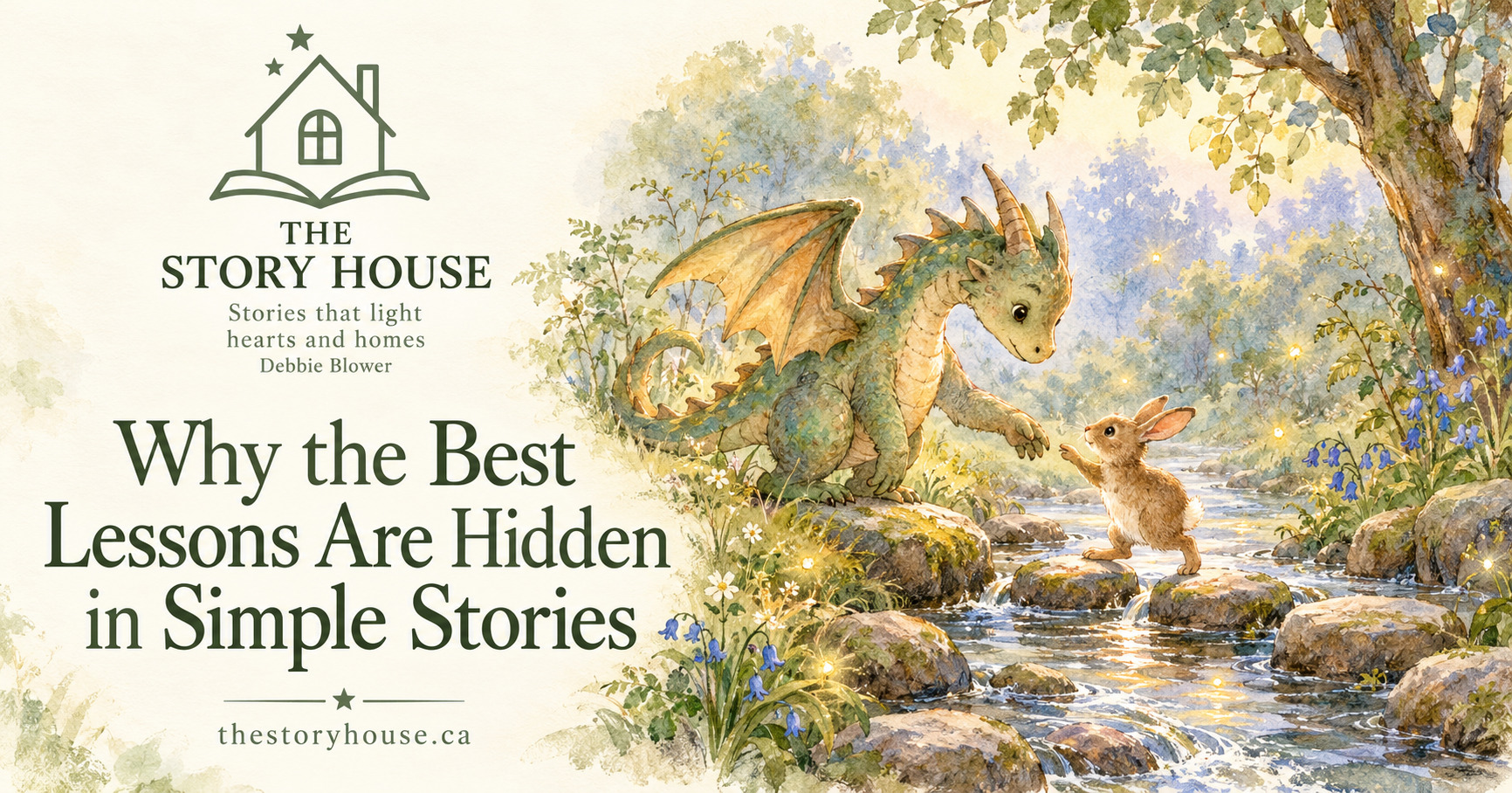
Why the Best Lessons Are Hidden in Simple Stories
How Simple Stories Make Room for Meaning
Simple stories give us a character to care about, a situation to understand, and a choice to consider. Through what happens, readers can explore kindness, courage, patience, and belonging without needing a long explanation.
Sometimes the part of a story that stays with us is surprisingly small.
Someone makes room at the table. A frightened character asks for help. A friend returns after an argument, unsure of the welcome they will receive.
The adventure may continue, but we remember that moment.
There is something familiar in it. We know what it feels like to want a place, need help, or hope for another chance. A story gives those experiences a shape we can recognise.
How Simple Stories Make Room for Meaning
A simple story can hold a thoughtful idea within a clear, manageable adventure.
Imagine a woodland creature hurrying home before dark. Along the path, it discovers someone struggling to carry a bundle of firewood.
The character has a decision to make. Stopping will take time. Continuing would be easier.
Through that small choice, the story can explore generosity, inconvenience, and responsibility. What matters is how the decision unfolds and what follows from it.
Some stories name their lesson directly, as many traditional fables do. Others leave more for readers to consider. Both approaches can offer something worthwhile when the characters and events give the message substance.
Kindness Becomes Something We Can Picture
“Be kind” is an important invitation, but it can feel broad.
A story makes it specific.
Kindness might mean waiting for someone who walks more slowly, listening before deciding who is at fault, or including a character whose ideas seem unfamiliar.
Those actions give us something to discuss. We can ask what the character noticed, what made the choice difficult, and how someone else experienced it.
The American Academy of Pediatrics’ guide to books about character and values describes books as conversation starters for exploring family values and helping children put feelings into words. HealthyChildren.org
A story offers the starting point. Listening to a child’s response helps us discover what they noticed.
Courage Can Begin With a Small Step
In stories, courage does not always need a battle or a dangerous journey.
It might appear when a character admits a mistake, tries again after disappointment, or speaks up when a friend is being excluded.
These moments leave room for uncertainty. A character can be afraid and still take a thoughtful step. They can also pause, seek help, or decide that a different approach is needed.
That gives readers more to consider than a character who always knows what to do.
Sometimes the most interesting question is:
“What helped them take the next step?”
The answer might be preparation, encouragement, or knowing they did not have to manage everything alone.
Familiar Stories Can Reveal Different Details
When we return to a favourite book, our attention may settle somewhere new.
A child might first remember the funny animal or the magical setting. Later, they may become interested in the friend who was left behind or the character who quietly offered help.
Adults can experience that change, too.
A story we once enjoyed for its adventure may eventually remind us of someone we love, a difficult decision, or a kindness we understood only years afterwards.
The words remain the same, but we bring different experiences to them.
That is one reason a short, familiar story can still be worth revisiting.
Let Children Notice Before Explaining
It can be tempting to close a book and immediately announce what it was meant to teach.
Try leaving a little room first.
Ask one question that fits the story:
- “Which part stayed with you?”
- “What do you think made that choice difficult?”
- “Was there anything you would have done differently?”
Allow an answer you had not expected.
A child may focus on a detail that seemed unimportant to you. They may feel sympathy for a character you found frustrating. That can become an interesting conversation if we stay curious.
There is also room to finish a book without discussing it. Shared reading can simply be enjoyable. A question may return later while you are walking, drawing, or getting ready for bed.
What Simple Stories Ask of the Writer
Writing a simple story still takes care.
The character needs a reason to act. The difficulty needs to matter within the world of the story. The ending needs to grow from what has happened.
If you are writing a story with a lesson in mind, begin by considering the experience:
Who wants something? What gets in their way? What choice will they face?
Then look at the consequences. If a character learns to listen, let listening change something. If they offer help, show what that help involves.
A small, believable action can give the reader plenty to think about.
The Quiet Wonder of the Forest of Fables
This connection between imagination and meaning is part of what I explore through The Forest of Fables.
Woodland creatures, magical discoveries, and moments of uncertainty offer places to consider kindness, courage, patience, and listening. The imaginative setting makes room for an adventure, while the characters’ choices give us something to reflect on afterwards.
You can explore these collections, including The Heart of the Forest, The Enchanted Forest, and Once Upon the Quiet Forest, at The Enchanted Forest Fables Series.
Choose a story that catches your interest. Read it together, enjoy its world, and see what stays with you.
A Gentle Reflection
Think of a story you have carried with you for years.
Can you remember one particular moment? Perhaps someone shared what little they had, welcomed an unlikely friend, or found the courage to begin again.
What does that moment mean to you now?
You do not need to find an impressive answer. A familiar feeling or a small memory is enough to explore.
A Thought to Carry With You
A story does not need a complicated plot to give us something meaningful.
One character, one difficulty, and one thoughtful choice can open a conversation worth having.
So if you are wondering whether your own story is too small, look closely at what happens within it. Does someone have a reason to care? Is there a moment of discovery? Does a choice change something?
Give those details your attention.
There may be more growing inside that simple story than you first realised.
Debbie Blower 💛
Author/Illustrator
Founder of The Story House
Stories that inspire. Words that heal.