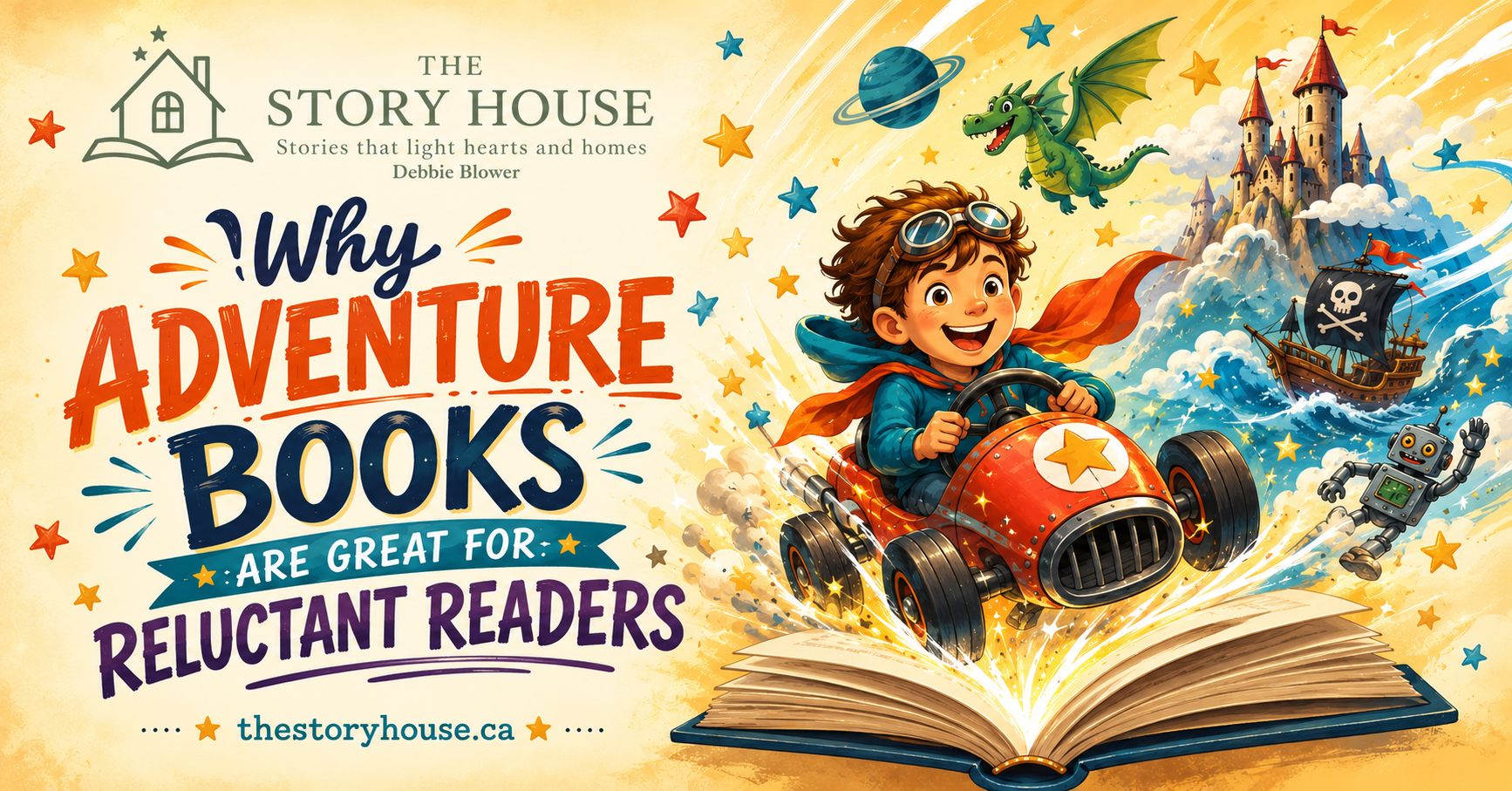
Why Adventure Books Are Great for Reluctant Readers
How Adventure Books Give Children a Reason to Keep Reading
Why are adventure books great for reluctant readers?
Adventure books can appeal to reluctant readers because they offer curiosity, action, humour and a reason to discover what happens next. When the subject interests a child and the reading demands are manageable, an adventure can make picking up a book feel more inviting.
Some children eagerly settle into a story. Others hesitate, lose interest or find reading tiring. They may enjoy listening to stories while feeling much less comfortable reading independently.
An adventure will not suit every child, but it can offer a useful starting point—especially for someone who loves mysteries, inventions, journeys or unexpected discoveries.
How Adventure Books Give Children a Reason to Keep Reading
A strange sound comes from the woods. A homemade vehicle breaks down before an important race. A character finds a map that does not quite match the place around them.
Each beginning gives the reader a question.
What caused the sound? Can the vehicle be repaired? Where does the map lead?
That unanswered question can make the next page feel worth exploring. The child is following something they want to understand.
When I write for children, I want that curiosity to grow through the story. An interesting beginning matters, but so do the characters, discoveries and choices that follow it.
Reluctance Can Have Different Causes
A child who avoids reading may not be avoiding stories.
Perhaps they have not found a subject they enjoy. Perhaps the book is too difficult, the print feels crowded or the story takes too long to get started. Some children also experience persistent difficulties with recognizing words or reading fluently.
It helps to ask what feels hard instead of assuming the child needs more encouragement.
An appealing story can support interest, but it does not remove a reading difficulty. If a child regularly struggles with the words, work with their teacher to understand what support would help. Meanwhile, shared reading can let them enjoy stories that interest them.
The aim is to find a way into reading that respects both the child’s interests and their current skills.
Start With What the Child Already Enjoys
“Adventure” covers many kinds of stories.
One child may love exploring forests. Another wants inventions, racing or a mystery to solve. Someone else may prefer a funny journey with a character who keeps getting into unexpected situations.
Those interests give us somewhere to begin.
Ask a child what they enjoy watching, building, drawing or talking about. Their answer may suggest a book they would like to try.
Reading Rockets’ Finding the Right Book for Your Child offers guidance on matching books with children’s interests and reading abilities, including reading together when a child needs support with a book they want to explore. www.readingrockets.org
A book does not need to be an adult’s favourite to become a child’s welcome discovery.
Curiosity Gives the Story Momentum
Adventure books often move through a series of connected questions. A character makes a choice, something changes, and the reader wonders what that change will bring.
The excitement does not always need to be dramatic. A missing object, an unexpected visitor or a puzzling discovery can be enough.
For a child who is interested in the story, these questions offer a reason to continue. They can also become part of a shared conversation:
“What do you think they should try?”
“Did you expect that to happen?”
“Which clue would you follow?”
There is no need to turn every page into a comprehension exercise. Sometimes the best response is to enjoy the suspense together.
You may also enjoy How “What If” Stories Help Reluctant Readers.
Humour Can Make an Adventure More Welcoming
An invention that behaves badly, a surprising comment or a plan that goes sideways can bring a welcome moment of laughter.
Humour gives children something to enjoy alongside the challenge. It can also make a character feel familiar: someone who gets embarrassed, says the wrong thing or has to recover from a spectacular mistake.
Not every reader enjoys the same kind of humour. Some prefer silly situations, while others like clever dialogue or an unexpected observation.
When a child wants to read a funny passage aloud to someone else, that is a lovely opportunity to listen. The book has given them something they want to share.
Adventure Books Offer Problems Worth Following
A satisfying adventure usually gives its characters something to work through.
They may need to repair something, make a difficult choice, cooperate with someone or reconsider a plan. The first attempt does not always succeed.
That creates opportunities for readers to watch characters respond to setbacks. Who listens? Who notices a useful detail? Who admits they need help?
I am drawn to stories where different strengths matter. The boldest character does not need to have every answer, and the quiet observer may notice the thing everyone else has missed.
Children can enjoy the action while deciding what they think about those choices.
A Turbo Minds Adventure to Explore
That combination of invention, humour and trying again is part of The Rocket Boosted Go-Kart, a Turbo Minds Series adventure.
Jax and his friends face a challenge that calls for more than a big idea. Their go-kart project brings mistakes, discoveries and opportunities to work together.
For children interested in vehicles, building and imaginative science adventures, it may be a story worth sampling. As with any longer book, the best fit depends on the individual reader; it can also be explored together.
Explore The Rocket Boosted Go-Kart at The Story House.
Would you like to take a peek first?
Read the Amazon sample of The Rocket Boosted Go-Kart.
A sample gives you and your child a chance to consider the writing, subject and reading demands before choosing the book.
Manageable Sections Can Make Starting Easier
A fast-moving plot does not automatically make a book easy to read.
Vocabulary, sentence structure, print size, page layout and chapter length all affect the experience. A child might love the idea of an adventure but need help reading the text.
Look inside before choosing. Notice how much writing appears on a page and whether there are comfortable stopping places.
You can begin with a small amount: a scene, a few pages or part of a chapter. Leave room for the child to respond without making finishing the book the only measure of success.
A useful first step might be finding a character they care about or asking to hear a little more tomorrow.
Adventure Books Can Be Read Together
A child does not have to read an adventure alone to enjoy it.
An adult can read while the child follows the illustrations, listens for clues or simply enjoys the story. You might take turns if the child wants to, but there is no need to make every shared reading session a test.
Reading Rockets’ Reading With Your Child resources offer ideas for making read-alouds interactive and enjoyable, with conversation around the words and pictures. www.readingrockets.org
Reading aloud also lets you share an adventure whose ideas interest the child even when the text is beyond their independent reading level.
As a Nana, I value those moments of enjoying something together. The questions, laughter and predictions become part of the experience.
Choosing Adventure Books for Reluctant Readers
Before choosing, consider both interest and accessibility.
Look for:
- A subject the child already enjoys
- A beginning that catches their attention
- Characters they want to follow
- Clear events and an understandable goal
- A suitable level of suspense
- Comfortable print and page layout
- Manageable sections or stopping places
- Language they can read, or support for reading together
Offer a small choice rather than an overwhelming pile. Let the child browse and, when possible, read or hear a sample.
It is also fine to put a book aside. Discovering what does not appeal helps narrow the search for something that does.
Let the Adventure Continue Beyond the Book
Some children enjoy a story more when they can do something with it afterwards.
They might draw a vehicle, build a setting with blocks, make a map or imagine a different solution to the character’s problem.
Follow their interest. An activity does not have to become an assignment.
For children who want to invent their own adventures, Storybuilding With Imagination: Helping Children Create Stories offers ways to begin with questions, drawings and conversation.
You can also explore The Imagination & Story Growing Resources, including The Imagination Series with Sly.
Explore Children’s Books at The Story House
If your child enjoys adventure, discovery, friendship or imaginative possibilities, visit Children’s Books at The Story House.
Take time to look for a story that suits their interests and the way you plan to read it—independently, with support or aloud together.
For more encouragement, read How to Help Children Fall in Love With Reading.
Frequently Asked Questions
Why can adventure books appeal to reluctant readers?
Adventure books often offer intriguing questions, clear goals, humour and discoveries. These features can encourage a child to explore further when the story interests them and the reading demands are appropriate.
Are all adventure books easy to read?
No. Adventure describes the kind of story, not its reading difficulty. Check a sample for vocabulary, sentence length, print layout and the amount of text.
Can I read an adventure aloud to an older child?
Yes. Shared reading can continue beyond the years when a child first learns to read. Choose a story they are interested in and agree on a way to enjoy it together.
What if my child likes the story but struggles with the words?
You can read it aloud or share the reading while seeking appropriate support for their skills. Persistent reading difficulties are worth discussing with their teacher.
Should my child finish every book they start?
No. Give a book a reasonable chance, then listen to the child’s response. Choosing a different book can be more useful than turning an unsuitable one into a battle.
Final Thoughts
Adventure books can offer reluctant readers an inviting question: What happens next?
The right story may bring humour, a favourite subject or a character the child wants to follow. Pair that interest with manageable reading demands and whatever support they need.
I want children to have the chance to discover that pleasure in a book. Sometimes it begins with a shared chapter, an unexpected laugh or a request to keep reading a little longer.
That is an adventure worth making room for.
Debbie Blower 💛
Author/Illustrator
Founder of The Story House
Stories that inspire. Words that heal.